








Rs. 100- Rs. 10 crore
Start investing with Rs. 100 | Easy KYC | Expert-managed funds
Key Investment & Market Concepts Every Investor Should Know
In summary
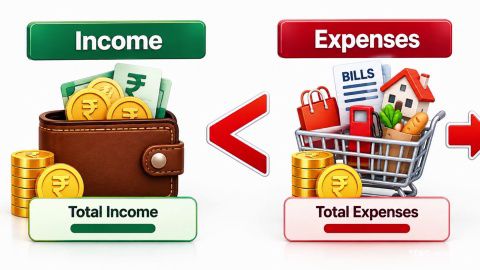
A deficit means that available income or receipts are lower than expenses or payments during a given period. It can apply to individuals, businesses, governments, or an economy.
- A deficit shows a shortfall between receipts and expenditure.
- A revenue deficit compares revenue expenditure with revenue receipts.
- A fiscal deficit shows the government’s overall borrowing requirement.
- A primary deficit excludes interest payments from the fiscal deficit.
- A trade deficit occurs when goods imports exceed goods exports.
- A current account deficit covers goods, services, and income flows.
- A deficit can be temporary or persist over several periods.
- Repeated deficits may increase borrowing and outstanding debt.
For example, spending Rs. 50,000 against income of Rs. 40,000 creates a Rs. 10,000 deficit. In India’s Budget for FY 2026-27, the fiscal deficit is projected at 4.3% of GDP.
What is a deficit?
A deficit occurs when spending is higher than income or when payments are higher than receipts. It shows that the available money or resources are not enough to cover the amount being spent or owed.
For an individual, a deficit can happen when monthly expenses are higher than income. You may need to use savings or borrow money to meet the shortfall.
For a government, a deficit can occur when expenditure is higher than its revenue and other receipts. The government may then need to borrow to meet the gap.
A deficit is the opposite of a surplus. A surplus occurs when income or receipts are higher than expenses or payments.
What are the different types of financial deficit?
The term deficit can describe different financial gaps. Government finances use several deficit measures because each one looks at a different part of income, spending or borrowing. The main types are explained below.
Revenue deficit
A revenue deficit occurs when a government's revenue expenditure is higher than its revenue receipts during a financial year. In simple terms, the government's regular income is not enough to meet its regular expenses.
Revenue expenditure can include items such as salaries, pensions, subsidies and interest payments. A high revenue deficit can mean that more borrowing may be needed to meet regular expenses instead of funding capital assets.
Formula: Revenue Deficit = Revenue Expenditure – Revenue Receipts
A persistent revenue deficit can put pressure on government finances. It can also reduce the funds available for capital expenditure and development activities.
Fiscal deficit
A fiscal deficit is the difference between a government's total expenditure and its total non-debt receipts during a financial year. It shows the amount that needs to be financed through borrowing and other financing sources.
Formula: Fiscal Deficit = Total Expenditure – (Revenue Receipts + Non-Debt Capital Receipts)
Fiscal deficit is an important measure of the government's overall fiscal position. It also indicates the government's borrowing requirement.
A higher fiscal deficit can increase the government's interest burden over time. Its wider impact depends on economic conditions and how the funds are used.
Primary deficit
A primary deficit is the fiscal deficit after deducting interest payments on previous borrowings. It focuses on the government's current financial position without including the cost of servicing past debt.
Formula: Primary Deficit = Fiscal Deficit – Interest Payments
This measure helps show how much of the current fiscal gap remains after excluding interest payments. A lower primary deficit means the gap is smaller when past interest obligations are left out.
A zero primary deficit means the fiscal deficit is equal to the interest payments.
Budget deficit
A budget deficit occurs when total government expenditure is higher than total government receipts during a financial year.
Formula: Budget Deficit = Total Expenditure – Total Receipts
It provides a broad view of the gap between government expenditure and receipts. However, it does not show the government's borrowing requirement as clearly as the fiscal deficit.
In India, fiscal deficit is used as the key measure of the government's borrowing requirement and fiscal position.
Trade deficit
A trade deficit occurs when the value of a country's imports of goods is higher than the value of its exports of goods. It measures the gap in merchandise trade with other countries.
Formula: Trade Deficit = Imports – Exports
A trade deficit does not automatically mean that an economy is in a weak financial position. Its effect depends on factors such as the goods being imported, the country's wider external position and how imports support economic activity.
A trade deficit forms part of the country's current account balance.
Current Account Deficit (CAD)
A current account deficit, or CAD, occurs when a country's current account payments are higher than its current account receipts.
The current account includes trade in goods and services, primary income and secondary income. This means CAD covers more than just the import and export of goods.
Formula: CAD = Current Account Payments – Current Account Receipts
A persistent CAD can increase an economy's need for external financing. It can also make the economy more sensitive to changes in global financial conditions.
Effective revenue deficit
Effective revenue deficit is calculated by subtracting grants provided for the creation of capital assets from the revenue deficit.
Formula: Effective Revenue Deficit = Revenue Deficit – Grants for Creation of Capital Assets
This measure gives a clearer view of the part of revenue expenditure that does not result in the creation of capital assets. It can help assess the nature and quality of government expenditure.
How is deficit different from surplus?
Deficit and surplus describe opposite financial positions. A deficit means there is a shortfall, while a surplus means income or receipts are higher than expenses or payments. The table below shows the main differences.
| Basis | Deficit | Surplus |
|---|---|---|
| Meaning | Expenses or payments exceed income or receipts | Income or receipts exceed expenses or payments |
| Financial position | Shows a shortfall | Shows excess funds |
| Individual example | Spending Rs. 60,000 with income of Rs. 50,000 | Earning Rs. 60,000 and spending Rs. 50,000 |
| Government example | Government expenditure exceeds receipts | Government receipts exceed expenditure |
| Impact | May require borrowing or use of savings | Can support savings, investment or debt repayment |
| Long-term effect | May increase financial pressure if persistent | Can support financial stability if sustained |
A deficit does not automatically mean a financial position is unhealthy. The impact depends on why the deficit exists, how it is financed and whether it continues over time.
How is deficit different from debt?
Deficit and debt are related, but they are not the same. A deficit is a shortfall that occurs during a particular period. Debt is the amount borrowed that remains outstanding.
For example, if your expenses are higher than your income in a particular month, you have a deficit for that period. If you borrow money to cover the shortfall, the borrowed amount becomes debt.
A deficit does not always have to be financed through borrowing. Existing savings, retained earnings or other available funds may also be used, depending on the situation.
When borrowing is used to finance a deficit, the borrowing adds to outstanding debt. Therefore, repeated deficits can contribute to higher debt over time.
The effect of debt also depends on factors such as the cost of borrowing, the ability to repay it and how the borrowed funds are used.
Conclusion
A deficit represents a financial shortfall when expenditure or payments exceed income or receipts during a particular period. Different deficit measures help assess different aspects of government finances, trade, and external transactions.
Understanding the difference between deficit, surplus, and debt can make financial and economic information easier to interpret. The effect of a deficit depends on its size, duration, purpose, and method of financing.
Last reviewed: September 2026
Mutual funds are subject to market risk. Please read the scheme-related documents carefully before investing.
Explore Investment Tools
Articles and Insights


Frequently Asked Questions
Overview
Is deficit a loss?
A deficit indicates a financial shortfall where expenses exceed income, but it does not always mean a loss, as it may support growth or temporary needs.
Is a deficit good or bad?
A deficit can be beneficial in the short term to stimulate demand but may become harmful if it leads to unsustainable debt over time.
What happens if a country has a high fiscal deficit?
A high fiscal deficit means the government spends more than it receives through revenue and other receipts. If the deficit remains high for an extended period, it can increase public debt and borrowing costs. It may also put pressure on inflation or interest rates. The impact depends on the country’s economic conditions and how it uses borrowed funds.
Why does the government run a deficit?
A government runs a deficit when its expenditure exceeds its revenue and other receipts. You may see governments use deficit spending to finance infrastructure, public services, welfare programmes and economic stimulus. During an economic slowdown, higher spending can support demand and growth. However, increased spending can also raise the government’s borrowing requirements and add to public debt.
How does the government finance a fiscal deficit?
Governments primarily finance fiscal deficits through borrowing. You may see them raise funds by issuing instruments such as government securities and Treasury Bills. In India, the central government raises funds through the domestic market and other sources. This borrowing helps bridge the gap between government expenditure and receipts. However, the additional borrowing also contributes to the government’s overall public debt.
Is a fiscal deficit always bad?
No, a fiscal deficit is not always bad. You can view government borrowing as a way to fund infrastructure, public services and economic activity when the borrowed funds are used productively. However, a persistently high deficit can increase public debt and borrowing costs. The impact depends on whether the deficit remains sustainable and how effectively the government uses the borrowed funds.
Disclaimer
Bajaj Finance Limited ("BFL") is registered with the Association of Mutual Funds in India ("AMFI") as a distributor of third party Mutual Funds (shortly referred as 'Mutual Funds) with ARN No. 90319
BFL does NOT:
(i) provide investment advisory services in any manner or form.
(ii) carry customized/personalized suitability assessment.
(iii) carry independent research or analysis, including on any Mutual Fund schemes or other investments; and provide any guarantee of return on investment.
In addition to displaying the Mutual fund products of Asset Management Companies, some general information is sourced from third parties, is also displayed on As-is basis, which should NOT be construed as any solicitation or attempt to effect transactions in securities or the rendering any investment advice. Mutual Funds are subject to market risks, including loss of principal amount and Investor should read all Scheme/Offer related documents carefully. The NAV of units issued under the Schemes of mutual funds can go up or down depending on the factors and forces affecting capital markets and may also be affected by changes in the general level of interest rates. The NAV of the units issued under the scheme may be affected, inter-alia by changes in the interest rates, trading volumes, settlement periods, transfer procedures and performance of individual securities forming part of the Mutual Fund. The NAV will inter-alia be exposed to Price/Interest Rate Risk and Credit Risk. Past performance of any scheme of the Mutual fund do not indicate the future performance of the Schemes of the Mutual Fund. BFL shall not be responsible or liable for any loss or shortfall incurred by the investors. There may be other/better alternatives to the investment avenues displayed by BFL. Hence, the final investment decision shall at all times exclusively remain with the investor alone and BFL shall not be liable or responsible for any consequences thereof.
Investment by a person residing outside the territorial jurisdiction of India is not acceptable nor permitted.
Disclaimer on Risk-O-Meter:
Investors are advised before investing to evaluate a scheme not only on the basis of the Product labeling (including the Riskometer) but also on other quantitative and qualitative factors such as performance, portfolio, fund managers, asset manager, etc, and shall also consult their Professional advisors, if they are unsure about the suitability of the scheme before investing.
Disclosure: Bajaj Finance Limited (BFL) is a distributor of Mutual Funds with ARN - 90319 and distributes mutual funds of Bajaj Finserv Asset Management Limited (BFSAMC). BFL receives commission towards distribution of mutual fund products. BFSAMC is a group company of BFL, carrying business on arm’s length basis without any conflict of interest and in accordance with the prevailing law / regulation.
Disclaimer
Bajaj Finance Limited ("BFL") is an NBFC offering loans, deposits and third-party wealth management products.
The information BFL contained in this article is for general informational purposes only and does not constitute any financial advice. The content herein has been prepared by BFL on the basis of publicly available information, internal sources and other third-party sources believed to be reliable. However, BFL cannot guarantee the accuracy of such information, assure its completeness, or warrant such information will not be changed.
This information should not be relied upon as the sole basis for any investment decisions. Hence, User is advised to independently exercise diligence by verifying complete information, including by consulting independent financial experts, if any, and the investor shall be the sole owner of the decision taken, if any, about suitability of the same.
Disclaimer
Mutual Fund SIP calculator may provide potential investors an approximate estimate on the maturity amount of the monthly SIP, purely based on mathematical calculation of the projected annual return rate selected by investor. However, such calculation does not factor the actual performance by the Asset Management Company (AMC) and should not be treated as any advice or assurance about the actual return of investment. Mutual Funds do not have a fixed rate of return and it is not possible to predict the rate of return. Please note that the SIP calculator are for illustrations only and do not represent actual returns which may vary depending on various factors including but not limited to actual performance, expense ratio, taxation, exit load (if any), etc.