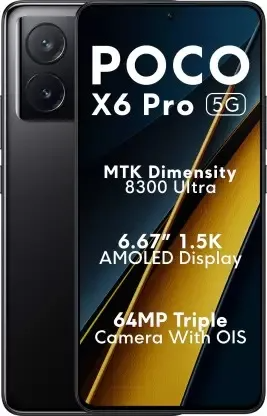
The POCO X7 Pro launched in India in January 2025 starting at Rs. 23,999, while the realme Neo 7 launched globally in December 2024 and is expected in India soon. Both target performance-focused buyers but take different approaches — the POCO X7 Pro prioritises charging speed and a compact build, while the realme Neo 7 pushes flagship-tier processing power and a massive 7,000 mAh battery. Here is how they compare section by section.
General
The POCO X7 Pro is slimmer, lighter, and already available at Indian retail. The realme Neo 7 is heavier due to its larger battery but packs a more powerful chipset.
| Spec | POCO X7 Pro | realme Neo 7 | What it means |
|---|
| Launch status | Launched in India (Jan 2025) | Expected in India (launched globally Dec 2024) | POCO is available now; realme's India pricing and variants are unconfirmed |
| Manufacturer | Xiaomi (POCO) | realme | Different software ecosystems and after-sales networks across India |
| SIM | Dual Nano-SIM | Dual Nano-SIM | Standard dual-SIM 5G on both |
| Network | 5G, 4G | 5G, 4G | Both support Indian 5G bands |
| Dimensions | 160.95 × 75.24 × 8.31 mm | 162.6 × 76.4 × 8.6 mm | POCO is noticeably more compact — easier to use one-handed and pocket |
| Weight | 195 g | 213 g | realme is 18 g heavier — a trade-off for its larger battery |
| Warranty | 1 year | 12 months (expected) | Standard manufacturer warranty on both |
Display and design
Both use high-refresh AMOLED panels, but the realme Neo 7 steps ahead with LTPO technology (adaptive 1–120 Hz for battery savings), a higher 1264 × 2780 resolution, and a staggering 6,000 nits peak brightness. The POCO X7 Pro counters with Dolby Vision support, Gorilla Glass 7i, and a triple IP rating.
| Spec | POCO X7 Pro | realme Neo 7 | What it means |
|---|
| Screen size | 6.67 inches | 6.78 inches | realme's larger panel suits media consumption; POCO is more pocketable |
| Display type | AMOLED | LTPO AMOLED | LTPO on realme adapts refresh rate dynamically — saves battery on static screens |
| Resolution | 1220 × 2712 (1.5K) | 1264 × 2780 (1.5K) | Both deliver sharp visuals well above standard Full HD+ |
| Pixel density | 446 PPI | 450 PPI | Identical sharpness for all practical purposes |
| Refresh rate | 120 Hz | 120 Hz | Both deliver smooth scrolling and responsive gaming |
| Touch sampling rate | 240 Hz | 360 Hz | realme's higher sampling rate registers touch input faster — an edge in competitive gaming |
| Peak brightness | 3,200 nits | 6,000 nits | realme is nearly twice as bright — significantly more readable in harsh sunlight |
| HBM brightness | 1,400 nits | 1,600 nits | realme holds a brighter sustained level for everyday outdoor use |
| HDR support | HDR10+, Dolby Vision | HDR10+ | POCO supports Dolby Vision — a wider HDR format used by Netflix and Apple TV+ |
| Screen protection | Corning Gorilla Glass 7i | Crystal Armor glass | Gorilla Glass 7i is the more widely tested standard; Crystal Armor is realme's proprietary alternative |
| Water resistance | IP66, IP68, IP69 | IP68, IP69 | POCO's additional IP66 covers high-pressure water jets — a rare spec at this price |
| Screen-to-body ratio | ~88.8% | ~90.0% | realme has slimmer bezels |
Performance and software
This is where the two phones diverge most. The realme Neo 7's Dimensity 9300+ is a flagship chipset with four Cortex-X4 cores, while the POCO X7 Pro's Dimensity 8400 Ultra uses an all-Cortex-A725 configuration — powerful for the mid-range but a tier below. The realme also starts at 12 GB RAM and offers up to 1 TB storage.
| Spec | POCO X7 Pro | realme Neo 7 | What it means |
|---|
| Processor | MediaTek Dimensity 8400 Ultra (4 nm) | MediaTek Dimensity 9300+ (4 nm) | Dimensity 9300+ is a flagship-class chip — meaningfully faster in gaming and sustained workloads |
| CPU config | 1×3.25 GHz + 3×3 GHz + 4×2.1 GHz (all Cortex-A725) | 1×3.4 GHz + 3×2.85 GHz Cortex-X4 + 4×2 GHz Cortex-A720 | realme's Cortex-X4 cores deliver higher single-threaded performance for app launches and responsiveness |
| GPU | Mali-G720 MC7 | Immortalis-G720 MC12 | realme has 12 GPU cores vs 7 on POCO — substantially better for high-fidelity gaming |
| RAM | 8 / 12 GB (LPDDR5X) | 12 / 16 GB (LPDDR5X) | realme starts higher and offers 16 GB — more headroom for heavy multitasking and gaming |
| Storage | 256 GB (UFS 4.0) | 256 / 512 GB / 1 TB (UFS 4.0) | realme offers up to 1 TB — a major advantage for users with large media libraries or game installs |
| Expandable storage | No | No | Neither supports microSD — choose your storage variant carefully |
| OS | Android 15 (HyperOS 2) | Android 15 (realme UI 6.0) | HyperOS is feature-rich but heavier; realme UI is cleaner but less customisable |
| Fingerprint | On-screen optical | Under-display optical | Same technology — no practical difference |
| Audio | Stereo speakers, Dolby Atmos | Stereo speakers, Hi-Res audio | POCO offers spatial sound processing; realme supports higher-fidelity audio output |
Camera features
Both use 50 MP primary sensors with OIS and 8 MP ultrawide lenses. The POCO X7 Pro uses a Sony IMX882 sensor with a wider f/1.5 aperture — letting in more light for low-light photography. The POCO also has a sharper 20 MP selfie camera versus 16 MP on the realme.
| Spec | POCO X7 Pro | realme Neo 7 | What it means |
|---|
| Rear camera setup | 50 MP + 8 MP | 50 MP + 8 MP | Same dual-camera layout on both |
| Primary sensor | 50 MP, f/1.5, Sony IMX882, OIS | 50 MP, f/1.9, 1/1.95" sensor, OIS | POCO's wider f/1.5 aperture captures more light — better for low-light and indoor shots |
| Ultrawide camera | 8 MP, f/2.2 | 8 MP, f/2.2 | Same ultrawide on both — adequate for landscapes and group shots |
| OIS | Yes | Yes | Both stabilise the primary lens for blur-free handheld shots and video |
| Front camera | 20 MP | 16 MP | POCO captures sharper selfies and video calls |
| Rear video | 4K @ 60 fps | 4K @ 60 fps | Both record 4K at a smooth 60 fps |
| Front video | 1080p @ 30 fps | 1080p @ 30 fps | Same front video capability |
| Flash | LED | LED | Standard flash on both |
Storage and connectivity
Both offer UFS 4.0 storage, NFC, IR blasters, and 5G. The realme Neo 7 steps ahead with Wi-Fi 7 support and NavIC satellite positioning (useful for Indian GPS accuracy). The POCO X7 Pro stays on Wi-Fi 6E.
| Spec | POCO X7 Pro | realme Neo 7 | What it means |
|---|
| Storage options | 256 GB | 256 / 512 GB / 1 TB | realme offers significantly more storage flexibility |
| Storage type | UFS 4.0 | UFS 4.0 | Same fast read/write speeds on both |
| SIM | Dual Nano-SIM | Dual Nano-SIM | Standard dual 5G SIM support |
| VoLTE | Yes | Yes | HD voice calls over 4G/5G on both |
| Wi-Fi | Wi-Fi 6E | Wi-Fi 7 | realme's Wi-Fi 7 delivers faster speeds and lower latency on compatible routers |
| Bluetooth | 5.4 | 5.4 | Same version — stable audio and accessory connections |
| NFC | Yes | Yes | Both support tap-to-pay via Google Pay and contactless cards |
| GPS | GPS, A-GPS, GLONASS | GPS, BDS, Galileo, QZSS, NavIC, GLONASS | realme adds NavIC — India's own satellite system for better local positioning accuracy |
| IR blaster | Yes | Yes | Both can control TVs, ACs, and set-top boxes |
| USB | USB Type-C | USB Type-C 2.0 | Same charging and data transfer port |
Battery and other features
The realme Neo 7 has a clear battery advantage with 7,000 mAh (silicon carbon) — one of the largest in its segment. The POCO X7 Pro counters with faster 90 W charging and the more comprehensive IP66/68/69 water resistance rating.
| Spec | POCO X7 Pro | realme Neo 7 | What it means |
|---|
| Capacity | 6,550 mAh (silicon carbon) | 7,000 mAh (silicon carbon) | realme's larger cell extends screen-on time — especially useful for gaming and travel |
| Fast charging | 90 W Turbo Charging | 80 W wired | POCO charges faster — roughly 42 minutes to full vs ~45 minutes on realme |
| Reverse charging | Yes | Yes | Both can charge accessories like earbuds in a pinch |
| Speakers | Stereo | Stereo | Both deliver dual-speaker audio |
| Water resistance | IP66, IP68, IP69 | IP68, IP69 | POCO's extra IP66 means protection from high-pressure water jets |
| Sensors | Light, proximity, accelerometer, barometer, compass, gyroscope | Fingerprint, accelerometer, gyroscope, proximity, compass | POCO includes a barometer — useful for altitude tracking in fitness and hiking apps |