








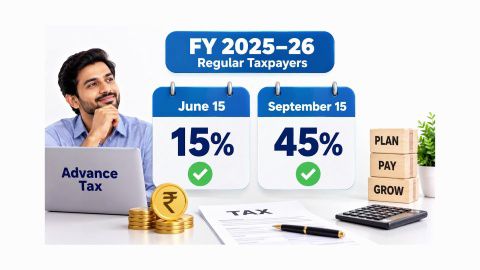
Advance Tax Due Dates - Advance Tax Payment Last Date for FY 2025-26
-
In Summary
Self-assessment tax is the additional income tax payable when your final tax liability exceeds the eligible taxes already paid or credited for the relevant tax year. It is generally paid before submitting your Income Tax Return (ITR).
- Calculation: Work out your total tax liability, add applicable interest and fees, and subtract eligible TDS, TCS, advance tax and other tax credits.
- Payment: Use the official Income Tax Department e-Filing portal and select the correct tax payment category and period.
- Example: If your final tax liability, including applicable interest, is Rs. 52,000 and your eligible tax credits total Rs. 40,000, the balance payable is Rs. 12,000.
- Receipt: Save the payment confirmation and check that the payment is reflected correctly in your tax records.
- Important: Payments for Assessment Year (AY) 2026–27 relating to FY 2025–26 remain governed by the Income-tax Act, 1961. The Income-tax Act, 2025 applies to Tax Year 2026–27 onwards.
Calculate the amount carefully and use the tax period that matches the income being reported.
Why is self-assessment tax important?
-
Self-assessment tax helps taxpayers settle the outstanding balance identified while preparing their income tax return. Paying the correct amount supports accurate tax reporting and helps prevent a mismatch between the tax declared in the return and the tax paid.
It is particularly relevant when:
- TDS has not covered the full tax liability.
- Income from rent, investments, capital gains or other sources increases the final tax payable.
- Advance tax paid during the year is insufficient.
- A taxpayer identifies an unpaid balance while preparing their ITR.
- Applicable interest or fees need to be included in the final amount.
Paying self-assessment tax does not, by itself, complete the income tax return filing process. The taxpayer must still file the applicable return, where required, and report the payment correctly.
What is self-assessment tax?
-
Self-assessment tax is the balance tax a taxpayer pays after calculating their final income tax liability and adjusting eligible taxes already paid or credited. It commonly arises when tax deducted at source (TDS), tax collected at source (TCS) and advance tax do not fully cover the tax payable.
For example, a salaried individual may have additional income from rent, interest or capital gains that is not fully covered by TDS. After including that income and calculating the applicable tax, the individual may need to pay the remaining amount as self-assessment tax.
The calculation depends on the taxpayer’s total taxable income, the applicable tax regime, eligible deductions and exemptions, applicable tax rates, tax credits and any interest or fees payable.
How is self-assessment tax calculated?
The calculation starts with the final tax liability for the relevant period. The taxpayer then accounts for eligible tax credits and adds any applicable interest or fees.
Follow these steps:
- Calculate your taxable income. Include income from all applicable sources, such as salary, house property, business or profession, capital gains and other sources. Apply the deductions, exemptions and loss adjustments permitted under the applicable tax regime.
- Calculate the tax liability. Apply the relevant tax rates and account for any eligible rebate, surcharge, cess, relief or tax credit.
- Add applicable interest and fees. Check whether interest or fees are payable under the provisions governing your tax period. The applicable rules depend on the facts of the case and the law in force for that period.
- Subtract taxes already paid or credited. Account for eligible TDS, TCS, advance tax and other available tax credits.
- Pay the remaining balance. If the result is a positive amount, it is the balance payable, subject to the correct calculation and available credits.
A simplified formula is:
Self-assessment tax payable = Final tax liability + applicable interest and fees − eligible taxes already paid or credited
If the result is zero or negative, there may be no additional self-assessment tax payable. However, the taxpayer should verify the figures and any refund eligibility before filing.
Example of self-assessment tax calculation
Consider this illustrative example:
| Particulars | Amount |
|---|---|
| Final income tax liability, before additional interest or fees | Rs. 50,000 |
| Applicable interest and fees | Rs. 2,000 |
| Total amount payable | Rs. 52,000 |
| TDS and other eligible tax credits | Rs. 30,000 |
| Advance tax already paid | Rs. 10,000 |
| Balance self-assessment tax payable | Rs. 12,000 |
In this example, the taxpayer has a total amount payable of Rs. 52,000. After adjusting Rs. 40,000 in eligible tax credits and advance tax, Rs. 12,000 remains payable.
The figures are illustrative. Actual tax liability, interest, fees and credits will depend on the taxpayer’s circumstances and the rules applicable to the relevant period.
What is the difference between self-assessment tax and advance tax?
Both are ways of paying income tax, but they differ in timing and purpose.
| Basis | Advance tax | Self-assessment tax |
|---|---|---|
| When it is paid | During the relevant financial or tax year | Usually after calculating the final liability and before filing the return |
| Basis of calculation | Estimated income and tax liability | Final tax liability after considering eligible taxes already paid or credited |
| Main purpose | Pay tax progressively during the year | Settle any remaining balance |
| Applicability | Depends on the applicable advance-tax rules and exemptions | Arises when a balance remains payable after adjustments |
| Payment record | Payment confirmation or challan | Payment confirmation or challan |
Under the rules applicable to FY 2025–26, advance tax generally applies when the estimated tax liability, after accounting for TDS, is Rs. 10,000 or more, subject to statutory exceptions. Do not automatically apply this threshold to a different tax period without checking the relevant rules.
How to pay self-assessment tax online
Self-assessment tax can be paid through the official Income Tax Department e-Filing portal. The steps and payment options depend on the applicable Act and tax period.
- Open the official portal. Visit the Income Tax Department e-Filing website.
- Select e-Pay Tax. Choose the e-Pay Tax option. The portal may allow you to start a payment before logging in or through your registered account.
- Select the applicable Income-tax Act. Choose the Income-tax Act, 1961 for payments relating to AY 2026–27 and earlier applicable assessment years. Choose the Income-tax Act, 2025 for Tax Year 2026–27 onwards, as directed by the portal.
- Choose the relevant tax payment category. Select the applicable income tax or corporation tax payment option, depending on whether the taxpayer is an individual or a company.
- Select self-assessment tax. Choose the self-assessment tax payment category and the correct tax period.
- Enter the payment details. Provide the required tax amount and its applicable breakup, including interest or other amounts where relevant.
- Choose a payment method. Select an available option, such as net banking, debit card, UPI or another mode offered by the portal for the transaction.
- Review and submit. Check the taxpayer details, Act, tax period, payment category and amount before completing the transaction.
- Save the receipt. Download or retain the payment confirmation and challan details for your records.
The portal’s instructions take precedence if the screen labels or payment options differ. Refer to the official Income Tax Department challan creation guide for the relevant payment flow.
Which challan should you select?
The challan depends on the applicable Act, tax type and payment period.
For income tax payments relating to AY 2026–27 and earlier relevant assessment years, the portal uses the applicable Income-tax Act, 1961 payment flow, including ITNS 280 for ordinary self-assessment tax payments. For Tax Year 2026–27 onwards, the Income-tax Act, 2025 payment flow uses the corresponding new challan format, such as ITNS 280N for the relevant income tax payment category.
Do not select a challan solely because its number appears in an older guide. Confirm the applicable Act, tax period and payment category on the official portal before making payment.
How to download a self-assessment tax challan?
A challan or payment receipt is evidence that a tax payment was made. Keep it with your tax records and use its details when checking your return.
To retrieve your payment record:
- Visit the Income Tax Department e-Filing portal.
- Open the relevant e-Pay Tax or payment-history facility, following the options available for your login and transaction.
- Locate the payment using the details shown in your account.
- Download or save the available challan or payment receipt.
- Check the payment amount, date, tax period and other details against your records.
The exact menu names and available retrieval options may change as the portal is updated. If the payment does not appear, check the transaction status with the payment provider and consult the portal’s official help resources before making a duplicate payment.
How does self-assessment tax affect income tax return filing?
Self-assessment tax settles the balance identified during tax calculation, but the taxpayer must still complete the applicable return-filing requirements.
Before submitting the ITR:
- Check that the income reported includes all applicable sources.
- Reconcile TDS and TCS with the available tax records.
- Verify advance tax and other eligible payments.
- Include applicable interest and fees in the calculation.
- Confirm that the self-assessment tax payment relates to the correct tax period.
- Enter or verify the payment details in the relevant section of the return.
- Retain the payment receipt and the return acknowledgement.
A payment made under the wrong tax period or payment category may require correction or follow-up. If the payment is not reflected in the tax records, investigate the discrepancy rather than assuming that the return has been fully settled.
Check out different FD Rates
What happens if self-assessment tax is not paid correctly?
If a balance remains unpaid, or the amount paid is insufficient, the taxpayer may face additional interest, a tax demand or other consequences under the applicable law. The outcome depends on the tax period, the amount outstanding, the return-filing circumstances and the provisions that apply.
For returns relating to FY 2025–26, provisions of the Income-tax Act, 1961 continue to govern the relevant assessment. For Tax Year 2026–27 onwards, the Income-tax Act, 2025 and applicable rules govern the payment and compliance requirements.
Do not assume that all interest begins on the same date or that every unpaid amount attracts the same consequence. Check the rules for the specific tax period or consult a qualified tax professional if the calculation is unclear.
Self-assessment tax is the balance payable after a taxpayer calculates their final income tax liability and adjusts eligible taxes already paid or credited. An accurate calculation, correct selection of the tax period and payment category, and retention of the challan help support proper ITR filing. Because India’s income tax framework transitioned to the Income-tax Act, 2025 from 1 April 2026, taxpayers should take particular care to select the correct Act and period when making a payment. For complex calculations, mismatched credits or uncertain interest obligations, consult the official Income Tax Department guidance or a qualified tax professional.
Fixed Deposit variants
Get ROI up to
8.15% p.a.
Senior citizen
Starting with just Rs. 15,000
Get ROI up to
7.75% p.a.
Age below 60 years
Starting with just Rs. 15,000
Get ROI up to
7.75% p.a.
Minor
Starting with just Rs. 15,000
Get ROI up to
7.75% p.a.
HUF
Starting with just Rs. 15,000
Get ROI up to
7.75% p.a.
Sole proprietor
Starting with just Rs. 15,000
Locate to your nearest FD branch

Related Articles

Frequently Asked Questions
Overview
Is self-assessment tax mandatory?
Self-assessment tax is payable when a balance remains due after calculating the final tax liability and adjusting eligible taxes already paid or credited. Whether an individual must pay it depends on their actual tax position and the applicable rules.
Can self-assessment tax be paid after filing an ITR?
The timing and consequences depend on the circumstances. The usual process is to pay the balance before submitting the return. If a shortfall is discovered after filing, check the applicable payment, correction and return procedures rather than assuming the original filing has settled the amount.
Is self-assessment tax refundable?
Self-assessment tax is a payment towards an income tax liability, not a deduction or a refund in itself. If the total tax paid exceeds the final liability, a refund may be due after the return is processed, subject to the applicable rules and verification.
What is the difference between a challan and a tax return?
A challan or payment receipt records a tax payment. An income tax return reports income, deductions, tax calculations and tax payments for the relevant period. Paying tax does not replace the requirement to file a return when filing is required.
How can I check whether my self-assessment tax payment was successful?
Check the payment status and receipt through the Income Tax Department’s e-Filing or e-Pay Tax facilities, as applicable. Verify the amount and tax period, and retain the receipt. If the transaction is debited from your account but not reflected, follow the portal’s guidance or contact the relevant payment provider before attempting another payment.
Disclaimer
1. Bajaj Finance Limited (“BFL”) is a Non-Banking Finance Company (BAJAJ FINANCE) and Prepaid Payment Instrument Issuer offering financial services viz., loans, deposits, Bajaj Pay Wallet, Bajaj Pay UPI, bill payments and third-party wealth management products. The details mentioned in the respective product/ service document shall prevail in case of any inconsistency with respect to the information referring to BFL products and services on this page.
2. All other information, such as, the images, facts, statistics etc. (“information”) that are in addition to the details mentioned in the BFL’s product/ service document and which are being displayed on this page only depicts the summary of the information sourced from the public domain. The said information is neither owned by BFL nor it is to the exclusive knowledge of BFL. There may be inadvertent inaccuracies or typographical errors or delays in updating the said information. Hence, users are advised to independently exercise diligence by verifying complete information, including by consulting experts, if any. Users shall be the sole owner of the decision taken, if any, about suitability of the same.