






Health insurance goes beyond hospitalization—it covers OPD visits, medicines, ambulance charges, preventive checkups, and even alternative treatments, giving you all-around financial security.

Check health insurance plans with comprehensive coverage
Get Quote
Health plans from leading insurers | Comprehensive coverage | Offers multiple optional add-ons to enhance coverage
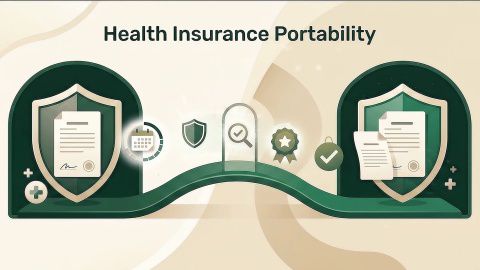
Health Insurance Portability How It Works
In Summary
Understanding how to file an e-claim under corporate group health insurance ensures fast, hassle-free reimbursement:
- Paperless digital submission: Upload scanned copies or high-resolution smartphone photos of hospital bills, discharge summaries, and prescriptions directly into the portal.
- Rapid claim turnaround: E-claims are processed within 5 to 7 working days, compared to three to four weeks for traditional physical courier submissions.
- Real-time digital status tracking: Receive instant SMS alerts and in-app notifications at every stage of medical audit, document verification, and NEFT payment.
- Zero risk of physical document loss: Electronic document storage guarantees that original bills and receipts cannot be lost in transit.
- Direct electronic bank settlement: Approved claim funds are transferred directly into the employee’s registered salary bank account via NEFT.
Did you know?
Under the latest IRDAI Master Circular on Health Insurance, insurance companies and Third Party Administrators (TPAs) are mandated to communicate all claim document requirements in a single consolidated query rather than raising piecemeal objections.
What is an e claim in group health insurance
An e-claim (electronic claim) in group health insurance is a fully digital claims processing workflow where an insured corporate employee submits medical reimbursement documents online via a web portal or smartphone application, eliminating the need to physically mail paper documents to the insurer or Third Party Administrator (TPA). Source: Ministry of Electronics and Information Technology
In corporate Group Medical Cover (GMC) arrangements, employers partner with insurance companies and TPAs who provide dedicated employee self-service portals. Instead of filling out handwritten claim forms and mailing original hospital invoices via courier, employees use an intuitive digital interface to enter hospitalisation details, upload PDF scans of clinical documents, and track claim adjudication milestones in real time. Bajaj Finance partners with insurers that offer advanced digital claim portals designed to maximise convenience and transparency for corporate workforces. Source: General Insurance Council
Quick fact:
Digital e-claim adoption across corporate health insurance in India has surged to over 85 percent, reducing administrative claim handling costs for employers and cutting average settlement cycles by more than 60 percent.
Pro tip
Benefits of e claim process in group health Insurance
Transitioning from traditional paper-based claims to digital e-claims delivers compelling advantages for employees and corporate HR teams alike:
- Unmatched speed and turnaround: Automated optical character recognition (OCR) and electronic document routing allow TPAs to process claims within 5 to 7 days of online submission.
- Complete transparency and real-time tracking: Employees can monitor their claim status dynamically—from initial receipt and medical officer review to financial audit and NEFT transfer.
- Elimination of lost transit documents: Physical couriers carry the risk of misplaced original bills; e-claims permanently archive digital records on secure cloud servers.
- Simplified query resolution: If the insurer requires additional clinical clarification, the employee receives an in-app alert and can upload supplementary documents immediately.
- Reduced environmental footprint: Paperless claims eliminate millions of physical paper forms and courier deliveries every year, aligning with corporate ESG sustainability goals.
Step-by-step guide to filing an e claim
Filing an e-claim under your corporate group medical insurance follows a structured, logical sequence:
Step 1: Intimate the claim online within 24 to 48 hours
Log into your corporate TPA portal or mobile app. Navigate to the "Intimate Claim" section and enter basic hospitalisation details (hospital name, admission date, tentative discharge date, and provisional diagnosis) immediately upon admission.
Step 2: Settle hospital bills and collect original records
Upon clinical discharge, settle all hospital room rents, surgical fees, pharmacy invoices, and diagnostic charges directly with the hospital billing counter. Collect the original discharge summary, itemised final bill, and payment receipts.
Step 3: Digitize and organize your medical documents
Scan or take high-resolution photographs of all hospital papers, pre-hospitalisation prescriptions, and diagnostic lab reports. Ensure all documents are sharp, well-lit, and saved in PDF or JPEG formats under 5 MB per file.
Step 4: Complete the digital claim application form
Log into the e-claim portal, open the reimbursement claim section, and fill in the digital claim form. Enter the total claimed amount, breaking down expenses by room rent, doctor fees, diagnostics, and pharmacy.
Step 5: Upload documents and verify bank details
Upload the digitized files under the appropriate document heads. Verify that your registered bank account number and IFSC code match your salary account (or upload a cancelled cheque). Submit the claim and note down your unique Claim Reference Number.
Did you know?
Most corporate e-claim mobile apps allow employees to upload post-hospitalisation follow-up pharmacy and diagnostic bills for up to 90 to 180 days after discharge under the same primary claim reference number.
Popular plans for you



Documents required for e claim submission
To ensure that your e-claim is processed smoothly without unnecessary delays, organize the following verified documents before initiating your online submission:
| Document head | Detailed description and requirements | Verification standard |
|---|---|---|
| Digital claim form | Completed online application detailing employee ID, patient relation, and claim amount | E-signed via mobile OTP authentication |
| Hospital discharge summary | Clinical summary outlining history of illness, treatment course, operative notes, and vitals | Signed and stamped by treating consultant |
| Itemised final hospital bill | Detailed invoice showing line-item break-up of room rent, nursing, ICU, and surgery | Official printed bill with hospital seal |
| Numbered payment receipts | Official cash or digital receipts confirming payments made to the hospital | Numbered receipts with hospital revenue stamp |
| Diagnostic reports | Laboratory blood tests, biopsy findings, X-rays, CT scans, and ECG tracings | Signed by reporting pathologist or radiologist |
| Prescriptions and pharmacy bills | Doctor’s consultation slips and itemised pharmacy vouchers for purchased drugs | Matched against treating doctor's advice notes |
| Employee identity and health card | Corporate e-card copy and government photo ID of the patient | Matches registered corporate HR records |
| Bank proof (cancelled cheque) | Cancelled cheque showing employee’s printed name, account number, and IFSC code | Ensures error-free NEFT bank disbursement |
Common reasons for e claim rejection and how to avoid them
Understanding frequent causes of claim rejection enables employees to prepare airtight submissions:
- Illegible or blurry document uploads: Uploading poor-quality, out-of-focus phone pictures prevents medical auditors from verifying billed items. Always use document scanning apps.
- Missing hospital registration numbers: Non-network private nursing homes must meet the minimum bed criteria (usually 10 to 15 beds) and hold a valid municipal clinical registration certificate.
- Unsubstantiated pharmacy expenses: Submitting pharmacy vouchers for medications that are not prescribed in the treating doctor’s case sheet will result in specific item deductions.
- Filing after the submission deadline: Most corporate policies mandate that reimbursement claims must be submitted within 15 to 30 days of hospital discharge. Late filings face rejection unless justified by medical force majeure.
- Pre-existing disease non-disclosure: If the group policy does not carry a formal pre-existing disease (PED) waiver, claims for undisclosed chronic conditions may face scrutiny.
Quick fact:
Corporate Group Medical Covers facilitated through Bajaj Finance frequently feature comprehensive "Day 1 Coverage" riders that waive standard waiting periods for pre-existing illnesses and maternity care for all enrolled employees.
How long does it take to process an e claim
The digital architecture of e-claims significantly compresses traditional settlement timelines. A typical processing timeline follows these milestones:
- Day 1 (Submission and Acknowledgement): The employee submits the dossier online; the portal generates a Claim ID and transmits an SMS acknowledgement.
- Day 2 to 3 (Medical Underwriting Audit): TPA medical officers review clinical indications, cross-reference invoices against contracted institutional tariffs, and verify coverage limits.
- Day 4 (Query Management, if any): If additional documents are required, an instant notification is dispatched; the employee uploads the missing papers digitally.
- Day 5 to 7 (Financial Approval and NEFT Transfer): The claim is approved, an electronic settlement letter is generated, and funds are disbursed via NEFT directly to the employee’s bank account.
Health Insurance in different cities

Health Insurance in Bangalore

Health Insurance in Jaipur

Health Insurance in Pune

Health Insurance in Mumbai

Health Insurance in Kerala
Compare types of Health Insurance Plans
Tax-savings plans for you
Practical scenario: Smooth e-claim reimbursement for a corporate employee
Anand Iyer, a 31-year-old product manager at a technology firm in Bengaluru, is covered under his employer’s Group Health Insurance policy of Rs. 5 lakh facilitated by Bajaj Finance. While visiting family in a semi-urban town in Tamil Nadu, Anand underwent an emergency appendectomy at an unlisted private nursing home that lacked cashless tie-ups. Anand settled the hospital bill of Rs. 68,000 out-of-pocket upon discharge.
Returning to Bengaluru, Anand initiated an e-claim on the insurer’s mobile app. Using his smartphone camera, he scanned the original discharge summary, itemised hospital bills, diagnostic ultrasound reports, and payment receipts. The insurer’s digital OCR system verified document completeness and generated a real-time claim tracking ID. Within 48 hours, the medical adjudication team reviewed the digital dossier, raised zero document queries, and processed direct electronic reimbursement of Rs. 64,500 via NEFT into Anand’s verified salary account, with only standard non-payable consumables deducted.
The seamless digital reimbursement prevented out-of-pocket distress. To evaluate supplementary retail policies, employees can check now online.
Do's and don'ts: Ideal practices in filing e-claims
Follow these guidelines to ensure rapid and dispute-free reimbursement for your group health claims:
| Do | Why it matters | Don’t | Risk to avoid |
| Intimate the claim online within 24 to 48 hours of hospital admission. | Establishes a formal claim file and alerts TPA auditors in advance. | Wait several weeks after discharge before informing the insurer or TPA. | Potential claim rejection due to delayed claim intimation. |
| Ensure all scanned PDF documents are sharp, upright, and legible. | Enables TPA medical teams to verify line-item charges and diagnostic notes. | Upload blurry, cropped, or dark mobile phone photographs. | Audit queries, processing suspensions, and delayed claim settlement. |
| Maintain original physical paper bills in a secure home file for 6 months. | Insurers reserve the statutory right to request physical copies during random fraud audits. | Throw away original receipts immediately after uploading digital scans. | Inability to comply with regulatory audits if physical proof is requested. |
| Verify that hospital final bills have itemised break-ups with revenue stamps. | Necessary to assess admissible clinical heads against policy terms. | Submit consolidated summary bills without itemised room and doctor charges. | Claim queries and provisional disallowance of unsubstantiated charges. |
| Submit post-hospitalisation follow-up bills within the contracted time limit. | Reimburses outpatient doctor consultations and medications for 60 to 180 days. | Forget to submit post-discharge pharmacy vouchers before the deadline. | Forfeiture of eligible post-hospitalisation follow-up medical expenses. |
What our customer say about us
+ Customers
Play Store Rating
Reviews
Arjun Mehta
13 Jul 2025
I opted for the Health Infinity plan for my parents. The digital onboarding was incredibly fast with no medical tests required since they are under 50. We had a minor daycare procedure last month, and the cashless approval came through in less than 2 hours. Very impressed with the efficiency.
Priya Sharma
28 Feb 2025
The Bajaj Finance Health app is a lifesaver. I use it for my regular OPD consultations and medicine orders. The 10% discount on pharmacy bills and the easy reimbursement for doctor visits make it much more than just a 'hospitalization' policy. It’s daily health support.
Sneha Kapoor
15 Mar 2025
Switched my family floater to Bajaj General this year. The network of hospitals in my city (Pune) is excellent. The only downside was a slight delay in getting my physical card, but the digital copy on the app works everywhere. The 'Wellness Rewards' for hitting step goals is a cool touch!
What to do next: action roadmap
Follow this structured five-phase roadmap to streamline your corporate group health insurance e-claims:
- Phase 1: Obtain Digital TPA Credentials (Day 1): Download your corporate insurer or TPA mobile application and register using your corporate employee ID, policy number, and date of birth.
- Phase 2: Prepare Digital Claim Dossier (Days 2 to 3): Scan clear, legible PDF copies of itemised hospital bills, pharmacy vouchers, diagnostic test reports, payment receipts, and the final discharge summary.
- Phase 3: Submit Online E-Claim Application (Day 4): Fill in the online reimbursement form, upload digitized documents, enter bank account NEFT details with a cancelled cheque, and generate a claim tracking ID.
- Phase 4: Track E-Claim Adjudication in Real Time (Days 5 to 10): Monitor query notifications on the TPA app, promptly upload any requested physician justifications, and track digital settlement.
- Phase 5: Secure Preventative Health Insurance via Bajaj Finance (Ongoing): Complement your employer cover with an independent retail health policy or super top-up to maintain continuous lifelong coverage.
Sources and references
| Source / reference authority | Document / research topic | Relevant insights and context | Publication month and year |
|---|---|---|---|
| Insurance Regulatory and Development Authority of India (IRDAI) | Master circular on operations and allied matters of health insurance business | Digital claim submission standards, OCR verification, and 15-day reimbursement SLAs | October 2026 |
| General Insurance Council (GIC) | Guidelines on electronic claims processing and document uploads | Standardised digital claim forms, verification protocols, and anti-fraud checks | October 2026 |
| Ministry of Electronics and Information Technology (MeitY) | Digital India healthcare and paperless transaction framework | Standards for digital document authentication and secure electronic fund transfers | October 2026 |
| National Health Authority (NHA) | Ayushman Bharat Digital Mission (ABDM) claim exchange specs | Health Claims Exchange (HCX) protocols and digital claim interoperability | October 2026 |
Data last updated as of October 2026.
Glossary of health insurance technical terms
| Technical term | Definition and regulatory context |
|---|---|
| E-claim | A digital health insurance reimbursement claim submitted, verified, and settled electronically via online portals. |
| Third Party Administrator (TPA) | An IRDAI-licensed entity contracted by insurance companies to administer claims, verify documents, and coordinate hospital networks. |
| Claim intimation | The preliminary formal notification sent by the insured to the insurer or TPA reporting that hospitalisation has occurred. |
| Day care procedure | Medical treatments or surgical interventions that require less than 24 hours of hospitalisation due to advanced medical technology. |
| Reasonable and customary charges | Fees typically charged for similar medical services by healthcare providers of comparable standing in the same geographic region. |
| Non-medical consumables | Disposable medical items (such as gloves, syringes, and PPE kits) excluded from standard health insurance reimbursement. |
| Discharge summary | A clinical document prepared by treating hospital physicians detailing the patient’s diagnosis, treatment course, operative notes, and recovery. |
| Optical Character Recognition (OCR) | Digital technology that converts scanned text and printed medical invoices into machine-readable digital data for rapid processing. |
Explore and stay informed
Can you buy health insurance on EMI
Why buy health insurance
Health Insurance for family
Health Insurance Claim settlement ratio
Health Insurance waiting period
Importance of health insurance
Health Insurance for Senior Citizens
Health Insurance tax benefits
Health Insurance for parents
Health Insurance premium calculator
Conclusion
The e-claim process for corporate group health insurance represents a vital technological leap forward, transforming what was once a slow, paper-heavy chore into an efficient, transparent mobile experience. By allowing employees to submit scanned hospital invoices, resolve documentation queries in real time, and receive rapid NEFT bank disbursements, e-claim portals eliminate administrative friction during vulnerable family healthcare crises. Corporate organisations partnering with Bajaj Finance benefit from progressive group medical policies supported by cutting-edge TPA digital infrastructure, ensuring employee satisfaction and operational excellence. Empower your organisation with seamless corporate health coverage and digital claims management by exploring tailored group plans on Bajaj Finance today.
Whether managing corporate group health insurance, evaluating individual health insurance policies, or adding mediclaim insurance, Bajaj Finance provides transparent tools and instant digital onboarding.
Health Insurance for Other Diseases

Antral Gastritis

Hepatomegaly Symptoms Causes & Treatment

Blood Pressure Range

PCOS Causes and Symptoms

Health insurance for Obesity
Frequently Asked Questions
Digital e-claim submission and filing procedures
Documentation, queries, and physical bill verification
Claim tracking, turnaround, and bank settlements
What is the deadline for submitting an e-claim after hospital discharge?
Most corporate group health insurance policies require employees to submit reimbursement e-claims within 15 to 30 days of hospital discharge. Post-hospitalisation follow-up bills can typically be submitted within 60 to 90 days of discharge.
Can I file an e-claim for day care procedures that take less than 24 hours?
Yes. Day care surgeries and treatments (such as dialysis, chemotherapy, cataract surgery, and minor orthopaedic interventions) that do not require overnight hospitalisation are fully eligible for e-claim reimbursement under corporate group policies.
What should I do if the file size of my medical documents exceeds the portal limit?
Most portals accept files up to 5 MB. If your multi-page PDF exceeds this limit, use free online document compression tools or reduce your scanner resolution to 150-200 DPI to compress the file while maintaining text legibility.
Do I need to send physical paper bills after submitting an e-claim?
In most standard cases, digital upload is sufficient for processing and payment. However, under IRDAI audit guidelines, insurers retain the right to request original physical bills for high-value claims or random verification audits, so you must preserve physical papers for at least six months.
How do I respond to a query raised on my e-claim?
When a query is raised, you will receive an SMS and email notification outlining the specific document required. Simply log into the portal, open your active claim dossier, and upload the requested supplementary file directly.
Can I submit bills in regional languages for an e-claim?
Most national TPAs require hospital discharge summaries and invoices to be in English or Hindi. If your local medical documents are in a regional language, provide an authorized English translation signed by the treating hospital.
How do I track the real-time status of my group health e-claim?
You can track your claim by logging into your corporate TPA mobile app or website and entering your Claim ID or Employee Number. The tracker shows real-time progress across document verification, medical review, and bank disbursement.
How is the approved claim amount paid to the employee?
Approved claim funds are transferred directly into the employee’s registered salary bank account via electronic NEFT transfer, accompanied by a detailed digital Claim Settlement Voucher detailing approved and deducted heads.
What happens if my e-claim is partially rejected?
If certain line items (such as non-medical consumables, registration fees, or room rent excesses) are disallowed, the insurer provides a line-item explanation in the settlement voucher. If you believe a medical deduction was incorrect, you can file a formal digital grievance with supporting doctor certification.





Articles and Insights


Disclaimer
*T&C Apply - Bajaj Finance Limited (‘BFL’) is a registered corporate agent of third party insurance products of Bajaj Allianz Life Insurance Company Limited, HDFC Life Insurance Company Limited, Life Insurance Corporation of India (LIC), Bajaj Allianz General Insurance Company Limited, SBI General Insurance Company Limited, ACKO General Insurance Company Limited, HDFC ERGO General Insurance Company, TATA AIG General Insurance Company Limited, ICICI Lombard General Insurance Company Limited, New India Assurance Limited, Chola MS General Insurance Company Limited, Zurich Kotak General Insurance Co. Limited , Star Health & Allied Insurance Co. Limited, Care Health Insurance Company Limited, Niva Bupa Health Insurance Company Limited , Aditya Birla Health Insurance Company Limited and Manipal Cigna Health Insurance Company Limited under the IRDAI composite CA registration number CA0101. Please note that, BFL does not underwrite the risk or act as an insurer. Your purchase of an insurance product is purely on a voluntary basis after your exercise of an independent due diligence on the suitability, viability of any insurance product. Any decision to purchase insurance product is solely at your own risk and responsibility and BFL shall not be liable for any loss or damage that any person may suffer, whether directly or indirectly. Please refer insurer's website for Policy Wordings. For more details on risk factors, terms and conditions and exclusions please read the product sales brochure carefully before concluding a sale. Tax benefits applicable if any, will be as per the prevailing tax laws. Tax laws are subject to change. Tax laws are subject to change. BFL does NOT provide Tax/Investment advisory services. Please consult your advisors before proceeding to purchase an insurance product. Visitors are hereby informed that their information submitted on the website may also be shared with insurers. BFL is also a distributor of other third-party products from Assistance Services providers such as CPP Assistance Services Pvt. Ltd., Bajaj Finance Health Ltd. etc. All product information such as premium, benefits, exclusions, sum insured, value added services, etc. are authentic and solely based on the information received from the respective insurance company or the respective Assistance service provider company.
Note – While we have made all efforts and taken utmost care in gathering precise information about the products, features, benefits, etc. However, BFL cannot be held liable for any direct or indirect damage/loss. We request our customers to conduct their research about these products and refer to the respective product’s sales brochures before concluding their sale.