








Rs. 2 lakh – Rs. 80 lakh
Check your pre-approved doctor loan
Enter mobile and OTP | Check offer | Know your exact loan terms
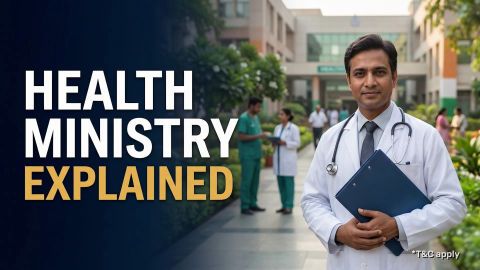
Health Ministry Explained
In summary
The Ministry of Health and Family Welfare (MoHFW) is the Union government's nodal ministry for public health in India. It works through two departments and oversees key health programmes, medical education bodies and healthcare initiatives.
- Full name: Ministry of Health and Family Welfare (MoHFW).
- Structure: It has two departments: the Department of Health and Family Welfare and the Department of Health Research.
- Flagship scheme: Ayushman Bharat PM-JAY provides health cover of up to Rs. 5 lakh per eligible family per year. The scheme covers around 12 crore families, or approximately 55 crore beneficiaries.
- Major programme: The National Health Mission (NHM), launched in 2013, combines the National Rural Health Mission and the National Urban Health Mission to improve access to healthcare.
- Regulatory bodies: The National Medical Commission oversees medical education and professional standards, while the Central Drugs Standard Control Organisation regulates drugs and medical devices. The National Health Authority implements PM-JAY.
Doctors planning to establish a clinic, upgrade medical facilities or pursue specialisation can check their Doctor Loan eligibility to understand the funding options available.
What does the Union Ministry of Health and Family Welfare do?
Three things, mainly. MoHFW sets national health policy, it runs the national health programmes, and it regulates the professions and products that healthcare depends on. The work is split across two departments, with statutory councils and autonomous bodies reporting into them, and the table below shows which body carries which function.
| Function | Department or body responsible | What it produces |
| Policy formulation | Department of Health and Family Welfare | The National Health Policy, 2017, which recommends public health spending of 2.5% of GDP by 2025 |
| Programme implementation | National Health Mission | Launched in 2013, bringing the rural mission of 2005 and the urban mission under one roof |
| Drug and device regulation | Central Drugs Standard Control Organisation (CDSCO) | Approvals for drugs, devices and clinical trials under the Drugs and Cosmetics Act, 1940 |
| Medical education | National Medical Commission (NMC) | Standards for medical colleges and the undergraduate curriculum |
| Health research | Department of Health Research, through the Indian Council of Medical Research | Funding for biomedical and public health research |
| Health financing | National Health Authority (NHA) | Delivery of Ayushman Bharat PM-JAY |
Last updated: 23rd November, 2026
Healthcare professionals looking to advance their careers may check doctor loan eligibility to fund further studies or certifications.
You can enter the exact loan amount
What is the health ministry of India?
The health ministry, formally the Ministry of Health and Family Welfare or MoHFW, is the Union government body responsible for health policy and administration in India. It formulates policy, runs the national health programmes, regulates medical education and drug approvals, and coordinates with state health departments.
The constitutional position explains why that coordination carries so much weight. Public health, hospitals and dispensaries sit with the states under Entry 6 of the State List in the Seventh Schedule, while the medical profession sits in the Concurrent List at Entry 26, where the Union and the states can both legislate. MoHFW therefore sets the national frame, and the states deliver most of the care on the ground.
How is the health ministry organised?
Through two departments and a chain that runs from the Union minister down to district health officials. The Department of Health and Family Welfare carries the bulk of the work and the Department of Health Research handles biomedical research. Statutory councils and autonomous bodies sit alongside that chain, reporting into the ministry rather than into the field structure.
| Level | Role | Key bodies at this level |
| Minister of Health and Family Welfare | Provides policy direction and leadership for the ministry | Political head of both departments |
| Secretary (Health) | Oversees administrative functioning and policy implementation | Department of Health and Family Welfare |
| Additional secretaries | Manage specific portfolios and national programmes | National Health Mission and the national programme divisions |
| Directors and Joint secretaries | Supervise departments and health initiatives | Programme divisions, with regulators such as NMC and CDSCO reporting through the ministry |
| State and District health officials | Implement programmes and ensure compliance at regional levels | State health departments, district hospitals, community health centres and primary health centres |
Last updated: 23rd November, 2026
This structure ensures that health programmes are executed from the national level down to the local one.
Get professional loan for your needs
Personal loan for doctors for wedding
Get doctor loan for for wedding

Chartered accountant loan
Get CA loan with minimal documents

CA loan for setting practice
Get CA loan for setting up your practice

CA loan for office renovation
Get CA loan for renovating office

Business loan for lawyer
Get business loan for lawyer today

Business loan for CA
Get business loan for CA today
Medical equipment finance for diagnostic centre
Setup diagnostic centre with medical equipment finance

Personal loan for lawyer
Get a personal loan for lawyer

Personal loan for doctors for wedding
Get a personal loan for wedding

Personal loan for doctors
Get a personal loan for doctor

Personal loan for CA
Get a personal loan for CA
Medical equipment finance
Get a medical equipment finance
Lawyer loan to start firm
Get a lawyer loan to start firm

Lawyer loan for Chamber
Get a lawyer loan for Chamber

Lawyer loan
Get a lawyer loan
Hospital loan
Get a hospital loan

Doctor loan for setting up practice
Get a doctor loan for setting up practice
Doctor loan for clinic renovation
Get a doctor loan for clinic renovation

Doctor loan
Get a doctor loan
Our loan variants
Use our popular calculators



What are the departments of the health ministry and their roles?
Two, and only two: the Department of Health and Family Welfare and the Department of Health Research. The bodies often described as departments, such as the National Health Mission or the National Medical Commission, are a programme and a statutory council respectively. Both sit under the ministry rather than beside the two departments, which is worth keeping straight when you are looking for the right office to deal with.
| Department or arm | What it covers | Examples of its work |
| Department of Health and Family Welfare | Public health, disease control, maternal and child health, and the national health programmes | National Health Mission, the Universal Immunisation Programme, the National AIDS Control Programme |
| Department of Health Research | Biomedical and public health research, and research governance | The Indian Council of Medical Research and its institutes |
| Statutory councils under the ministry | Regulation of the professions and their education | National Medical Commission, Pharmacy Council of India |
| Regulatory bodies under the ministry | Products, safety and standards | CDSCO for drugs and devices, FSSAI for food safety |
| Autonomous institutions | Tertiary care, training and disease surveillance | AIIMS, NIMHANS, the National Centre for Disease Control |
Last updated: 23rd November, 2026
Together these arms cover policy, delivery, regulation and research across India.
Which national health programmes does the health ministry run?
Four run at national scale, and the largest are Ayushman Bharat PM-JAY, the National Health Mission and the Universal Immunisation Programme. PM-JAY is the one with hard numbers attached: Rs. 5 lakh of cover per family a year, reaching 12 crore families, or roughly 55 crore people. The National Health Mission is the delivery backbone underneath it, carrying primary and secondary care in both rural and urban areas.
| Programme | Focus area | Launched | Coverage or scale |
| Ayushman Bharat PM-JAY | Health insurance for secondary and tertiary hospitalisation | 2018 | Rs. 5 lakh per family a year, 12 crore families and about 55 crore beneficiaries, with 36,229 empanelled hospitals |
| National Health Mission | Rural and urban healthcare delivery | 2013 | Brought the rural mission of 2005 and the urban mission under one programme, operating across states and union territories |
| National AIDS Control Programme | HIV prevention, treatment and awareness | 1992 | Nationwide |
| Universal Immunisation Programme | Childhood vaccination | 1985 | Nationwide |
Last updated: 23rd November, 2026
PM-JAY figures are as reported by the Press Information Bureau for 28th February, 2026, covering 11.69 crore hospital admissions authorised and 36,229 empanelled hospitals, of which 19,483 are public and 16,746 private.
How does the health ministry impact public health in India?
Two numbers capture the direction of travel. Maternal mortality fell from 130 per lakh live births in 2014-16 to 93 in 2019-21, and out-of-pocket spending fell from 62.6% of total health expenditure in 2014-15 to 39.4% in 2021-22. Both movements track the period in which the National Health Mission and PM-JAY scaled up, and both still sit short of the targets the ministry has set itself.
| Impact area | Measurable outcome |
| Maternal health | Maternal mortality ratio fell from 130 per lakh live births in 2014-16 to 93 in 2019-21, per the Sample Registration System |
| Child health | Infant mortality fell from 39 per 1,000 live births in 2014 to 27 in 2021, and under-five mortality from 45 to 31 across the same period, per the Sample Registration System |
| Health financing | Out-of-pocket spending fell from 62.6% of total health expenditure in 2014-15 to 39.4% in 2021-22, per the National Health Accounts |
| Public spending | Government health spending stood at 1.84% of GDP in 2021-22, against the National Health Policy, 2017 recommendation of 2.5% by 2025 |
| Disease control | India was certified polio-free in 2014 |
Last updated: 23rd November, 2026
These interventions have contributed to lower mortality and a smaller share of health costs falling directly on households.
How can you access health ministry services online?
You can access several services offered by the Ministry of Health and Family Welfare (MoHFW) through its digital platforms. These services help you find healthcare information, consult doctors remotely, check government health schemes and manage health records. Most platforms allow you to complete basic registration and verification online.
Here are some key services you can access.
1. Explore health programmes and government updates
The official Health Ministry portal provides information about national health policies, public health initiatives, government notifications and healthcare programmes. You can browse its sections to understand ongoing schemes, eligibility conditions and available services.
2. Book an online doctor consultation
The eSanjeevani platform allows you to consult doctors through a digital interface. You can register with your mobile number, select an available medical department and describe your health concern. Depending on the service, you may receive a video consultation and an electronic prescription.
3. Check eligibility for Ayushman Bharat PM-JAY
The PM-JAY beneficiary platform helps you check whether you qualify for the government health insurance scheme. You can enter the required details, complete verification and access available beneficiary services. Eligible families can also use the platform to access their Ayushman card details.
4. Create an Ayushman Bharat Health Account
The Ayushman Bharat Digital Mission allows individuals to create an ABHA number. This digital health identity can help you link and access health records through participating healthcare providers. You can manage the sharing of linked records based on the consent process.
5. Access vaccination records
The U-WIN platform supports digital vaccination services for pregnant women and children under the Universal Immunisation Programme. Registered users can check vaccination schedules, view available records and access certificates where the facility is provided.
6. Find other healthcare services
The ministry also supports digital platforms for specific healthcare needs. These include:
- National Health Mission: Provides information about rural and urban healthcare programmes.
- Central Government Health Scheme: Offers online services and information for eligible central government employees and pensioners.
- Tele-MANAS: Provides access to mental health support and related information.
- National Health Authority: Shares information about PM-JAY and digital healthcare initiatives.
How is the health ministry different from the WHO?
The health ministry is India's own government body, with legal authority inside the country. The World Health Organisation is a United Nations agency whose role is global and advisory. That distinction decides what each one can require and what it can only recommend.
| Aspect | Health ministry (India) | World Health Organisation (WHO) | Why it matters for India |
| Scope | National | Global | MoHFW sets policy and rules that bind in India; WHO guidance stays advisory until India adopts it |
| Role | Implements health policies, programmes and regulations within India | Provides guidance, research and coordination for global health initiatives | A WHO recommendation reaches patients only once the ministry or a state turns it into a rule |
| Authority | Government body | United Nations agency | Enforcement sits with MoHFW and the states, never with WHO |
| Focus | National public health, sanitation and disease control | International public health, research and technical support | Domestic programmes such as the National AIDS Control Programme run inside a global framework rather than under it |
Last updated: 23rd November, 2026
Which bodies and councils work under the health ministry?
Three matter most to a practising doctor: the National Medical Commission for registration and education, the Central Drugs Standard Control Organisation for anything you prescribe or install, and the National Health Authority if your clinic treats PM-JAY patients. Beyond those, the ministry's reach runs through research bodies, statutory councils and tertiary institutions, each with its own remit.
| Body | Type | Key responsibility |
| National Medical Commission (NMC) | Statutory commission | Regulates medical education and professional standards |
| Central Drugs Standard Control Organisation (CDSCO) | Regulatory body | Approves drugs, devices and clinical trials under the Drugs and Cosmetics Act, 1940 |
| National Health Authority (NHA) | Autonomous body | Implements Ayushman Bharat PM-JAY |
| Indian Council of Medical Research (ICMR) | Research body | Funds and conducts biomedical and public health research |
| Food Safety and Standards Authority of India (FSSAI) | Regulatory body | Sets and enforces food safety standards |
| Pharmacy Council of India (PCI) | Statutory council | Regulates pharmacy education and practice |
| National Dental Commission (NDC) | Statutory commission | Regulates dental education and practice, having replaced the Dental Council of India in March 2026 |
| All India Institute of Medical Sciences (AIIMS) | Autonomous institution | Tertiary care, teaching and research |
| National Institute of Mental Health and Neuro Sciences (NIMHANS) | Autonomous institution | Mental health and neurosciences |
| National Centre for Disease Control (NCDC) | Technical body | Disease surveillance and outbreak response |
Last updated: 23rd November, 2026
How are health responsibilities divided between the Centre and states?
Health is primarily a State subject. Entry 6 of the State List in the Seventh Schedule gives the states public health, hospitals and dispensaries, so most of the delivery is theirs. The Centre sets national policy, funds the large programmes, and legislates where the Concurrent List allows, which is how the health ministry reaches into medical education and drug regulation.
| Responsibility | Central government | State government |
| Policy and legislation | Sets the National Health Policy and central laws such as the Drugs and Cosmetics Act, 1940 | Make state health laws and local regulations |
| Funding | Provides grants-in-aid and the central share of the National Health Mission | Contribute the state share and their own budget allocation |
| Medical education | Regulates through the NMC and approves new medical colleges | Own and run state medical colleges |
| Public hospitals | Runs AIIMS and central government hospitals | Run district hospitals, community health centres and primary health centres |
| Disease control | Sets national guidelines for programmes such as the National AIDS Control Programme | Implement them at district level |
Last updated: 23rd November, 2026
The two tiers co-fund the National Health Mission, with the ministry providing the central share and each state adding its own. That shared structure is why implementation quality differs from one state to the next even under a single national programme.
How does the health ministry regulate medical education in India?
Through the National Medical Commission, which MoHFW oversees. The NMC sets the standards, approves the colleges and prescribes the curriculum, while registration itself stays with the State Medical Councils.
- MoHFW oversees the National Medical Commission, constituted in 2020 under the National Medical Commission Act, 2019, which replaced the Medical Council of India.
- The NMC approves new medical colleges and sets seat intake. Its revised seat matrix for 2026-27 lists 1,40,664 MBBS seats across 839 medical colleges.
- The NMC prescribes the undergraduate curriculum through the Competency-Based Medical Education framework introduced in 2019.
- Registration sits with the State Medical Councils, with the NMC maintaining the National Medical Register. The Act also provides for a National Exit Test as a common licensing and postgraduate entrance examination, and its rollout has been deferred more than once, so check the commission's current notifications before planning around it.
Doctors planning a postgraduate specialisation or a clinic of their own can review their doctor loan options to fund the next step. Check your eligibility for a doctor loan using just mobile number and OTP – 100% online process.
Doctor loan for different budget
Doctor loan in different cities

Loan for doctor in Mumbai

Loan for doctor in Kolkata

Loan for doctor in Pune
Doctor loan for different budgets

Doctor loan for different budgets
Doctor loan for different budgets1
Doctor loan for different budgets2
Doctor loan for different budgets3
Types of doctor loan

Business loan for doctors

Business loan for chartered accountants

Set up a diagnostic centre with medical equipment finance

How to start a law firm in India

Doctor loan for clinic renovation
Frequently asked questions
Overview
What is the full form of MoHFW, and what does it do?
MoHFW stands for the Ministry of Health and Family Welfare, the Union government's nodal body for public health in India. It works through two departments, the Department of Health and Family Welfare and the Department of Health Research. Between them they set national health policy, run programmes such as the National Health Mission and Ayushman Bharat, and oversee the regulators for medical education, drugs and food safety.
How can I file a complaint against a hospital with the health ministry?
Use CPGRAMS, the Centralised Public Grievance Redress and Monitoring System, at pgportal.gov.in. Register on the portal, select the Ministry of Health and Family Welfare as the department, and submit the complaint with the hospital's details and any supporting documents. If the hospital is empanelled under Ayushman Bharat, the scheme's own grievance channel through the National Health Authority usually moves faster.
What is the AYUSH department, and how does it differ from MoHFW?
AYUSH covers Ayurveda, Yoga and Naturopathy, Unani, Siddha and Homoeopathy, the traditional and alternative systems of medicine recognised in India. It was a department within the health ministry until 2014, when it became a ministry in its own right. So the two now sit side by side in the Union government, with MoHFW handling allopathic healthcare and AYUSH handling the traditional systems.
How does the health ministry regulate health insurance in India?
It does not regulate private health insurance. That sits with the Insurance Regulatory and Development Authority of India, which licenses insurers and approves policy terms. What the health ministry runs is public health assurance: the National Health Authority, under MoHFW, delivers Ayushman Bharat PM-JAY, which gives Rs. 5 lakh of cover per family a year to 12 crore families. So a dispute with a private insurer goes to IRDAI, and a PM-JAY claim goes to the NHA.
What role does the health ministry play in drug and device regulation?
MoHFW oversees the Central Drugs Standard Control Organisation, or CDSCO, which is India's national drug regulator. CDSCO works under the Drugs and Cosmetics Act, 1940 and its rules, approving new drugs, licensing manufacture and import, regulating medical devices, and clearing clinical trials. State drug controllers handle licensing for manufacture and sale within their own states, so regulation runs across both tiers.
What is the National Health Mission, and who does it cover?
The National Health Mission is India's largest public health programme, launched in 2013 to bring the National Rural Health Mission of 2005 and the National Urban Health Mission under one framework. It covers both rural and urban populations across states and union territories, funding primary and secondary care through primary health centres, community health centres and district hospitals. The Centre and each state share the cost.
Which ministry is responsible for AYUSH in India?
The Ministry of AYUSH, which has been a separate cabinet ministry since 2014. Before that, AYUSH was a department inside the Ministry of Health and Family Welfare. Practitioners of Ayurveda, Yoga, Unani, Siddha and Homoeopathy therefore deal with the Ministry of AYUSH and its councils rather than with MoHFW for matters specific to their system of medicine.
Can doctors get a loan to set up a clinic or fund further studies?
Yes. Doctors can apply for a Doctor Loan to set up a clinic, purchase medical equipment or fund further studies. Bajaj Finance offers eligible medical professionals loans of up to Rs. 80 lakh, with tenures of up to 96 months and no collateral requirement. Check your eligibility for a doctor loan using just mobile number and OTP – 100% online process.
What do our customers say about us
Dr. Rohan Mehta
Reviewed on
I applied for a doctor loan to upgrade my clinic infrastructure, and the experience was excellent. The application process was simple, the documentation was minimal, and the approval came through quickly. The team guided me throughout the process and ensured a seamless experience. I would highly recommend this financing option to medical professionals looking for reliable funding support.
Dr. Priya Sharma
Reviewed on
The doctor loan helped me manage my professional expenses without any financial stress. The loan disbursal was fast, and the customer support team was always available to answer my questions. The repayment options were flexible and suited my financial requirements perfectly. Overall, I am very satisfied with the service and support provided.
Dr. Arvind Nair
Reviewed on
I availed a doctor loan to purchase advanced medical equipment for my practice. The entire process was smooth, transparent, and completed within a short time. The competitive interest rates and hassle-free documentation made the experience even better. The support team remained helpful at every stage, making the loan journey convenient and stress-free.
Dr. Neha Kapoor
Reviewed on
I needed financial assistance to expand my healthcare practice, and this doctor loan proved to be the right solution. The approval process was quick, and the team provided clear guidance from application to disbursal. The flexible repayment tenure helped me plan my finances effectively. I am pleased with the overall experience and would recommend it to fellow doctors.
More articles

5 tips for hiring the best front office staff for your clinic
Read More
Step-by-step guide to expand your practice from clinic to polyclinic
Read More

How to Start a Physical Therapy Clinic: 12 Steps Guide
Read More

The essentials of clinic management
Read More
Disclaimer
Bajaj Finance Limited has the sole and absolute discretion, without assigning any reason to accept or reject any application. Terms and conditions apply*.