













An OTP will be sent to this number for verification

You may have a pre-approved offer
Enter required loan against property amount
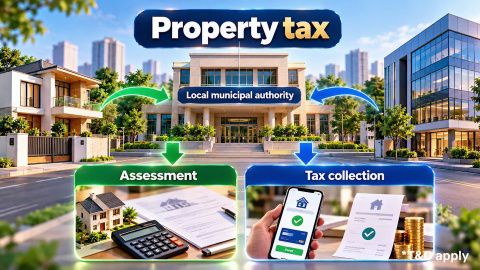
Property tax in your city
In summary
New Town Kolkata Development Authority (NKDA) levies property tax on eligible properties within its jurisdiction. Check the property details and current tax demand on the official NKDA portal before making a payment.
- The NKDA property tax portal uses an assessment number to access annual property valuation and tax details
- Property owners can apply for self-assessment through the West Bengal e-District portal
- The application requires details such as property address, ownership information, property type and date of completion, possession or purchase
- NKDA offers a 5% rebate on property tax paid within the applicable due date
- An additional 5% rebate is available if you pay the annual property tax in a single instalment within the first instalment's due date
- Late payment attracts penalties as prescribed under the applicable rules
- A property-tax receipt records tax payment but does not independently establish ownership
Use the current tax demand shown against your property assessment record. If the tax amount, property details or payment status appears incorrect, contact NKDA's Assessment Department to resolve the discrepancy before making another payment.
What is NKDA property tax?
NKDA property tax is a charge levied on eligible land and buildings within New Town, Kolkata. The New Town Kolkata Development Authority is responsible for assessing and collecting this tax under the applicable state legislation. The money collected forms part of NKDA's development fund. This fund supports the authority's responsibilities, including public works and amenities such as roads, water supply, drainage, sewerage and street lighting. NKDA maintains property-tax assessment records to identify properties, determine their annual valuation and track outstanding payments. These records can include property details, assessment information, tax demands and payment history.
Property owners should keep their tax accounts updated. However, a property-tax receipt is not a replacement for registered ownership documents or NKDA's separate record-of-title process.
Source: New Town Kolkata Development Authority and the New Town, Kolkata Development Authority Act.
What are the NKDA property tax payment dates?
NKDA property tax is payable in quarterly instalments. The financial year is divided into four quarters, beginning in April, July, October and January.
Under the applicable Act, payment is generally due within 30 days after the end of each quarter. The authority's bill or payment demand should be checked for the exact amount and due date.
| Tax period | Quarter | General payment deadline |
| First quarter | April to June | 30 July |
| Second quarter | July to September | 30 October |
| Third quarter | October to December | 30 January |
| Fourth quarter | January to March | 30 April |
The law also provides rebates for timely payment:
- A 5% rebate is allowed when the amount due is paid by the specified date.
- An additional 5% rebate is allowed when the full annual property tax is paid in one instalment within the due date of the first instalment.
The rebate depends on the applicable payment conditions. Check your current NKDA demand to confirm the rebate available before making a payment. Do not deduct a rebate yourself if it is not reflected in the amount shown by the authority.
How is NKDA property tax calculated?
NKDA calculates property tax using the annual valuation of the land or building. This is different from simply multiplying the property's market price or purchase price by a fixed tax rate.
The annual valuation is based on area-related values and factors prescribed under NKDA's assessment scheme. These factors include:
- Property area: The covered space of a building or the total area of land.
- Location: The property's location within New Town.
- Property use: Whether the property is residential, commercial or used for another purpose.
- Age: The age of the building.
- Structure: The type and nature of the building.
- Occupancy: The property's occupancy status.
Consider Ananya, who owns a residential property in New Town. Assume NKDA has determined its annual valuation as Rs. 1,00,000
The illustrative calculation is: Annual property tax = Annual valuation × Applicable tax rate
= Rs. 1,00,000 × 15% = Rs. 15,000
| Calculation detail | Value |
| Property category | Residential |
| Assessed annual valuation | Rs. 1,00,000 |
| Applicable rate | 15% |
| Illustrative annual property tax | Rs. 15,000 |
This is only an example to explain the calculation. It is not an actual NKDA tax demand. The final amount may differ based on the authority's assessment, applicable rebates and other permitted adjustments.
She should compare:
- The assessment year on both records.
- The built-up area recorded as 1,200 sq. ft.
- The zone and property category.
- The self-occupied or tenanted status.
- Earlier unpaid dues.
- Interest or penalty shown against the property.
If the current assessment details are correct, the current municipal demand should guide her payment. If the property information itself is wrong, Ananya should resolve the record mismatch before relying on the demand. The decision rule is simple: use an old receipt for comparison, but use the verified current property record for payment.
How do you pay NKDA property tax online?
You can begin the property-tax assessment and payment process through the official NKDA website. Its assessment service guides applicants through the e-District system.
Follow these general steps:
- Visit the official NKDA website.
- Open the Assessment and Payment of Property Tax service.
- Select the option to apply for self-assessment and payment.
- Log in to the e-District portal or complete citizen registration if you are a new user.
- Select the NKDA property-tax assessment service.
- Enter the requested property and applicant details.
- Provide the property type, location, area and other assessment information.
- Review the details and upload the supporting documents requested by the portal.
- Submit the application and save the acknowledgement.
- Check the annual valuation and tax details generated against the assessment number.
- Select the payment option available and complete the transaction.
NKDA's published procedure describes online payment as well as an offline challan option. Under the offline process, the applicant downloads the challan, pays at the bank within the date printed on it and uploads the payment receipt. The electronic receipt becomes available after the authority verifies the payment. Payment options may depend on the service and portal currently available. Follow the instructions displayed during your transaction and retain the acknowledgement and payment reference.
What if your NKDA property tax payment is wrong?
Check the nature of the issue before submitting another payment or application. NKDA provides separate processes for assessment modification, objections and payment-related queries.
Different issues need different actions:
| Issue | Suggested action |
| Payment is not reflected | Check the transaction status and retain the bank reference |
| Incorrect annual valuation | Submit a written objection to NKDA |
| Change in property use or occupancy | Apply for assessment modification |
| Incorrect property details | Contact the NKDA Assessment Section |
| Ownership details need updating | Apply separately for Record of Title (Mutation) |
| Receipt is unavailable | Track the application and check the download option |
Consider Rahul, who pays Rs. 18,000 towards his property tax. His bank account is debited, but the portal does not immediately show a successful payment.
Rahul should first save the bank transaction reference and check the payment status. He should contact NKDA if the payment remains unresolved. Making another payment immediately could lead to a duplicate transaction. If Rahul disagrees with the annual valuation, he can submit a written objection explaining the disputed details. NKDA's published guidance also provides for a hearing where the objection is considered.
Does NKDA property tax prove ownership?
An NKDA property-tax receipt confirms that a payment has been recorded against a property. It does not independently establish legal ownership. NKDA has a separate Record of Title (Mutation) service for recording the name of a valid owner in its property records.
Consider Priya, who purchases a flat in New Town. She has a registered sale deed, but the NKDA property record still carries the previous owner's name.
Paying the property tax does not automatically update the ownership record. Priya should apply for mutation through NKDA and submit the documents required for her case.
| Record | Main purpose |
| Property-tax receipt | Records payment of property tax |
| Property-tax assessment | Records the property's details and tax valuation |
| Registered sale or lease deed | Provides evidence of the documented property transaction or rights |
| NKDA Record of Title (Mutation) | Records the valid owner's name in NKDA's property records |
Keeping these records updated can help when selling, transferring or using a property for financing.
Can NKDA property tax records affect a loan against property?
Updated NKDA property-tax records can support the documentation process when applying for a loan against property. However, a tax receipt alone does not establish ownership or guarantee loan approval. A lender may review several aspects before considering a property as security.
| Assessment area | What may be checked |
| Ownership | Sale deed, title and ownership records |
| Property tax | Assessment details and outstanding dues |
| Legal assessment | Title documents and legal status |
| Technical assessment | Property type, location and condition |
| Valuation | Current value of the property |
| Applicant profile | Income, credit history and repayment capacity |
Consider Arjun, who owns a property in New Town and is exploring a loan against property for business expansion. He is considering a loan of Rs. 50 lakh at an illustrative interest rate of 10% per annum for 15 years.
The approximate Equated Monthly Instalment (EMI) is Rs. 53,730.
If he increases the loan amount to Rs. 60 lakh while keeping the interest rate and tenure unchanged, the approximate EMI becomes Rs. 64,476.
| Illustrative loan amount | Interest rate | Tenure | Approximate EMI |
| Rs. 50 lakh | 10% p.a. | 15 years | Rs. 53,730 |
| Rs. 60 lakh | 10% p.a. | 15 years | Rs. 64,476 |
The additional Rs. 10 lakh increases the monthly EMI by approximately Rs. 10,746. These figures are illustrative and exclude applicable fees and charges.
Arjun's income, credit profile and property documents will form part of the lender's assessment. None of these factors independently guarantees approval.
Bajaj Finance offers Loan Against Property amounts of up to ₹15.50 crore with repayment tenure of up to 15 years, subject to eligibility and property assessment. Bajaj Finance loan against property interest rates currently range from 7.5% per annum to 14.25% per annum.
Borrow according to the amount you need and the EMI you can manage rather than selecting the maximum available amount.
You can compare loan against property interest rates and use a loan against property EMI calculator to test different loan amounts, rates and repayment tenures. Planning to use your property for financing? Check eligibility for a loan against property with Bajaj Finance.
Frequently Asked Questions
Payment and calculation
Assessment and property records
Property tax and borrowing
How often should you pay NKDA property tax?
NKDA property tax is generally payable in quarterly instalments. The quarters begin in April, July, October and January. Check the demand notice for the applicable payment deadline and amount.
Can you get a rebate on NKDA property tax?
Yes. The applicable law provides a 5% rebate for payment by the specified date. An additional 5% rebate is available when the annual tax is paid in one instalment within the first instalment's due date. Check your current demand for the applicable rebate.
What happens if you pay NKDA property tax late?
Late payment can attract penalties and interest under the applicable rules. The amount depends on the relevant provisions and your outstanding demand. Check the current bill or contact NKDA rather than assuming a fixed monthly penalty.
How can you correct an incorrect NKDA property-tax assessment?
You can submit a written objection to NKDA if you disagree with the annual valuation. Explain the disputed details and provide supporting documents. NKDA's published guidance provides for consideration of objections and a hearing.
How do you update the ownership details of a New Town property?
You need to apply separately for Record of Title (Mutation) through NKDA. The authority may ask for documents such as the allotment letter, possession letter and sale or lease deed, depending on the property and ownership history.
Does an NKDA property-tax receipt prove that you own a property?
A tax receipt records payment but does not independently establish ownership. Registered property documents and the relevant ownership records are important for establishing property rights.
Loan Against Property for different budget
Check your pre-approved offer now
Loan Against Property for Professionals




Find your nearest branch

What do our customers say about us
customers
Play Store rating
reviews
Anita Das
04 March 2026
The loan against property process was smooth and transparent. Interest rates were competitive, and the documentation requirements were minimal. The team provided clear guidance at every step, making the entire experience hassle-free. Highly recommended for quick approvals and reliable support.
Aashish
04 March 2026
The loan disbursal was quick, and the customer support team handled all my queries with patience and clarity. Flexible EMIs made it easy to manage monthly expenses. Overall, a great experience, especially for salaried individuals seeking a loan against property.
Prakash
04 March 2026
I had a great experience transferring my existing loan against property. The process was quick and hassle-free, and I saved significantly with the lower interest rate. The customer service team was supportive throughout. Highly recommended for anyone considering a balance transfer.
Yogesh Singh
04 March 2026
Clear guidance, quick approval, and flexible repayment options made purchasing my new house much easier than expected. The team managed the entire process professionally and ensured smooth coordination at every stage. Overall, a very satisfying experience, and I would recommend their home loan services to others.
Related articles


Watch our videos

Know the tax benefits on your loan against property
What are the documents required for a Loan Against Property?

What are the types of property eligible for Loan Against Property

What is the eligibility criteria for a Loan Against Property
Bajaj Finance app for all your financial needs and goals
Trusted by 50 million+ customers in India, Bajaj Finance App is a one-stop solution for all your financial needs and goals.
You can use the Bajaj Finance App to:
- Apply for loans online, such as Instant Personal Loan, Home Loan, Business Loan, Gold Loan, and more.
- Invest in fixed deposits and mutual funds on the app.
- Choose from multiple insurance for your health, motor and even pocket insurance, from various insurance providers.
- Pay and manage your bills and recharges using the BBPS platform. Use Bajaj Pay and Bajaj Wallet for quick and simple money transfers and transactions.
- Apply for Insta EMI Card and get a pre-qualified limit on the app. Explore over 1 million products on the app that can be purchased from a partner store on Easy EMIs.
- Shop from over 100+ brand partners that offer a diverse range of products and services.
- Use specialised tools like EMI calculators, SIP Calculators
- Check your credit score, download loan statements and even get quick customer support—all on the app.
Download the Bajaj Finance App today and experience the convenience of managing your finances on one app.
Disclaimer
1. Bajaj Finance Limited (“BFL”) is a Non-Banking Finance Company (NBFC) and Prepaid Payment Instrument Issuer offering financial services viz., loans, deposits, Bajaj Pay Wallet, Bajaj Pay UPI, bill payments and third-party wealth management products. The details mentioned in the respective product/ service document shall prevail in case of any inconsistency with respect to the information referring to BFL products and services on this page.
2. All other information, such as, the images, facts, statistics etc. (“information”) that are in addition to the details mentioned in the BFL’s product/ service document and which are being displayed on this page only depicts the summary of the information sourced from the public domain. The said information is neither owned by BFL nor it is to the exclusive knowledge of BFL. There may be inadvertent inaccuracies or typographical errors or delays in updating the said information. Hence, users are advised to independently exercise diligence by verifying complete information, including by consulting experts, if any. Users shall be the sole owner of the decision taken, if any, about suitability of the same.