








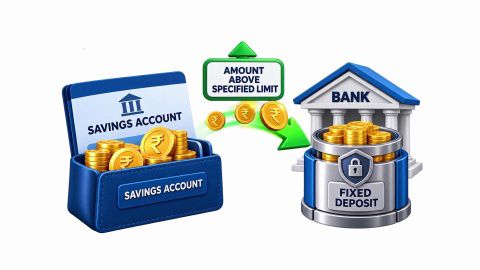
Fixed Deposit Sweep In
-
In summary
An FD-linked savings account combines the everyday accessibility of a savings account with the interest-earning potential of a fixed deposit.
- Automatic transfers: When your savings account balance exceeds a specified threshold, the surplus may be transferred to an FD.
- Access to funds: If the savings balance falls below the required amount, the bank may transfer funds back from the linked FD.
- Interest earnings: The amount held in the FD earns interest according to its applicable terms, while the remaining savings account balance earns the savings account rate.
- Bank-specific conditions: Minimum balances, transfer amounts, FD tenure, premature withdrawal rules and interest calculations vary by institution.
- Tax implications: Interest earned on an FD is generally taxable under the applicable income tax rules.
- Separate FD option: If you want to invest surplus savings in a separate deposit rather than use an automatic sweep facility, Bajaj Finance FD rates currently go up to 7.75% p.a. for customers below 60 and 8.15% p.a. for senior citizens, subject to tenure and payout option.
A sweep-in facility does not mean every FD can be linked to every savings account. Check the bank's terms before opening or linking a deposit.
What is FD linking on a savings account?
-
FD linking is a banking facility that connects an eligible fixed deposit with a savings or current account. It is commonly known as an auto-sweep or sweep-in facility.
The facility is designed to help manage surplus money. Instead of leaving the entire balance in a savings account, the bank can transfer eligible surplus funds into a linked FD when the balance crosses a predefined threshold. If the account balance later falls below the required level, the bank can transfer funds back from the FD.
For example, a bank may allow you to maintain a specified balance in your savings account and automatically transfer eligible surplus amounts into an FD. If you subsequently make a payment that reduces your savings balance, the bank may use the linked FD to cover the shortfall, subject to the facility's rules.
The precise mechanism differs across banks. Some facilities create FDs automatically, while others link an existing FD to a savings account. Some may break only the amount required from the deposit, while others apply different rules.
How does FD linking on a savings account work?
The process depends on the bank's sweep-in rules, but it generally involves three stages: setting a threshold, transferring surplus funds into an FD and moving funds back when needed.
1. Set a threshold balance
The bank specifies a minimum or threshold balance for the savings account. Depending on the facility, you may be able to select the threshold yourself or use the bank's prescribed amount.
2. Transfer surplus funds into an FD
When the account balance exceeds the threshold, the bank transfers eligible surplus money into an FD. The transfer may happen in specified multiples, such as Rs. 1,000, depending on the bank's rules.
3. Transfer money back when required
If a payment or withdrawal reduces the savings account balance below the required amount, the bank may transfer the necessary funds from the linked FD back to the account. The amount transferred and the order in which deposits are used depend on the facility's terms.
Example of an FD-linked savings account
Suppose your bank requires you to maintain Rs. 30,000 in your savings account and transfers surplus money into an FD in multiples of Rs. 1,000.
| Particulars | Amount |
|---|---|
| Initial savings account balance | Rs. 50,000 |
| Threshold balance | Rs. 30,000 |
| Potential surplus transferred to FD | Rs. 20,000 |
| Savings account balance after transfer | Rs. 30,000 |
If you later make a payment of Rs. 10,000 and the account balance falls to Rs. 20,000, the bank may transfer Rs. 10,000 from the linked FD to restore the threshold balance.
This is an illustration of how a sweep-in facility may work. Actual transfers depend on the bank's threshold, transfer multiples, FD balance and other conditions.
What are the benefits of linking an FD to a savings account?
An FD-linked savings account may help you manage everyday expenses and surplus savings through a single banking arrangement. The benefits depend on the bank's terms and the amount of money transferred into the FD.
Potential to earn more interest on surplus funds
Money transferred into an FD earns interest at the rate applicable to that deposit. This may be higher than the interest rate on the savings account, although the difference depends on the bank, FD tenure and prevailing rates.
Access to funds when needed
The sweep-in mechanism can make funds available for eligible payments without requiring you to manually close the entire FD. However, the amount that can be accessed and the interest adjustment on the withdrawn portion depend on the bank's rules.
Automatic money management
Once activated, the facility manages eligible transfers automatically. This can reduce the need to move money between accounts manually or repeatedly create new deposits.
Support for short-term cash-flow needs
A linked FD may help manage fluctuations in the savings account balance, such as when a large payment is due or expenses vary from month to month. It should not replace an adequate emergency fund that remains readily accessible.
Easier tracking of linked balances
Depending on the bank's digital banking services, you may be able to view the savings account and linked FD details through its mobile application or internet banking platform.
What are the limitations of an FD-linked savings account?
An FD-linked account can be convenient, but it does not eliminate all restrictions associated with fixed deposits.
- Eligibility restrictions: Not every FD or savings account is eligible for linking.
- Threshold requirements: The bank may require a minimum balance in the savings account or a minimum FD amount.
- Premature withdrawal rules: Interest on the amount withdrawn from an FD may be recalculated, reduced or otherwise adjusted under the bank's terms.
- Transfer limitations: The facility may operate in specified multiples or follow a particular order when using multiple linked deposits.
- Tax liability: Interest earned on the FD remains subject to the applicable tax rules.
- Potential loss of interest: Accessing funds before maturity may affect the interest earned on the withdrawn amount.
Read the facility's terms before activating it. In particular, confirm how the bank calculates interest when money is transferred back from the FD.
How can you link an FD to a savings account?
The exact process varies by bank. In general, you can follow these steps if your bank offers a sweep-in facility:
- Check eligibility: Confirm whether your savings account and FD qualify for linking.
- Log in to internet banking or mobile banking: Look for options such as ‘Sweep-in facility’, ‘Auto sweep’ or ‘Link FD to savings account’.
- Select the accounts: Choose the eligible savings account and FD, or follow the process to create a new linked FD.
- Set the threshold or transfer conditions: Enter the required balance, transfer multiples and other preferences if the bank allows you to customise them.
- Review the terms: Check the interest calculation, withdrawal conditions, charges and other restrictions.
- Confirm the request: Complete the required authentication and wait for the bank to confirm activation.
- Monitor transactions: Check your account statements to understand how funds are transferred and how interest is calculated.
Some banks may require a branch visit or an offline request. A bank may also restrict online linking for joint deposits or certain FD types. Follow the instructions published by your bank rather than relying on a generic process.
How does an FD-linked savings account compare with a regular FD?
An FD-linked savings account and a regular FD both use fixed deposits to earn interest, but they differ in how money is accessed and managed.
| Feature | FD-linked savings account | Regular FD |
|---|---|---|
| Primary purpose | Manage surplus funds while retaining access through a linked account | Earn interest over a selected tenure |
| Fund transfers | May happen automatically under sweep-in rules | Generally requires a separate deposit or withdrawal instruction |
| Access to funds | Depends on the sweep-in mechanism and withdrawal rules | Premature withdrawal is subject to the FD's terms |
| Interest rate | Depends on the linked FD terms | Depends on the deposit provider, tenure and payout option |
| Threshold balance | May be required for the linked savings account | Not generally applicable to a standalone FD |
| Suitable use | Surplus funds that may be needed for payments | Savings that can remain invested for the selected tenure |
If you need automatic transfers to manage everyday payments, a sweep-in facility may be useful. If you want to invest a defined amount for a specific period, a regular FD may be simpler.
For a separate fixed-return investment, Bajaj Finance offers FDs with tenures from 12 to 60 months. Current rates go up to 7.75% p.a. for customers below 60 and 8.15% p.a. for senior citizens, depending on tenure and payout option. A Bajaj Finance FD is a separate deposit product and should not be assumed to be directly linkable to a bank's savings account sweep-in facility. Review the current Bajaj Finance FD interest rates and product terms before investing.
What are the tax implications of an FD-linked savings account?
Interest earned on an FD linked to a savings account is generally taxable under the applicable income tax rules. Linking the accounts does not, by itself, make the interest tax-free.
The tax treatment and any tax deducted at source (TDS) depend on the type of deposit, the amount of interest, the depositor's circumstances and the rules applicable to the relevant financial year.
A five-year tax-saving FD may qualify for a deduction under Section 80C if it meets the applicable requirements and the taxpayer is eligible under the relevant tax regime. However, such deposits typically have a lock-in period and may not qualify for sweep-in linking. Check the bank's terms rather than assuming a tax-saving FD can be linked to a savings account.
Bajaj Finance does not offer tax-saving FDs. If tax treatment is a key consideration, verify the current rules with the Income Tax Department or a qualified tax professional.
Check out different FD Rates
Linking an FD to a savings account through a sweep-in facility can help transfer surplus money into an interest-bearing deposit while making funds available when the account balance falls. The facility may be useful for managing everyday expenses, but its operation depends on the bank's eligibility criteria, threshold balance, transfer rules and premature withdrawal conditions.
Before activating the facility, compare the interest you may earn with the restrictions that apply when money is moved back from the FD. If you prefer to invest a separate amount for a defined tenure, consider a regular FD as a distinct option and check its current interest rate and withdrawal terms.
Fixed Deposit variants
Get ROI up to
8.15% p.a.
Senior citizen
Starting with just Rs. 15,000
Get ROI up to
7.75% p.a.
Age below 60 years
Starting with just Rs. 15,000
Get ROI up to
7.75% p.a.
Minor
Starting with just Rs. 15,000
Get ROI up to
7.75% p.a.
HUF
Starting with just Rs. 15,000
Get ROI up to
7.75% p.a.
Sole proprietor
Starting with just Rs. 15,000
Locate to your nearest FD branch

Related Articles


Frequently Asked Questions
Overview
What is an FD-linked savings account?
An FD-linked savings account connects an eligible fixed deposit to a savings account through a sweep-in facility. When the account balance crosses a specified threshold, surplus funds may be transferred into the FD. If the balance falls below the required level, funds may be transferred back. The exact process, interest calculation and withdrawal rules depend on the bank.
Is an FD-linked savings account better than a regular FD?
It depends on how you need to use your money. An FD-linked account can help manage surplus funds while providing access through automatic transfers. A regular FD may be more suitable when you want to invest a defined amount for a selected tenure. Compare the interest rate, access conditions, premature withdrawal rules and any applicable charges before choosing.
Can I withdraw money from an FD linked to a savings account?
You may be able to access funds through the sweep-in mechanism when your savings account needs money. However, the amount transferred, the order in which linked deposits are used and any interest adjustment depend on the bank's rules. Some linked deposits may also have restrictions. Check the facility terms before relying on it for emergency expenses.
How do I activate the FD sweep-in facility?
If your bank offers the facility, log in to its internet banking platform or mobile application and look for the sweep-in or auto-sweep option. Select the eligible accounts, set the threshold or transfer preferences if permitted, review the terms and authenticate the request. Some banks require an offline application or restrict linking for particular account types.
Disclaimer
1. Bajaj Finance Limited (“BFL”) is a Non-Banking Finance Company (BAJAJ FINANCE) and Prepaid Payment Instrument Issuer offering financial services viz., loans, deposits, Bajaj Pay Wallet, Bajaj Pay UPI, bill payments and third-party wealth management products. The details mentioned in the respective product/ service document shall prevail in case of any inconsistency with respect to the information referring to BFL products and services on this page.
2. All other information, such as, the images, facts, statistics etc. (“information”) that are in addition to the details mentioned in the BFL’s product/ service document and which are being displayed on this page only depicts the summary of the information sourced from the public domain. The said information is neither owned by BFL nor it is to the exclusive knowledge of BFL. There may be inadvertent inaccuracies or typographical errors or delays in updating the said information. Hence, users are advised to independently exercise diligence by verifying complete information, including by consulting experts, if any. Users shall be the sole owner of the decision taken, if any, about suitability of the same.