








Rs. 100- Rs. 10 crore
Start investing with Rs. 100 | Easy KYC | Expert-managed funds
In summary
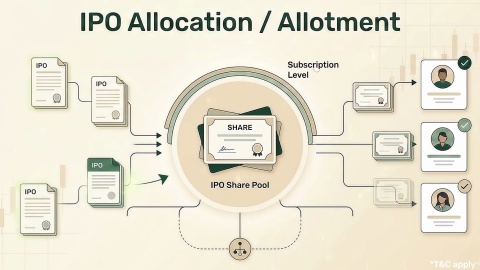
What is IPO Allocation
IPO allocation explains how shares offered through an Initial Public Offering (IPO) are distributed among eligible applicants. When an IPO receives more valid applications than the shares available, you may receive fewer shares than you applied for or no shares at all.
Here are the key points to remember:
- IPO allocation determines how available shares are distributed among eligible investors.
- The process can differ across retail, non-institutional, and qualified institutional investors.
- Oversubscription means that demand for shares is higher than the number of shares available.
- Retail investors may receive the minimum bid lot when the available retail shares are insufficient to satisfy all eligible applications.
- The final allotment depends on the applicable rules and the basis of allotment for that IPO.
As per SEBI's regulatory framework, at least 35% of the net offer is generally available for allocation to Retail Individual Investors in a book-built public issue, subject to the applicable conditions.
Understanding these rules can help you know what happens after you submit an IPO application and why the number of shares allotted may differ from the number you requested.
What is IPO allocation?
IPO allocation refers to the process of distributing the shares available in a public issue among eligible investors. An IPO allows a company to offer its shares to the public and raise capital.
The available shares are divided among different investor categories according to the issue structure and applicable regulations. The number of shares you receive depends on factors such as the number of valid applications, demand in your category, and the applicable basis of allotment.
What is oversubscription?
An IPO is oversubscribed when investors apply for more shares than are available.
For example, suppose an IPO offers 1,00,000 shares, but investors submit valid applications for 5,00,000 shares. The IPO is then oversubscribed five times.
The issuer cannot allot all 5,00,000 requested shares because only 1,00,000 shares are available. The available shares must therefore be distributed according to the applicable rules.
Allocation vs allotment
Allocation and allotment are closely related, but they are not exactly the same.
Allocation refers to the process of distributing the available shares among eligible applicants. Allotment refers to the final assignment of shares to successful applicants after the basis of allotment has been determined.
For example, you may apply for one lot in an IPO. The allocation process determines how the available shares are distributed within your investor category. The final allotment then confirms the number of shares assigned to you.
How IPO allocation works
The IPO allocation process depends on the issue structure, investor category, demand, and applicable regulatory requirements.
Step 1: You submit an IPO application
You submit your bid during the IPO bidding period. Your application states the number of shares or lots you want to apply for and the bid price, where applicable.
Step 2: Valid applications are considered
Once the IPO closes, the valid applications received from different investor categories are considered. Applications that do not meet the applicable requirements may not be included in the allotment process.
Step 3: Demand is compared with available shares
The number of shares investors have applied for is compared with the number available in each relevant category.
If demand is within the available quantity, eligible applicants may receive shares according to the terms of the issue.
If demand exceeds the available quantity, the issue is oversubscribed and the prescribed allotment process is followed.
Step 4: Shares are distributed according to the investor category
Different investor categories can have different allocation rules.
For book-built public issues, the SEBI framework provides for category-wise allocation. Not less than 35% of the net issue is generally available for Individual Investors, not less than 15% for Non-Institutional Investors, and not more than 50% for Qualified Institutional Buyers, subject to the applicable conditions.
Step 5: The basis of allotment is finalised
After the applicable process is completed, the basis of allotment is finalised. This determines how many shares are allotted to successful applicants.
Your final allotment may therefore be different from the number of shares you originally applied for.
How shares are allocated in an oversubscribed IPO
When an IPO is oversubscribed, there are more valid applications or bids than the shares available. The allocation process then depends on the investor category and applicable rules.
For Individual Investors, the allocation to each successful investor is not generally less than the minimum bid lot, subject to availability. Where the number of eligible applications exceeds the number of available lots, a computerised draw of lots can be used to determine successful applicants. SEBI-filed issue documents describe this mechanism for oversubscribed individual investor portions.
For Non-Institutional Investors and Qualified Institutional Buyers, the applicable rules can provide for proportionate allocation. The exact process should therefore be checked in the offer document for the specific IPO.
How is IPO allocation calculated?
There is no single formula that applies to every IPO.
The allocation depends on factors such as:
- The Number Of Shares Offered In The IPO.
- The Number Of Valid Applications Received.
- The Investor Category.
- The Number Of Shares Available In That Category.
- The Subscription Level.
- The Applicable Basis Of Allotment.
For example, under the current SEBI framework for a book-built public issue, not less than 35% of the net issue is generally available to Individual Investors, not less than 15% to Non-Institutional Investors, and not more than 50% to Qualified Institutional Buyers, subject to the applicable provisions.
The final allotment within each category is then determined according to the applicable rules and basis of allotment.
Example of IPO allocation
Consider a fictional company that offers 1,00,000 shares through an IPO. Investors collectively apply for 5,00,000 shares.
The IPO is oversubscribed five times because investors have applied for five times the number of shares available.
Now suppose Ravi applies for one lot in the Individual Investor category. If the number of eligible applications exceeds the number of available minimum lots, Ravi may receive the lot or may receive no shares, depending on the basis of allotment.
This is an illustrative example. The actual outcome depends on the issue structure, valid applications, shares available, and applicable regulations.
Why does IPO allocation matter?
IPO allocation matters because it determines how many shares you ultimately receive from a public issue.
Understanding the process can help you:
- Understand why you may receive fewer shares than you applied for.
- Understand why an oversubscribed IPO may result in no allotment.
- Understand how your investor category affects the allocation process.
- Read the basis of allotment for a specific IPO more clearly.
Avoid assuming that applying for more shares automatically guarantees a larger allotment.
IPO allocation does not guarantee that you will receive shares. It explains how the available shares are distributed under the applicable rules.
What factors affect IPO allocation?
Several factors can affect the number of shares you receive.
Investor category
IPO shares are distributed across categories such as Individual Investors, Non-Institutional Investors, and Qualified Institutional Buyers. Each category can have different allocation rules.
Subscription demand
The level of demand affects the allocation process. When applications significantly exceed the shares available in a category, investors may receive fewer shares than they requested or no shares.
Number of valid applications
The number of valid applications is relevant to the allotment process. Invalid applications may not be considered when determining the final allotment.
Shares available in the category
The number of shares reserved for a particular category determines the pool available for applicants in that category.
Basis of allotment
The basis of allotment explains how the available shares are distributed among eligible applicants. It depends on the IPO's structure and the applicable regulatory requirements.
What does the latest IPO allocation framework say?
SEBI regulates the framework governing public issues in India. The current framework provides category-wise allocation requirements for book-built public issues.
As reflected in SEBI-filed public issue documents in 2025, not less than 35% of the net issue was available for Individual Investors, not less than 15% for Non-Institutional Investors, and not more than 50% for Qualified Institutional Buyers, subject to valid bids and the applicable conditions.
The rules can also provide for sub-categories within the Non-Institutional Investor portion and specific mechanisms for the Individual Investor portion. For this reason, you should not assume that one allocation method applies to every IPO.
Always check the relevant offer document for the specific IPO before relying on a particular allocation percentage or allotment mechanism.
Common mistakes to avoid when applying for an IPO
Understanding the allocation process can help you avoid common assumptions.
- Do not assume that applying for more shares guarantees a larger allotment.
- Do not assume that every oversubscribed IPO uses the same allotment process.
- Do not treat allocation and allotment as identical terms.
- Do not assume that the subscription multiple tells you your exact allotment.
- Do not rely on generic allocation rules without checking the specific IPO's offer documents.
Explore Investment Tools
Articles and Insights




Frequently Asked Questions
Understanding IPO allocation
How the allotment process works
Understanding the outcome
What is a sensible equity allocation for a college student?
No. IPO allocation refers to the process of distributing available shares among eligible applicants. IPO allotment refers to the final assignment of shares to successful applicants after the basis of allotment has been determined.
What happens if an IPO is oversubscribed?
If an IPO is oversubscribed, investors have applied for more shares than are available. You may therefore receive fewer shares than you applied for or no shares. The outcome depends on your investor category and the applicable allotment rules.
Why do I receive fewer shares than I applied for?
You may receive fewer shares when demand is higher than the number of shares available in your investor category. The available shares are distributed according to the applicable basis of allotment.
Are IPO shares allotted through a lottery?
A computerised draw of lots can be used for the Individual Investor portion when the number of eligible applications exceeds the number of available minimum lots. However, this is not a universal allocation method for every investor category.
Does applying for more shares increase my chances of getting an IPO allotment?
Applying for more shares does not automatically guarantee an allotment or a larger allotment. The outcome depends on your investor category, demand, shares available, and the applicable allotment rules.
How is the final IPO allotment decided?
The final allotment is determined according to the basis of allotment applicable to the IPO. This takes into account the investor category, valid applications, shares available, and the regulatory and issue-specific rules.
Can I receive no shares after applying for an IPO?
Yes. If the relevant portion is oversubscribed and the number of eligible applicants is higher than the number of available lots or shares, you may receive no shares.
Where can I find the basis of allotment for an IPO?
The basis of allotment forms part of the IPO's allotment process. You should refer to the official information provided for the specific IPO and its registrar to understand how the shares were allotted.
Can the allocation process differ between IPOs?
Yes. The applicable process can differ depending on the issue structure, investor category, subscription level, and regulatory provisions. Check the offer document for the specific IPO for the applicable rules.
Disclaimer
Bajaj Finance Limited ("BFL") is registered with the Association of Mutual Funds in India ("AMFI") as a distributor of third party Mutual Funds (shortly referred as 'Mutual Funds) with ARN No. 90319
BFL does NOT:
(i) provide investment advisory services in any manner or form.
(ii) carry customized/personalized suitability assessment.
(iii) carry independent research or analysis, including on any Mutual Fund schemes or other investments; and provide any guarantee of return on investment.
In addition to displaying the Mutual fund products of Asset Management Companies, some general information is sourced from third parties, is also displayed on As-is basis, which should NOT be construed as any solicitation or attempt to effect transactions in securities or the rendering any investment advice. Mutual Funds are subject to market risks, including loss of principal amount and Investor should read all Scheme/Offer related documents carefully. The NAV of units issued under the Schemes of mutual funds can go up or down depending on the factors and forces affecting capital markets and may also be affected by changes in the general level of interest rates. The NAV of the units issued under the scheme may be affected, inter-alia by changes in the interest rates, trading volumes, settlement periods, transfer procedures and performance of individual securities forming part of the Mutual Fund. The NAV will inter-alia be exposed to Price/Interest Rate Risk and Credit Risk. Past performance of any scheme of the Mutual fund do not indicate the future performance of the Schemes of the Mutual Fund. BFL shall not be responsible or liable for any loss or shortfall incurred by the investors. There may be other/better alternatives to the investment avenues displayed by BFL. Hence, the final investment decision shall at all times exclusively remain with the investor alone and BFL shall not be liable or responsible for any consequences thereof.
Investment by a person residing outside the territorial jurisdiction of India is not acceptable nor permitted.
Disclaimer on Risk-O-Meter:
Investors are advised before investing to evaluate a scheme not only on the basis of the Product labeling (including the Riskometer) but also on other quantitative and qualitative factors such as performance, portfolio, fund managers, asset manager, etc, and shall also consult their Professional advisors, if they are unsure about the suitability of the scheme before investing.
Disclosure: Bajaj Finance Limited (BFL) is a distributor of Mutual Funds with ARN - 90319 and distributes mutual funds of Bajaj Finserv Asset Management Limited (BFSAMC). BFL receives commission towards distribution of mutual fund products. BFSAMC is a group company of BFL, carrying business on arm’s length basis without any conflict of interest and in accordance with the prevailing law / regulation.
Disclaimer
Bajaj Finance Limited ("BFL") is an NBFC offering loans, deposits and third-party wealth management products.
The information BFL contained in this article is for general informational purposes only and does not constitute any financial advice. The content herein has been prepared by BFL on the basis of publicly available information, internal sources and other third-party sources believed to be reliable. However, BFL cannot guarantee the accuracy of such information, assure its completeness, or warrant such information will not be changed.
This information should not be relied upon as the sole basis for any investment decisions. Hence, User is advised to independently exercise diligence by verifying complete information, including by consulting independent financial experts, if any, and the investor shall be the sole owner of the decision taken, if any, about suitability of the same.
Disclaimer
Mutual Fund SIP calculator may provide potential investors an approximate estimate on the maturity amount of the monthly SIP, purely based on mathematical calculation of the projected annual return rate selected by investor. However, such calculation does not factor the actual performance by the Asset Management Company (AMC) and should not be treated as any advice or assurance about the actual return of investment. Mutual Funds do not have a fixed rate of return and it is not possible to predict the rate of return. Please note that the SIP calculator are for illustrations only and do not represent actual returns which may vary depending on various factors including but not limited to actual performance, expense ratio, taxation, exit load (if any), etc.