





Tips to Maximise Suzuki e-ACCESS Range
Improve your Suzuki e-ACCESS range with efficient riding, smart charging, correct tyre pressure, and practical battery-care habits for daily commuting.


Key Specifications
-
Digital Instrument Console
-
LED Headlight
-
Tubeless Tyre Type
-
LED Tail Light
-
Combat Grey, Pearl Grace White, Pearl Jade Green Color

You may be eligible for a pre-approved offer
Quick approval | Flexible tenure options | Minimal paperwork
In summary
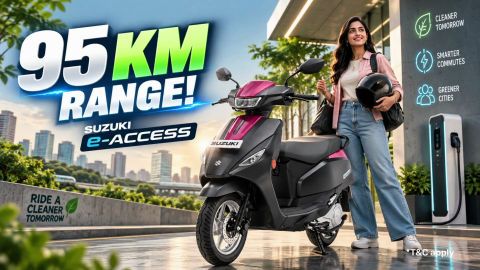
Suzuki e-ACCESS Smart Electric Mobility for Everyday Rides
Suzuki e-ACCESS range depends on riding mode, acceleration, traffic, load, and battery condition. Unlike petrol scooters, the e-ACCESS uses a rechargeable battery, so its efficiency is measured through electric range rather than petrol mileage.
- Battery: The Suzuki e-ACCESS uses a 3.072 kWh lithium iron phosphate (LFP) battery.
- Certified range: The scooter has a claimed Indian Driving Cycle (IDC) range of 95 km per full charge.
- Real-world range: An independent July 2026 test recorded 88.4 km in Ride A mode.
- Riding modes: Eco, Ride A, and Ride B offer different riding characteristics, with the two Ride modes differing in regenerative braking strength.
- Range improvement: Gentle acceleration, appropriate riding modes, correct tyre pressure, and sensible charging habits can help you manage battery consumption.
- Bajaj Finance Two-wheeler Loan amount: Rs. 35,000 to Rs. 21 lakh
If your current scooter no longer meets your commuting needs, explore the Bajaj Finance Two-wheeler Loan to understand financing options for an eligible replacement.
Last updated: 27th October, 2026
What is the Suzuki e-ACCESS range?
The Suzuki e-ACCESS has a claimed IDC range of 95 km on a full charge. In an independent real-world test conducted in July 2026, the scooter covered 88.4 km in Ride A mode. The tested scooter used its 3.072 kWh battery and stronger regenerative braking setting. Actual range may vary with riding mode, acceleration, road conditions, load, and weather.
| Range type | Suzuki e-ACCESS range |
|---|---|
| Claimed IDC range | 95 km |
| Independently tested mixed-route range | 88.4 km |
| Tested efficiency | 28.78 km/kWh |
The 88.4 km result was obtained through a controlled real-world evaluation, not a separate city-only or highway-only test. It should not be presented as two different results.
Pro tip: If your round-trip commute is 60 km, compare it with the scooter's remaining displayed range before leaving. Maintain an appropriate battery reserve rather than planning to use every kilometre of the claimed range.
Source: Autocar India (July 2026 real-world range test); Suzuki official product specifications (2026)
How can you maximise Suzuki e-ACCESS range?
-
1. Accelerate smoothly - Apply the accelerator gradually when starting from a stop. Sudden acceleration demands higher power from the battery, particularly during repeated stop-start journeys. The e-ACCESS provides smooth electric motor response, so you do not need to accelerate aggressively to keep pace with normal city traffic.
2. Maintain a steady riding speed - Try to maintain a consistent, safe speed where traffic permits. Frequent acceleration increases energy demand, while sustained high-speed riding can also reduce the distance available from a full charge. Avoid unnecessary speed changes on open roads and choose a pace appropriate to your surroundings.
3. Maintain correct tyre pressure - Underinflated tyres increase rolling resistance and can reduce electric range. Check tyre pressure when the tyres are cold and follow Suzuki's recommendations for your model and load. Remember to use the appropriate pressure when carrying a passenger. Do not overinflate tyres to extend range, as this can affect traction, ride comfort, and braking.
4. Follow the recommended service schedule - Electric scooters need regular inspection even though they do not require conventional petrol-engine servicing. Follow Suzuki's service schedule for brakes, tyres, steering, suspension, electrical connections, and drivetrain components. The e-ACCESS uses a belt-drive system, so have the belt inspected according to the manufacturer's guidance. Avoid assuming that an electric scooter requires no maintenance.
5. Use an appropriate riding mode - The e-ACCESS offers Eco, Ride A, and Ride B modes. Eco provides gentler performance and is useful when extending range is more important than stronger acceleration. Ride A and Ride B offer the same peak power but use different regenerative braking settings. Ride A provides stronger regenerative braking. Select the mode that suits traffic conditions and your riding needs. Switch between Ride A and Ride B only when stationary, as required by the scooter's controls.
6. Maintain the battery and charging equipment - Use Suzuki-approved charging equipment and follow the charging instructions in the owner's manual. The e-ACCESS has an LFP battery, which differs in chemistry from many nickel-based electric scooter batteries. Avoid exposing charging equipment to water, damaged connections, or unsuitable electrical sockets. Do not attempt to open or repair the high-voltage battery yourself. Have battery-related problems inspected by an authorised technician.
7. Use regenerative braking sensibly - Regenerative braking allows the electric motor to recover some energy during deceleration. On the e-ACCESS, Ride A provides stronger regenerative braking than Ride B. Anticipate traffic and slow down progressively where safe. However, regenerative braking cannot recover all the energy used during acceleration. Always use the mechanical brakes whenever necessary. Never delay braking to improve range.
8. Avoid carrying unnecessary weight - Additional weight increases the energy needed during acceleration and uphill riding. Remove luggage you do not need and secure the items you carry. If you regularly travel with a pillion, account for the additional load when planning your charging stops. Follow Suzuki's permitted load limits and never overload the scooter.
9. Plan journeys and charging stops - Check the remaining battery percentage and estimated range before longer journeys. For example, if your intended journey is 70 km, do not assume the 95 km certified range will always be available in daily conditions. Traffic, road gradients, temperature, and riding speed may reduce your actual range. Plan a charging opportunity where possible and maintain sufficient charge to complete the journey safely.
10. Monitor your range regularly - Record the distance travelled and the battery percentage used across familiar routes. For more accurate comparisons, note the riding mode, traffic conditions, passenger load, and charging pattern. If the scooter begins showing a repeated reduction in range under similar conditions, arrange a battery and vehicle inspection. A single lower-range journey does not necessarily indicate battery deterioration.
How can you calculate Suzuki e-ACCESS efficiency accurately?
Electric efficiency = Distance travelled ÷ Battery energy consumed
Suzuki e-ACCESS efficiency is measured in kilometres per kilowatt-hour (km/kWh), while electric range represents the distance the scooter can travel on a charge.
To measure practical efficiency:
- Charge the scooter to a known battery percentage.
- Reset the trip meter or note the odometer.
- Select your usual riding mode.
- Complete your normal journey.
- Record the distance travelled.
- Record the change in battery charge.
- Estimate energy consumed using the battery capacity and percentage used.
- Divide the distance by the estimated energy consumption and repeat across several journeys.
Example: Suppose your e-ACCESS travels 60 km and uses an estimated 2 kWh of battery energy.
Efficiency = 60 km ÷ 2 kWh = 30 km/kWh
At that hypothetical efficiency, a 3.072 kWh battery would provide approximately 92.2 km of calculated range if the entire nominal capacity were usable. This example is illustrative, not an independently measured range result.
Battery percentage readings are approximate, and nominal capacity may differ from usable energy. Measuring several journeys gives a more useful picture of your real-world efficiency.
How much can better Suzuki e-ACCESS range save?
If you travel 1,000 km monthly, improving your electric efficiency from an illustrative 25 km/kWh to 30 km/kWh would reduce the calculated battery-energy cost by approximately Rs. 67 per month, assuming electricity costs Rs. 10 per kWh.
The following table compares different efficiency assumptions.
| Efficiency assumption | Battery energy for 1,000 km | Monthly energy cost |
|---|---|---|
| 25 km/kWh | 40.00 kWh | Rs. 400 |
| 28 km/kWh | 35.71 kWh | Rs. 357 |
| 30 km/kWh | 33.33 kWh | Rs. 333 |
| 32 km/kWh | 31.25 kWh | Rs. 313 |
Monthly battery-energy cost = Monthly distance ÷ Electric efficiency × Electricity tariff
These are illustrative calculations based on battery energy consumption. Actual electricity drawn from the socket can be higher because charging is not perfectly efficient. Fixed electricity charges, if applicable, are also excluded.
The improvement from 25 km/kWh to 30 km/kWh would save approximately Rs. 800 annually in the illustrative calculation. The larger benefit of efficient riding may be the additional distance available between charges, rather than a substantial reduction in the electricity bill.
What are Suzuki e-ACCESS specifications?
When should you get your Suzuki e-ACCESS checked?
Get your Suzuki e-ACCESS checked if its range declines repeatedly under similar riding conditions, charging takes unusually long, or battery-related warnings appear. Electric scooters can show range changes because of temperature, load, traffic, and riding mode. However, a persistent decline deserves an inspection.
| Warning sign | What to check |
|---|---|
| Range falls repeatedly | Battery health, tyre pressure, and drivetrain resistance |
| Charging stops unexpectedly | Charger, charging port, electrical supply, and connections |
| Charging takes unusually long | Charger performance, supply voltage, and battery management |
| Unusual drivetrain noise | Motor, belt drive, and related components |
| Scooter feels difficult to move | Tyre pressure, brakes, and wheel bearings |
| Sudden loss of performance | Battery charge, temperature, and electronic control systems |
| Warning light appears | Battery management and diagnostic fault codes |
Do not attempt high-voltage electrical repairs yourself. Arrange an inspection through an authorised Suzuki service facility, especially when charging or battery warnings are involved.
When should you consider replacing your Suzuki e-ACCESS?
Consider replacing your Suzuki e-ACCESS when recurring repair expenses, reduced reliability, or changing travel needs make continued ownership impractical. A modest difference between certified and actual range does not justify replacement.
For example, consider Kavya, a 34-year-old graphic designer in Hyderabad who travels 32 km daily for 25 working days. Her monthly distance is 800 km. Suppose her existing electric scooter delivers an illustrative 25 km/kWh, while a potential replacement delivers 30 km/kWh under comparable conditions.
At an assumed electricity tariff of Rs. 10 per kWh, the calculated battery-energy expenses would be:
| Expense | Existing scooter | Replacement scooter |
|---|---|---|
| Monthly travel | 800 km | 800 km |
| Illustrative efficiency | 25 km/kWh | 30 km/kWh |
| Battery energy consumed | 32.00 kWh | 26.67 kWh |
| Monthly battery-energy cost | Rs. 320 | Rs. 267 |
Kavya would save approximately Rs. 53 per month, or Rs. 640 annually, before charging losses.
These figures are hypothetical and do not represent independently tested performance for the existing or replacement scooter. Such a small saving would not normally justify purchasing another vehicle. If Kavya's travel requirements increase significantly or her scooter develops persistent battery or charging problems, replacement may become worth considering.
Before deciding, she should investigate repair options, battery warranty coverage, expected replacement costs, and the total expense of another scooter.
How Bajaj Finance Two-wheeler Loan can help
If your Suzuki e-ACCESS no longer meets your travel requirements, a Bajaj Finance Two-wheeler Loan may help finance an eligible replacement electric or petrol-powered two-wheeler. Review the loan details before choosing a replacement and estimating your monthly repayments.
| Loan detail | Bajaj Finance Two-wheeler Loan |
|---|---|
| Loan amount | Rs. 35,000 to Rs. 21 lakh |
| Maximum financing | Up to 100% of the on-road price |
| Repayment tenure | 6 months to 84 months |
| Interest rate | Up to 24.25% p.a. |
Last updated: 27th October, 2026
Loan availability for a selected vehicle and the applicable financing terms depend on eligibility, product coverage, and lender assessment.
What could a replacement electric scooter EMI look like?
Suppose Kavya considers purchasing an eligible replacement scooter and needs a loan of Rs. 60,000. Assume a repayment tenure of 24 months and an illustrative annual interest rate of 12%. The equated monthly instalment
(EMI) is calculated using the reducing-balance formula:
EMI = [P × R × (1 + R)^N] ÷ [(1 + R)^N − 1]
Where:
- P = Loan amount
- R = Monthly decimal interest rate
- N = Number of monthly instalments
For this calculation:
P = Rs. 60,000
R = 12 ÷ 12 ÷ 100 = 0.01
N = 24 months
The estimated repayment is shown below.
| EMI calculation detail | Illustrative amount |
|---|---|
| Loan amount | Rs. 60,000 |
| Annual interest rate | 12% |
| Repayment tenure | 24 months |
| Monthly EMI | Rs. 2,824 |
| Total repayment | Rs. 67,786 |
| Total interest | Rs. 7,786 |
Last updated: 27th October, 2026
The total repayment uses the unrounded EMI. The example is illustrative, excludes applicable fees and charges, and does not represent an approved loan offer.
Kavya's hypothetical electricity saving of Rs. 53 per month is much smaller than the estimated Rs. 2,824 EMI. She should therefore evaluate the replacement based on reliability, battery condition, travel requirements, and affordability.
Use the two-wheeler loan EMI calculator to compare monthly instalments before applying. After choosing an eligible replacement, check your pre-approved loan offer to explore available financing options.
What is the eligibility for a Bajaj Finance Two-wheeler Loan?
For a Bajaj Finance Two-wheeler Loan, the required CIBIL Score is 600 or above.
Quick definition: Credit Information Bureau (India) Limited Score (CIBIL Score) is a three-digit credit score ranging from 300 to 900. It reflects your credit history and repayment behaviour.
The basic requirements are:
- Nationality: Indian
- Age: 18 years to 70 years
- CIBIL Score: 600 or above
The maximum age applies at loan maturity.
Meeting these conditions does not guarantee approval. Your income, repayment history, and other applicable checks may affect the financing terms offered.
You may need identification and address information, including Aadhaar and Permanent Account Number (PAN) details. Income-related documents may be requested depending on your application. Review the complete two-wheeler loan eligibility requirements before proceeding.
Compare with similar products
Suzuki E Access STD (Pearl Jade Green)

Honda Activa e STD (Pearl Igneous Black)

BGauss C12i Ex (Pearl White)
EMI
₹2,805/ mo
₹1,796/ mo
₹1,513/ mo
Brand Name
Suzuki
Honda
BGauss
Color
Pearl Jade Green
Pearl Igneous Black
Pearl White
Rear Wheel Brake
Drum
Drum
Drum
Front Wheel Brake
Disc
Disc
Drum
Speedometer
Digital
Digital
Digital
Wheel Type
Tubeless
Tubeless
Tubeless
Compare other products with Suzuki E-Access
Find your nearest dealer

What are you looking for
Bike
Scooters
Electric Scooters
Popular two-wheelers
What our customers say about us
Kushal K
Reviewed on 04 Mar 2026
I applied for a Bajaj Finance two-wheeler loan last month and was surprised at how fast the approval came through. The process was simple, and I was riding my new bike within a week. Very happy with the service.
Vikram
Reviewed on 10 Jan 2026
This was my first loan, so I was nervous, but Bajaj Finance made it easy. The staff guided me step by step, and now I own my bike without any hassle. Highly recommend them.
Mamtha
Reviewed on 25 Dec 2025
The EMI options were flexible enough to fit my monthly budget. I didn’t feel pressured, and the repayment plan was explained clearly. It made buying my scooter stress-free.
Vishal
Reviewed on 05 Jan 2026
I liked that there were no hidden charges. Everything was transparent from the start, and the loan disbursal was quick. Bajaj Finance made the whole experience smooth.
Explore other brands











Related articles

Bajaj Finance app for all your financial needs and goals
Trusted by 50 million+ customers in India, Bajaj Finance App is a one-stop solution for all your financial needs and goals.
You can use the Bajaj Finance App to:
- Apply for loans online, such as Instant Personal Loan, Home Loan, Business Loan, Gold Loan, and more.
- Invest in fixed deposits and mutual funds on the app.
- Choose from multiple insurance for your health, motor and even pocket insurance, from various insurance providers.
- Pay and manage your bills and recharges using the BBPS platform. Use Bajaj Pay and Bajaj Wallet for quick and simple money transfers and transactions.
- Apply for Insta EMI Card and get a pre-qualified limit on the app. Explore over 1 million products on the app that can be purchased from a partner store on Easy EMIs.
- Shop from over 100+ brand partners that offer a diverse range of products and services.
- Use specialised tools like EMI calculators, SIP Calculators
- Check your credit score, download loan statements and even get quick customer support—all on the app.
Download the Bajaj Finance App today and experience the convenience of managing your finances on one app.
Frequently asked questions about Suzuki e-ACCESS mileage
Overview
Repayment
Does Eco mode increase Suzuki e-ACCESS range?
Eco mode can help the Suzuki e-ACCESS travel farther on a charge by providing gentler performance and limiting power demand. However, the actual improvement depends on your riding habits, traffic, gradients, and passenger load. There is no guaranteed percentage increase. Use Eco when its available performance suits the route, and switch to a suitable Ride mode when road conditions require different acceleration characteristics.
Does regenerative braking fully recharge the Suzuki e-ACCESS battery?
No. Regenerative braking recovers some energy when the scooter slows down, but it cannot replace charging from an external electricity supply. On the e-ACCESS, Ride A provides stronger regenerative braking than Ride B. The amount recovered depends on speed, deceleration, and battery conditions. Always use the mechanical brakes whenever required and avoid unnecessary acceleration simply to recover energy while slowing down.
How can I tell whether my Suzuki e-ACCESS battery range is declining?
Track the distance covered between charges on familiar routes while recording battery percentage, riding mode, load, and weather conditions. Compare several journeys rather than relying on a single low-range reading. If range falls repeatedly without a clear explanation, arrange an authorised service inspection. Battery temperature, electronic controls, tyre pressure, or mechanical resistance may affect results, so reduced range does not automatically mean the battery needs replacement.
Should I finance another electric scooter if my e-ACCESS range becomes insufficient?
First, check whether a different charging routine, route, or riding mode could meet your travel requirements. If your commute regularly exceeds the practical range available, compare replacement vehicles and their charging needs. Financing may help distribute the purchase cost, but you must account for interest, applicable charges, and monthly instalments. Replacing a working electric scooter solely for small electricity savings may not be financially worthwhile.
How much down payment should I pay when buying an electric scooter?
Your down payment depends on the selected scooter's on-road price, approved financing amount, and available savings. Paying more upfront generally lowers the amount borrowed and may reduce monthly instalments and total interest. However, retain money for charging arrangements, insurance, maintenance, and emergencies. Compare repayment terms carefully and confirm that the chosen electric scooter is eligible for financing before making your purchase decision.
Disclaimer
1. Bajaj Finance Limited (“BFL”) is a Non-Banking Finance Company (NBFC) and Prepaid Payment Instrument Issuer offering financial services viz., loans, deposits, Bajaj Pay Wallet, Bajaj Pay UPI, bill payments and third-party wealth management products. The details mentioned in the respective product/ service document shall prevail in case of any inconsistency with respect to the information referring to BFL products and services on this page.
2. All other information, such as, the images, facts, statistics etc. (“information”) that are in addition to the details mentioned in the BFL’s product/ service document and which are being displayed on this page only depicts the summary of the information sourced from the public domain. The said information is neither owned by BFL nor it is to the exclusive knowledge of BFL. There may be inadvertent inaccuracies or typographical errors or delays in updating the said information. Hence, users are advised to independently exercise diligence by verifying complete information, including by consulting experts, if any. Users shall be the sole owner of the decision taken, if any, about suitability of the same.