





Jawa Bikes Mileage: Model-wise Comparison
Jawa bikes offer mileage figures that vary by model, engine and riding conditions. Compare their fuel efficiency and estimated running costs before buying.


Key Specifications
-
Digital Instrument Console
-
LED Headlight
-
Tubeless Tyre Type
-
LED Tail Light
-
Mystique Copper, Cosmic Carbon, Nebula Blue Color

You may be eligible for a pre-approved offer
Quick approval | Flexible tenure options | Minimal paperwork
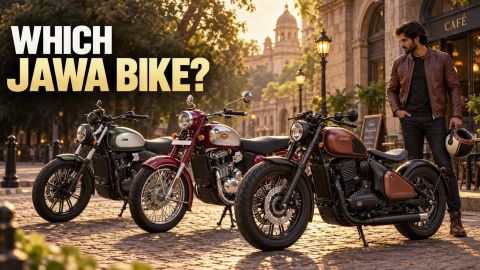
Jawa Bikes Classic Styling with Everyday Performance
In summary
Jawa motorcycles appeal to riders who enjoy classic design and responsive petrol engines. Their mileage varies across models, so comparing fuel efficiency alongside performance and comfort helps you choose a motorcycle that suits your daily travel.
- Mileage benchmark: The earlier Jawa 42 has a published ARAI-claimed mileage of 33 kmpl.
- Engine range: Jawa models use engines ranging from approximately 295cc to 334cc.
- Performance: The 42 FJ focuses on stronger acceleration, while the Jawa 350 prioritises a relaxed riding character.
- Transmission: Jawa motorcycles feature 6-speed gearboxes across the models discussed.
- Bajaj Finance Two-wheeler Loan amount: Rs. 35,000 to Rs. 21 lakh
If you are considering a purchase, a Bajaj Finance Two-wheeler Loan can help spread the purchase expense across monthly instalments.
Last updated: 12th October, 2026
What is the mileage of Jawa bikes?
The mileage of Jawa bikes differs depending on engine capacity, tuning, motorcycle weight and riding conditions. The earlier Jawa 42 has a published Automotive Research Association of India (ARAI)-claimed figure of 33 kmpl, while other Jawa models have different fuel-efficiency references. Some published figures relate to older model years rather than the latest models, so checking the exact version and testing method is essential.
| Jawa motorcycle | Engine capacity | Mileage reference |
|---|---|---|
| Jawa 42 (earlier model) | 294.72cc | 33 kmpl, ARAI-claimed |
| Jawa 42 FJ (earlier listing) | 334cc | 32 kmpl, previously published ARAI-claimed figure |
| Jawa 350 | 334cc | Model-specific certified figure not established |
| Jawa 42 Bobber (earlier model) | 334cc | Approximately 30.56 kmpl, published reference figure |
| Jawa Perak | 334cc | Model-specific certified figure not established |
→ Pro tip: Check whether the mileage figure belongs to the exact model year and engine version you intend to buy. Updated motorcycles, including the All Star 42, All Stars 42 FJ and All Stars 42 Bobber, should not automatically inherit mileage figures from their predecessors.
How does Jawa mileage differ between models?
Two Jawa motorcycles with similar engine capacities may deliver different fuel efficiency. Engine tuning, gearing, weight and intended riding character can all influence the result. Understanding the differences between models is therefore more helpful than assuming every 334cc Jawa will consume the same amount of petrol.
- Jawa 42 mileage - The earlier Jawa 42 has a published ARAI-claimed mileage of 33 kmpl. Its 294.72cc engine and 6-speed gearbox make it relevant to riders looking for retro styling alongside regular commuting. However, the earlier Jawa 42 and the newer All Star 42 should not be treated as identical listings. Verify the precise model and applicable mileage data before estimating your long-term fuel expenses.
- Jawa 350 mileage - The Jawa 350 uses a 334cc engine and takes a more traditional roadster approach. It is relevant to buyers who value relaxed riding, classic proportions and everyday usability. Your fuel expenses will depend on how often you ride through traffic, carry a pillion or travel on open roads. Use mileage data specific to the Jawa 350 rather than borrowing the earlier Jawa 42's certified figure.
- Jawa 42 FJ mileage - The Jawa 42 FJ uses a 334cc engine with a more performance-focused character. Earlier published information has quoted 32 kmpl, although this figure should not be assumed to apply automatically to every subsequent model update. The FJ may appeal to riders who want stronger acceleration and a more contemporary interpretation of Jawa styling. Consider its power delivery and riding position alongside fuel economy.
- Jawa 42 Bobber mileage - The earlier Jawa 42 Bobber has a published mileage reference of approximately 30.56 kmpl. Its low seating position and bobber design make it different from the brand's conventional roadsters. The Bobber's styling and seating arrangement may matter more to its target buyer than achieving the highest mileage. Check the exact version, especially when comparing an older 42 Bobber with a newer All Stars 42 Bobber.
- Jawa Perak mileage - The Jawa Perak is another bobber-style motorcycle powered by a 334cc engine. It is designed for a distinctive, low-slung riding experience rather than conventional commuter practicality. Fuel efficiency should be evaluated alongside its riding position and suitability for your regular journeys. If you need a motorcycle for frequent two-person travel, seating arrangements should be a major part of your decision.
What is the real mileage of Jawa bikes?
Real-world mileage changes according to the route, riding speed, traffic density and mechanical condition of the motorcycle. A certified or manufacturer-claimed mileage figure provides a comparison benchmark. It does not guarantee that you will achieve the same result during every journey.
- Jawa bikes city mileage - City riding can place greater demands on fuel consumption because the engine repeatedly accelerates from low speeds. Traffic lights, congestion and frequent braking make steady riding difficult. A daily route with fewer interruptions may therefore deliver better mileage than a shorter journey through severe congestion.
- Jawa bikes highway mileage - Highway conditions often allow more consistent throttle use and fewer gear changes. This can support improved efficiency compared with heavy urban traffic. However, high cruising speeds, repeated overtaking, strong headwinds and additional luggage may increase petrol consumption. There is no single city or highway mileage figure that applies accurately to every Jawa model. Compare instrumented figures for the exact motorcycle wherever reliable testing is available.
How much do Jawa bikes cost to run monthly?
Monthly fuel expenses depend on how far you travel and how much petrol your motorcycle consumes. To illustrate the difference, consider three mileage scenarios of 28 kmpl, 30 kmpl and 33 kmpl, assuming petrol costs Rs. 110 per litre. These are calculation assumptions rather than certified mileage claims for the entire Jawa range.
| Monthly distance | At 28 kmpl | At 30 kmpl | At 33 kmpl |
|---|---|---|---|
| 500 km | Rs. 1,964 | Rs. 1,833 | Rs. 1,667 |
| 1,000 km | Rs. 3,929 | Rs. 3,667 | Rs. 3,333 |
| 1,500 km | Rs. 5,893 | Rs. 5,500 | Rs. 5,000 |
For someone travelling 1,000 km monthly, the difference between 28 kmpl and 33 kmpl is approximately Rs. 596 in petrol expenses under these assumptions. Remember that insurance, servicing, replacement tyres and other maintenance requirements also affect the total cost of riding.
You can calculate your own estimate using:
Monthly fuel cost = Monthly distance ÷ Mileage × Petrol price
For better planning, use a mileage figure that reflects your likely riding conditions rather than relying only on the highest published number.
What factors affect Jawa bikes mileage?
Motorcycles with similar engine capacities do not always consume identical amounts of fuel. Even the same motorcycle can deliver different mileage on separate journeys.
Several factors influence the amount of petrol your Jawa uses:
- Traffic density: Repeated stopping and acceleration can increase consumption.
- Engine speed: Unnecessary high-rev riding requires additional fuel.
- Throttle inputs: Aggressive acceleration can reduce efficiency.
- Motorcycle weight: Additional load makes the engine work harder, especially on gradients.
- Tyre pressure: Underinflated tyres increase rolling resistance.
- Road gradients: Climbing hills requires more engine effort than travelling on level roads.
- Drivetrain maintenance: An improperly maintained chain can introduce avoidable resistance.
- Service condition: Engine oil, filters and other maintained components influence how efficiently the motorcycle operates.
The impact of these factors depends on the model and your riding pattern. A weekend highway rider may experience different fuel consumption from someone covering the same distance in dense city traffic.
How can you improve Jawa bikes mileage?
A Jawa motorcycle can deliver more consistent fuel efficiency when you combine appropriate riding habits with regular maintenance. Focus on the following practices rather than attempting to achieve a particular mileage number on every journey.
- Build speed progressively: Avoid abrupt throttle movements when leaving traffic signals.
- Anticipate traffic: Maintain adequate following distance and avoid unnecessary braking.
- Shift gears appropriately: Use a gear suitable for your speed and engine load.
- Check tyre pressure: Follow the recommended figures for solo or loaded riding.
- Maintain the drive chain: Inspect lubrication and adjustment as specified by the manufacturer.
- Follow service intervals: Replace or inspect consumables according to the recommended schedule.
- Avoid excess luggage: Carry only what you need for the journey.
- Reduce unnecessary idling: Switch off the engine during extended stops when safe and appropriate.
Good riding habits may also reduce avoidable wear on tyres, brakes and other components. Consistency is more useful than trying to maximise efficiency through unsafe riding speeds.
What are the Jawa bikes specifications?
Which Jawa motorcycle should you consider?
The right Jawa depends on how frequently you ride, whether you carry a pillion and how much value you place on styling versus fuel economy.
Consider Arjun, a 31-year-old graphic designer living in Jaipur. His regular commute is around 24 km per working day, and he occasionally rides beyond the city at weekends.
Arjun prefers a classic-looking motorcycle but does not want petrol expenses to disrupt his monthly budget. Assuming 25 commuting days, he covers 600 km monthly before adding weekend journeys.
At an illustrative 30 kmpl and petrol priced at Rs. 110 per litre, his commuting fuel expense would be about Rs. 2,200 per month. If his chosen motorcycle delivers 28 kmpl instead, the expense increases to approximately Rs. 2,357.
For Arjun, the Jawa 42 family may be a sensible starting point because he wants regular usability alongside retro design. However, he should verify the available model, test its riding position and confirm current fuel-efficiency information.
The other Jawa motorcycles address different needs:
- Jawa 350: Consider it if you prefer a traditional roadster and relaxed riding experience.
- Jawa 42 FJ: Explore it if stronger acceleration and sportier styling matter more.
- Jawa 42 Bobber: Consider it if low-slung design and individual styling are your priorities.
- Jawa Perak: Evaluate it if you specifically want a distinctive bobber-style motorcycle.
If minimum fuel consumption is your main priority, smaller commuter motorcycles may offer a better match. The most sensible purchase is one that suits your riding habits, ownership budget and seating requirements, not necessarily the model with the highest advertised mileage.
How Bajaj Finance Two-wheeler Loan can help
Choosing a Jawa involves balancing your preferred motorcycle with the total amount you can comfortably spend. Alongside petrol and servicing, consider the down payment and monthly equated monthly instalments (EMIs). A Bajaj Finance Two-wheeler Loan can help eligible buyers finance their purchase without paying the entire on-road amount upfront, subject to approval and applicable terms.
| Loan detail | Bajaj Finance Two-wheeler Loan |
|---|---|
| Loan amount | Rs. 35,000 to Rs. 21 lakh |
| Maximum financing | Up to 100% of the on-road price |
| Repayment tenure | 6 months to 84 months |
| Interest rate | Up to 24.25% p.a. |
Last updated: 12th October, 2026
→ Pro tip: Compare the total repayment amount, not just the monthly instalment. A longer tenure can reduce your EMI, but it may increase the total interest paid over the loan period. Use the two-wheeler loan EMI calculator to examine different borrowing amounts and repayment periods. Once you have estimated your expenses, check your pre-approved loan offer to understand whether an offer is available for your profile.
What is the eligibility for a Bajaj Finance Two-wheeler Loan?
For a Bajaj Finance Two-wheeler Loan, the required CIBIL Score is 600 or above.
→ Quick definition: Credit Information Bureau (India) Limited Score (CIBIL Score) is a three-digit credit score ranging from 300 to 900. It reflects your credit history and repayment behaviour.
The eligibility requirements are:
- Nationality: Indian
- Age: 18 years to 70 years
- CIBIL Score: 600 or above
The maximum age limit applies at the time of loan maturity.
Meeting the minimum two-wheeler loan eligibility requirements does not guarantee approval. Your income, credit history, submitted documents and overall loan assessment will also influence the decision. You may need identity documents such as Aadhaar, passport, voter ID or driving licence, along with your Permanent Account Number (PAN) card. Depending on your employment profile, an employee ID card, the latest month's salary slip and bank statements for the previous three months may also be required. Additional documents, where applicable, will be communicated during the application process.
Compare with similar products

Jawa 42 Double Disc BS6 (All Star Black)

Royal Enfield Hunter 350 Base (Factory Black)

Royal Enfield Goan Classic 350 Single Tone (Shack Black)
EMI
₹3,619/ mo
₹2,737/ mo
₹3,639/ mo
Brand Name
Jawa
Royal
Royal
Color
All Star Black
Factory Black
Shack Black
Rear Wheel Brake
Drum
Drum
Disc
Front Wheel Brake
Disc
Disc
Disc
Speedometer
Analogue And Digital
Analogue and Digital
Analogue and Digital
Wheel Type
Tubed
Tubeless
Tubeless
Compare other products with Jawa Bikes
Find your Nearest Dealer

What are you looking for
Bike
Scooters
Electric Scooters
Popular two-wheelers
What our customers say about us
Kushal K
Reviewed on 04 Mar 2026
I applied for a Bajaj Finance two-wheeler loan last month and was surprised at how fast the approval came through. The process was simple, and I was riding my new bike within a week. Very happy with the service.
Vikram
Reviewed on 10 Jan 2026
This was my first loan, so I was nervous, but Bajaj Finance made it easy. The staff guided me step by step, and now I own my bike without any hassle. Highly recommend them.
Mamtha
Reviewed on 25 Dec 2025
The EMI options were flexible enough to fit my monthly budget. I didn’t feel pressured, and the repayment plan was explained clearly. It made buying my scooter stress-free.
Vishal
Reviewed on 05 Jan 2026
I liked that there were no hidden charges. Everything was transparent from the start, and the loan disbursal was quick. Bajaj Finance made the whole experience smooth.
Explore other brands







Related articles

Bajaj Finance app for all your financial needs and goals
Trusted by 50 million+ customers in India, Bajaj Finance App is a one-stop solution for all your financial needs and goals.
You can use the Bajaj Finance App to:
- Apply for loans online, such as Instant Personal Loan, Home Loan, Business Loan, Gold Loan, and more.
- Invest in fixed deposits and mutual funds on the app.
- Choose from multiple insurance for your health, motor and even pocket insurance, from various insurance providers.
- Pay and manage your bills and recharges using the BBPS platform. Use Bajaj Pay and Bajaj Wallet for quick and simple money transfers and transactions.
- Apply for Insta EMI Card and get a pre-qualified limit on the app. Explore over 1 million products on the app that can be purchased from a partner store on Easy EMIs.
- Shop from over 100+ brand partners that offer a diverse range of products and services.
- Use specialised tools like EMI calculators, SIP Calculators
- Check your credit score, download loan statements and even get quick customer support—all on the app.
Download the Bajaj Finance App today and experience the convenience of managing your finances on one app.
Frequently asked questions
Overview
Repayment
What is the average mileage of Jawa bikes?
Jawa bike mileage depends on the specific model and engine configuration. The earlier Jawa 42 has a published ARAI-claimed mileage of 33 kmpl, while other models have different mileage references. There is no single certified average that applies to the entire range. Check whether a figure relates to your chosen model and whether it represents certified testing or another measurement method.
Which Jawa bike should I consider for daily commuting?
The Jawa 42 family can be worth evaluating if you want retro styling with regular commuting usability. The Jawa 350 offers a more traditional roadster character, while the 42 FJ places greater emphasis on performance. Compare the current versions, seat comfort, weight, traffic handling and available mileage evidence. A short test ride over familiar roads can help you judge everyday suitability.
Do Jawa bikes deliver better mileage on highways?
Jawa motorcycles may consume less petrol on open roads when you maintain a steady, appropriate speed. City traffic often involves frequent stops, gear changes and acceleration, which can increase consumption. However, sustained high-speed riding can reduce highway efficiency. The size of any mileage difference depends on the specific Jawa model, road conditions, motorcycle load and your riding habits rather than one brand-wide figure.
Can I purchase a Jawa bike using a two-wheeler loan?
Yes. Eligible customers can apply for a Bajaj Finance Two-wheeler Loan to purchase a Jawa motorcycle, subject to model availability and approval. Financing may cover up to 100% of the on-road price. Your eligibility depends on factors including age, income, credit profile and documents. Review the applicable requirements and assess your expected monthly fuel and maintenance expenses before borrowing.
How can I choose a suitable repayment tenure for my Jawa bike?
Start with the monthly amount you can afford after accounting for petrol, maintenance, insurance and household expenses. Available repayment tenures range from 6 months to 84 months, subject to eligibility. A longer tenure may reduce your EMI but increase total interest. Compare different borrowing amounts and repayment schedules before choosing an option that fits your regular cash flow.
Disclaimer
1. Bajaj Finance Limited (“BFL”) is a Non-Banking Finance Company (NBFC) and Prepaid Payment Instrument Issuer offering financial services viz., loans, deposits, Bajaj Pay Wallet, Bajaj Pay UPI, bill payments and third-party wealth management products. The details mentioned in the respective product/ service document shall prevail in case of any inconsistency with respect to the information referring to BFL products and services on this page.
2. All other information, such as, the images, facts, statistics etc. (“information”) that are in addition to the details mentioned in the BFL’s product/ service document and which are being displayed on this page only depicts the summary of the information sourced from the public domain. The said information is neither owned by BFL nor it is to the exclusive knowledge of BFL. There may be inadvertent inaccuracies or typographical errors or delays in updating the said information. Hence, users are advised to independently exercise diligence by verifying complete information, including by consulting experts, if any. Users shall be the sole owner of the decision taken, if any, about suitability of the same.