








Rs. 1 lakh – Rs. 2.50 crore
Check your pre-approved offer and other benefits
Enter mobile and OTP | Check offer | Know your exact loan terms
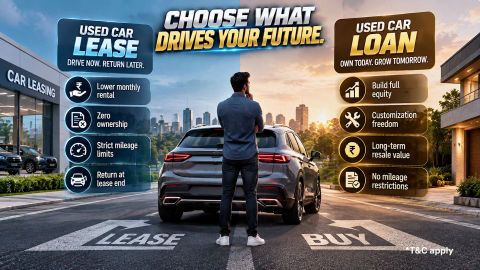
Leasing vs Buying Used Car on Loan
In summary
The key difference between leasing and buying is what happens after the payment period ends.
- Ownership: Leasing provides vehicle usage under a contract, while buying leads to ownership
- Contract conditions: A lease can set limits around usage, maintenance, damage, and vehicle return
- Loan tenure: Bajaj Finance Used Car Loan offers 12 months to 84 months
- Long-term value: A purchased car remains an asset you can continue using or sell after repayment
- Cost comparison: Look at total payments, maintenance, expected usage, and end-of-term value rather than monthly outgo alone
Choose according to how long you expect to use the car and whether temporary access or eventual ownership matters more to you.
Last updated: 29 September 2026
What is the difference between leasing and buying?
Leasing gives you contractual use of a vehicle, while buying with a loan means purchasing the car and repaying the financed amount over time.
Under a lease, you use the vehicle for the agreed period and follow the conditions in the contract. At the end, you normally return the vehicle unless the agreement provides another option.
When you buy a used car with a loan, you purchase the vehicle in your name, subject to the applicable financing and hypothecation arrangement.
After completing repayment and the required hypothecation-removal formalities, the car remains yours to keep, use, or sell.
How does used car leasing work?
A used-car lease lets you use a pre-owned vehicle for an agreed period without purchasing it outright.
The lease agreement determines the rental, tenure, permitted usage, maintenance responsibilities, vehicle-return conditions, and other obligations.
These terms matter because leasing arrangements can differ substantially. One agreement can include certain maintenance services, while another places those costs on the customer. Mileage or usage restrictions can also differ.
Before entering a lease, check:
- Total rental payable over the contract
- Initial deposit or payment, where applicable
- Usage or mileage conditions
- Servicing and maintenance responsibility
- Insurance responsibility
- Damage or return standards
- Early-termination conditions
- Options available when the lease ends
The monthly rental alone does not tell you the complete cost of using the car.
How does buying with a used car loan work?
Buying with a used car loan means choosing an eligible pre-owned vehicle, arranging the required financing, and repaying the loan through equated monthly instalments (EMIs).
The process should start with the car rather than the loan. Check its ownership history, documents, condition, expected maintenance, and purchase price.
You can then decide how much you want to contribute from savings and how much you need to finance.
With the Bajaj Finance Used Car Loan, the financing available depends on your repayment capacity, credit profile, borrowing requirement, and assessment of the selected vehicle.
The applicable financier interest is recorded through hypothecation during the financing period. After repayment, the hypothecation entry should be removed through the relevant registration process.
How do leasing and buying compare?
The useful comparison looks at the entire period for which you expect to use the vehicle.
Monthly payment is only one part of that comparison.
| Factor | Leasing a used car | Buying with a used car loan |
| Ownership | Vehicle is used under the lease agreement | You purchase the vehicle |
| Monthly outgo | Rental under the contract | EMI includes principal and interest |
| Usage limits | Can apply under the lease | No loan-related mileage allowance |
| Maintenance | Depends on lease terms | Owner bears maintenance costs |
| Modification | Subject to lease conditions | Greater owner control, subject to applicable rules |
| End of term | Vehicle is normally returned | Vehicle remains with you after repayment |
| Resale value | Does not normally accrue to you | You retain the car's resale value |
| Early exit | Governed by lease termination terms | Governed by applicable loan closure terms |
The cost comparison should also include the expenses outside the regular payment.
For leasing, review the initial payment, total rentals, maintenance responsibility, insurance, usage charges, damage conditions, and end-of-contract costs.
For buying, include your upfront contribution, loan repayment, insurance, servicing, tyres, repairs, and expected resale value.
A used car can also need immediate work after purchase. Include that cost before comparing ownership with leasing.
When can leasing make more sense?
Leasing can fit when you want access to a vehicle for a defined period without making long-term ownership the objective.
For example, your city, job, family requirements, or preferred vehicle type could change within a few years. Returning a vehicle after an agreed period can fit that situation better than purchasing and later selling it.
Leasing also removes the need to manage resale if the agreement simply requires you to return the vehicle.
The trade-off is contractual control. Your use of the car can be subject to mileage, condition, servicing, modification, and return requirements.
If you expect heavy daily or highway use, inspect any mileage or excess-usage clauses carefully before signing.
When can buying a used car make more sense?
Buying can fit when you expect to keep the car for several years and want ownership rather than temporary use.
Once the loan is repaid, you can continue using the vehicle without further loan EMIs. You also retain the resale value when you eventually sell it.
Ownership gives you greater control over how long you keep the car and how much you drive.
The trade-off is responsibility. You bear servicing, repair, insurance, tyre, and depreciation costs.
A low purchase price does not automatically make a used car a good ownership decision. A vehicle needing substantial repairs shortly after purchase can weaken the cost advantage.
Before committing, use the used car inspection checklist to examine the exterior, interior, engine, tyres, brakes, transmission, suspension, electrical equipment, and test-drive behaviour.
How does your driving pattern affect the choice?
Your expected usage can shift the balance between leasing and buying.
A lease can include an agreed mileage or usage allowance. Frequent long-distance driving can therefore make excess-usage terms more important.
Buying does not normally place a loan-related mileage restriction on how much you drive. Higher usage still increases fuel consumption, tyre wear, service frequency, repairs, and eventual depreciation.
Consider your real pattern rather than an ideal one.
A customer driving 8 km to work each day faces a different ownership profile from someone regularly travelling between cities. Estimate how far you are likely to drive during the full proposed lease or loan period before comparing the two routes.
What should you check before buying instead of leasing?
If buying is beginning to look more suitable, verify the car before arranging financing.
Do not repeat a full mechanical inspection from memory or rely only on the seller's description. Use a structured inspection and check the Registration Certificate, ownership history, insurance, service history, pending challans, and existing hypothecation.
Also understand whether upcoming tyres, brakes, battery, clutch, suspension, or major servicing will materially change your purchase budget.
If those checks reveal significant work, include the repair amount when comparing the car with a lease alternative.
The decision should compare the actual used car you can buy, not an idealised ownership scenario.
What are the Bajaj Finance Used Car Loan details?
If ownership fits your plans better than leasing, decide how much financing you need only after the vehicle passes your checks.
With the Bajaj Finance Used Car Loan, you can finance an eligible private car based on your borrowing requirement, repayment capacity, credit profile, and vehicle assessment.
Here are the current loan details to review.
| Loan detail | Bajaj Finance Used Car Loan |
| Loan amount | Rs. 1 lakh to Rs. 2.50 crore |
| Maximum financing | Up to 100% of the assessed car value |
| Repayment tenure | 12 months to 84 months |
| Interest rate | 10% to 18.25% p.a. |
| Credit score | CIBIL Score of 650 or higher |
| Vehicle requirement | Eligible private car, subject to vehicle age and ownership conditions |
Last updated: September 2026
The maximum financing available should not define the car you buy. Base the loan amount on the vehicle price, your own contribution, expected ownership costs, and repayment capacity.
If you have compared leasing with ownership and shortlisted the used car you want to purchase, check your pre-approved used car loan offer before starting the application.
How do you apply after deciding to buy?
Once you have chosen ownership, inspected the vehicle, and checked its records, you can proceed with the financing application.
- Open the eligibility form: Click on ‘CHECK ELIGIBILITY’.
- Verify your mobile number: Enter your number and confirm it with the one-time password (OTP).
- Fill in your personal details: Add the requested information.
- Enter employment and income details: Provide the information used to assess repayment capacity.
- Add the car details: Share information about the vehicle where applicable.
- Complete KYC and verification: Submit the required Know Your Customer (KYC) information and complete the applicable checks.
- Submit the application: Review the details and send the application for assessment.
Approval and disbursal remain subject to eligibility, vehicle assessment, document verification, and completion of the required checks.
What do our customers say about us
Amit Chauhan
Reviewed on 04 Mar 2025
Smooth and transparent used car loan process. The interest rates were competitive, and the documentation was minimal. The team guided me clearly at every step, making my used car purchase simple and stress-free. Highly recommended for quick approvals.
Ashwin Kamble
Reviewed on 24 Feb 2025
Clear guidance, quick approval, and flexible repayment options made buying my used car easier than expected. The team handled everything professionally. Very satisfied and would definitely recommend their used car loan.
Rohit Sharma
Reviewed on 12 Apr 2025
I had a great experience while applying for my used car loan. The process was quick, and the interest rate helped me manage the purchase better. Customer service was helpful throughout. Highly recommended for a smooth used car financing experience.
Ajay Kulkarni
Reviewed on 08 Dec 2024
My used car loan experience was simple and hassle-free. The approval was quick, the repayment options were flexible, and the team explained every step clearly. It helped me buy my preferred used car without financial stress. I would surely recommend it.
Related articles
Used Car Loan: Everything You Need To Know
Read More
Should You Opt for a Used Car Loan to Purchase Your Dream Car
Read More
How to choose the right tenure for your used car loan
Read More
Should You Opt for a Used Car Loan to Purchase Your Dream Car
Read More
Bajaj Finance app for all your financial needs and goals
Trusted by 50 million+ customers in India, Bajaj Finance App is a one-stop solution for all your financial needs and goals.
You can use the Bajaj Finance App to:
- Apply for loans online, such as Instant Personal Loan, Home Loan, Business Loan, Gold Loan, and more.
- Invest in fixed deposits and mutual funds on the app.
- Choose from multiple insurance for your health, motor and even pocket insurance, from various insurance providers.
- Pay and manage your bills and recharges using the BBPS platform. Use Bajaj Pay and Bajaj Wallet for quick and simple money transfers and transactions.
- Apply for Insta EMI Card and get a pre-qualified limit on the app. Explore over 1 million products on the app that can be purchased from a partner store on Easy EMIs.
- Shop from over 100+ brand partners that offer a diverse range of products and services.
- Use specialised tools like EMI calculators, SIP Calculators
- Check your credit score, download loan statements and even get quick customer support—all on the app.
Download the Bajaj Finance App today and experience the convenience of managing your finances on one app.
Frequently asked questions
Overview
Leasing vs buying
Is leasing a used car cheaper than buying one?
Not necessarily. A lease can result in a different monthly outlay because you pay for vehicle use rather than purchasing the full asset. To compare properly, calculate total lease rentals, deposits, maintenance responsibilities, usage conditions, and return costs. For buying, compare your upfront contribution, total loan repayment, maintenance, repairs, insurance, and expected resale value over the same period.
Do I own a leased car after the lease ends?
A standard lease does not automatically make you the vehicle owner when the agreed period ends. The vehicle is normally returned according to the contract unless that agreement provides a separate purchase or extension option. Read the actual lease terms before assuming you can keep the vehicle. Buying through a used car loan is different because the transaction is structured around purchasing the car.
Can a used car loan have mileage limits?
A normal used car loan does not set a mileage allowance in the way a lease agreement can. Once you buy the car, your mileage instead affects fuel, servicing, tyres, wear, repairs, and eventual resale value. The vehicle must still meet the applicable financing conditions when you obtain the loan, including the relevant age and ownership requirements.
What happens if I want to change cars frequently?
Leasing can suit a defined period of vehicle use if the contract and return terms match how often you want to change cars. Buying gives you ownership, but changing cars means selling or trading the vehicle and settling any outstanding finance first. Compare both routes using the same expected period so you can see the total cost and obligations clearly.
Should I use the lowest EMI to choose a used car loan?
No. A lower EMI can result from a longer repayment tenure, and a longer tenure increases total interest when the principal and interest rate remain unchanged. Choose the loan amount and tenure according to your cash flow and total borrowing cost. Before financing, also confirm that the used car itself is mechanically sound and worth purchasing.
Disclaimer
1. Bajaj Finance Limited (“BFL”) is a Non-Banking Finance Company (NBFC) and Prepaid Payment Instrument Issuer offering financial services viz., loans, deposits, Bajaj Pay Wallet, Bajaj Pay UPI, bill payments and third-party wealth management products. The details mentioned in the respective product/ service document shall prevail in case of any inconsistency with respect to the information referring to BFL products and services on this page.
2. All other information, such as, the images, facts, statistics etc. (“information”) that are in addition to the details mentioned in the BFL’s product/ service document and which are being displayed on this page only depicts the summary of the information sourced from the public domain. The said information is neither owned by BFL nor it is to the exclusive knowledge of BFL. There may be inadvertent inaccuracies or typographical errors or delays in updating the said information. Hence, users are advised to independently exercise diligence by verifying complete information, including by consulting experts, if any. Users shall be the sole owner of the decision taken, if any, about suitability of the same.