








Types of Fixed Deposit: Features, Options & Comparison
-
In summary
A cumulative fixed deposit (FD) is a deposit option in which the interest earned accumulates over the investment tenure and is paid along with the principal at maturity. Unlike a non-cumulative FD, it does not provide periodic interest payouts. Instead, the interest is reinvested, allowing the deposit to benefit from compounding.
- Interest payout: The principal and accumulated interest are paid together at maturity.
- Compounding: Interest earned is added to the deposit balance according to the applicable compounding method.
- Investment tenure: The deposit remains invested for a selected period, subject to the institution's available tenure options.
- Suitable for: Individuals saving towards future expenses who do not require regular interest income.
- Tax treatment: Interest earned is generally taxable according to the depositor's applicable income tax rules.
What is a cumulative fixed deposit?

Avoid these mistakes while booking FD
-
A cumulative fixed deposit is a type of fixed deposit in which interest accumulates over the selected tenure and is paid along with the original deposit at maturity. The interest is reinvested rather than paid out at regular intervals.
For example, when an individual invests Rs. 1 lakh in a cumulative FD, the interest earned remains invested for the duration of the deposit. As interest accumulates, the amount on which subsequent interest is calculated may increase, depending on the deposit's compounding terms.
This process is known as compounding. It allows the investment to generate returns on the original principal and, where applicable, on previously accumulated interest.
A cumulative FD may be considered by salaried individuals, self-employed professionals and other savers who want to set aside money for planned expenses, such as education, a home purchase or retirement. The final maturity amount depends on the principal invested, applicable interest rate, tenure and compounding frequency.
How does a cumulative fixed deposit work?
-
A cumulative FD works by keeping the principal and accumulated interest invested until the deposit matures. The process generally involves the following steps:
- Choose the deposit amount: Decide how much to invest based on your savings and financial commitments.
- Select the tenure: Choose an available investment period that corresponds with your financial goal.
- Check the applicable interest rate: Review the rate offered for the selected tenure and depositor category.
- Allow interest to accumulate: Interest is reinvested according to the deposit's terms rather than paid out periodically.
- Receive the maturity amount: At the end of the tenure, the principal and accumulated interest are paid together, subject to the deposit terms.
For example, suppose an individual invests Rs. 1 lakh in a cumulative FD for three years at an illustrative interest rate of 7% per annum, compounded annually.
Using annual compounding, the estimated maturity amount would be:
\[ A=P\left(1+\frac{r}{100}\right)^n \]
Where:
- \(A\) = maturity amount
- \(P\) = initial principal
- \(r\) = annual interest rate
- \(n\) = investment period in years
\[ A=1,00,000(1.07)^3 \]
This is an illustrative calculation using annual compounding. Actual maturity values may differ depending on the financial institution's interest calculation method, compounding frequency, applicable terms and tax treatment.
When combined with Bajaj Finance’s higher interest rates and AAA-rated safety, cumulative FDs become a dependable tool for stress-free wealth creation. Invest now!
Calculate your expected investment returns with the help of our Fixed Deposit and Recurring Deposit calculators.
What are the benefits of a cumulative fixed deposit?
A cumulative FD offers several features that may be useful for individuals planning their savings over a defined period.
1. Potential to earn returns through compounding
Interest remains invested throughout the tenure, allowing the deposit to benefit from compounding. Depending on the interest rate and compounding frequency, this can result in a higher maturity amount than simply earning interest on the original principal.
2. Lump-sum payment at maturity
The principal and accumulated interest are paid together when the FD matures. This can help individuals prepare for planned expenses, such as higher education fees, a property purchase or other future financial commitments.
3. No need to manage periodic interest payouts
Since interest is not paid out monthly or quarterly, depositors do not need to manage regular interest credits or reinvest those payments separately.
4. Predictable returns
For an FD with a fixed interest rate, the maturity amount can generally be estimated at the time of investment, subject to the deposit's terms and conditions. This can help with financial planning.
5. Encourages disciplined saving
Keeping the principal and interest invested until maturity may help individuals maintain their savings for a specific goal instead of relying on periodic withdrawals.
What is the difference between cumulative and non-cumulative fixed deposits?
The main difference is how the interest is handled during the investment tenure. A cumulative FD accumulates interest for payment at maturity, whereas a non-cumulative FD pays interest at regular intervals.
| Feature | Cumulative FD | Non-cumulative FD |
|---|---|---|
| Interest payout | At maturity | Monthly, quarterly, half-yearly or annually, depending on the option |
| Interest reinvestment | Interest accumulates within the deposit | Interest is paid out periodically |
| Cash flow | Lump-sum payment at maturity | Regular interest income |
| Common purpose | Saving for future expenses | Meeting recurring expenses |
| Suitable for | Individuals who do not need periodic payouts | Individuals who require regular income |
Neither option is universally better. The appropriate choice depends on whether the depositor prioritises accumulating savings or receiving interest throughout the tenure.
Check out different FD Rates
Who should consider a cumulative fixed deposit?
A cumulative FD may suit individuals who can keep their savings invested for a predetermined period and do not depend on the interest for day-to-day expenses.
It may be worth considering for the following groups:
- Salaried individuals: Those saving towards a future expense, such as a home down payment or education.
- Self-employed professionals: Those setting aside surplus funds for a planned financial requirement.
- Parents and guardians: Those building savings for a child's future education or other expenses.
- Long-term planners: Individuals who want to receive their principal and accumulated interest as a lump sum at maturity.
Individuals who depend on interest payments to meet regular expenses may find a non-cumulative FD more suitable. Before investing, it is useful to assess the intended investment period, liquidity requirements and other financial commitments.
How can you evaluate returns from a cumulative fixed deposit?
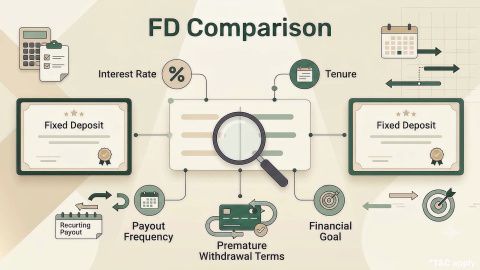
Evaluating a cumulative FD involves more than comparing the advertised interest rate. The investment tenure, compounding method and applicable conditions also affect the final amount received.
The following factors can help when comparing available deposits.
- Compare interest rates: Check the rates offered for the same tenure and depositor category.
- Review the compounding method: Confirm how frequently interest is compounded and how the maturity amount is calculated.
- Choose an appropriate tenure: Align the maturity date with the expected timing of your financial goal.
- Consider premature withdrawal conditions: Check whether withdrawing funds before maturity is permitted and whether a penalty or reduced interest applies.
- Account for taxes: Estimate the impact of tax on interest income when assessing the effective return.
- Use an FD calculator: Enter the deposit amount, interest rate and tenure to estimate the maturity value before investing.
A higher quoted rate does not automatically make a deposit the most appropriate choice. Liquidity, issuer credentials and the terms governing the deposit should also be considered.
Fixed Deposit variants
Get ROI up to
8.15% p.a.
Senior citizen
Starting with just Rs. 15,000
Get ROI up to
7.75% p.a.
Age below 60 years
Starting with just Rs. 15,000
Get ROI up to
7.75% p.a.
Minor
Starting with just Rs. 15,000
Get ROI up to
7.75% p.a.
HUF
Starting with just Rs. 15,000
Get ROI up to
7.75% p.a.
Sole proprietor
Starting with just Rs. 15,000
What are the cumulative fixed deposit options available with Bajaj Finance?
Bajaj Finance offers fixed deposits with cumulative and non-cumulative interest payout options. Under the cumulative option, interest accumulates until maturity instead of being paid at regular intervals.
The official Bajaj Finance fixed deposit page provides information on available interest rates, deposit amounts, tenures and payout choices. These details may change, so the applicable terms should be checked before booking a deposit.
Key features to review include:
- Investment amount: Check the minimum and maximum deposit amounts applicable to your chosen category.
- Tenure options: Select an available tenure that matches your financial plans.
- Interest rate: Verify the rate applicable to the selected tenure and depositor category.
- Credit ratings: Bajaj Finance's fixed deposits carry CRISIL AAA/STABLE and [ICRA]AAA(Stable) ratings, as stated on its official page. Credit ratings indicate an assessment of creditworthiness and are not a government guarantee of repayment.
- Digital access: Online booking and an FD calculator can help with the application process and maturity estimates.
Before making a decision, compare the applicable cumulative FD rate with other available deposit options and review the issuer's terms and conditions.
What are the tax implications of a cumulative fixed deposit?
Interest earned on a cumulative FD is generally taxable under the applicable Indian income tax rules. The fact that the interest is paid only at maturity does not automatically make it tax-free.
The following points are relevant:
- Taxable interest: Interest income is generally taxable according to the applicable provisions and the depositor's tax position.
- Tax deduction at source (TDS): The financial institution may deduct TDS when the applicable legal conditions and thresholds are met.
- Interest reporting: Depositors should maintain appropriate records of their FD interest and report taxable income as required.
- Senior citizens: Specific TDS thresholds or deductions may apply to eligible senior citizens, subject to current tax rules and conditions.
TDS is not necessarily the final tax liability. The amount ultimately payable depends on the individual's circumstances and applicable income tax provisions. The latest rules should be checked when filing a return.
Can a cumulative fixed deposit be withdrawn before maturity?
A cumulative FD may permit premature withdrawal, subject to the financial institution's terms and applicable regulations. However, withdrawing the deposit before its scheduled maturity can affect the returns.
Depending on the product and the circumstances, the institution may apply a reduced interest rate, a premature withdrawal penalty or other restrictions. The amount payable may therefore be lower than the originally estimated maturity value.
Before opening an FD, review the premature withdrawal policy and consider keeping sufficient funds accessible for emergencies. This can help reduce the need to close the deposit early.
Conclusion
A cumulative fixed deposit can be an option for individuals who want to accumulate savings over a defined period without receiving regular interest payouts. By keeping interest invested until maturity, the deposit may benefit from compounding and provide a lump-sum payment for a planned financial goal.
The suitability of a cumulative FD depends on the investment amount, tenure, interest rate, compounding method, liquidity needs and tax implications. Comparing these factors across available deposits can help individuals make an informed decision.
Bajaj Finance offers cumulative and non-cumulative FD options with different tenure and payout choices. Reviewing the current rates, applicable conditions and credit ratings can help prospective depositors assess whether the offering fits their financial requirements.
Locate to your nearest FD branch

Related Articles


Frequently Asked Questions
Overview
Is a cumulative FD better than a non-cumulative FD?
Yes, cumulative Fixed Deposit interest is taxable at your applicable slab rate, despite being paid only when the deposit matures.
Who should choose a cumulative fixed deposit over a regular fixed deposit?
Investors without periodic income needs who are saving towards a future lump-sum goal can choose cumulative interest.
When it comes to fixed deposits, how is noncumulative interest credited?
Non-cumulative interest is credited monthly, quarterly, half-yearly, or annually according to the payout frequency selected.
For fixed deposits, how is cumulative interest credited?
Cumulative interest remains invested during the tenure and is paid with the principal when the deposit matures.
Who should choose a noncumulative fixed deposit over a cumulative fixed deposit?
Investors needing predictable periodic income for household, retirement, or other recurring expenses can choose non-cumulative interest.
Is cumulative FD taxable?
Yes, cumulative Fixed Deposit interest is taxable at your applicable slab rate, despite being paid only when the deposit matures.
Is there a distinction between cumulative and noncumulative FD?
Yes, in a cumulative FD, the interest is compounded and paid at maturity along with the principal. In contrast, a noncumulative FD pays interest at regular intervals (monthly, quarterly, etc.) without compounding.
Which is better cumulative FD or traditional FD?
A cumulative FD is suitable for investors seeking higher maturity returns through compounded interest, while a traditional (non-cumulative) FD is better for those wanting regular interest payouts as income.
Can we break cumulative FD?
Yes, a cumulative FD can usually be withdrawn before maturity through premature withdrawal. However, banks and financial institutions may charge a penalty on the withdrawn amount.
Does FD give cumulative interest?
Yes, cumulative FDs offer compounded interest, where the earned interest is reinvested with the principal amount and paid together at maturity for potentially higher returns.
Disclaimer
1. Bajaj Finance Limited (“BFL”) is a Non-Banking Finance Company (BAJAJ FINANCE) and Prepaid Payment Instrument Issuer offering financial services viz., loans, deposits, Bajaj Pay Wallet, Bajaj Pay UPI, bill payments and third-party wealth management products. The details mentioned in the respective product/ service document shall prevail in case of any inconsistency with respect to the information referring to BFL products and services on this page.
2. All other information, such as, the images, facts, statistics etc. (“information”) that are in addition to the details mentioned in the BFL’s product/ service document and which are being displayed on this page only depicts the summary of the information sourced from the public domain. The said information is neither owned by BFL nor it is to the exclusive knowledge of BFL. There may be inadvertent inaccuracies or typographical errors or delays in updating the said information. Hence, users are advised to independently exercise diligence by verifying complete information, including by consulting experts, if any. Users shall be the sole owner of the decision taken, if any, about suitability of the same.