








Invest in equities, F&O and upcoming IPOs effortlessly by opening a demat account online. Enjoy a free subscription for the first year with Bajaj Broking

Know the benefits of a demat account
Check now
Free Demat account in minutes | Low brokerage | Online account opening
In summary
Penny Stocks in India Below Rs. 5
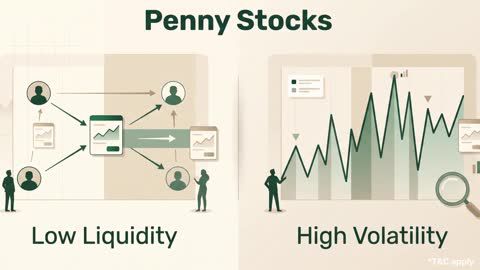
Penny stocks below ₹5 are shares trading below the ₹5 price level. Their low quoted price alone does not show the company's size, valuation or financial strength.
- ₹5 is only a price filter.
- Market cap depends on outstanding shares.
- Low liquidity can make exits difficult.
- Small price changes create large percentages.
- Company financials need careful checking.
- Exchange status can change over time.
Penny stocks can carry higher liquidity, volatility and business risks than established shares. Before considering one, check the company’s financial health, trading activity, governance and latest corporate disclosures.
Show More
Show Less
What are penny stocks?
Penny stocks are shares of companies that trade at a very low market price and usually have a small market value. These stocks may attract investors because they are inexpensive to buy, but they can also carry higher risk.
For example, a share trading at ₹4 may look affordable, but a low price does not mean the company is financially strong. Penny stocks can have low trading volume, sharp price movements, and limited publicly available information, so investors should study the company carefully before investing.
Show More
Show Less
Which penny stocks in India are below ₹5?
The following table lists examples of penny stocks trading below ₹5.
| Company | Closing price | Approx. market cap |
| GTL Infrastructure Ltd | ₹1.00 | ₹1,281 crore |
| Nandan Denim Ltd | ₹2.52 | ₹362 crore |
| GVK Power & Infrastructure Ltd | ₹2.03 | ₹321 crore |
| Evexia Lifecare Ltd | ₹1.57 | ₹295 crore |
| FCS Software Solutions Ltd | ₹1.30 | ₹222 crore |
| Vikas Lifecare Ltd | ₹1.12 | ₹209 crore |
| Vikas Ecotech Ltd | ₹0.98 | ₹173 crore |
| Filatex Fashions Ltd | ₹0.17 | ₹142 crore |
| Spright Agro Ltd | ₹0.31 | Around ₹34 crore |
The market capitalisation figures are based on publicly available data as of 29 October 2026 and are subject to change based on share price movements and market conditions.
The table is a dated price screen. Inclusion does not indicate financial strength, expected returns or suitability for any investor.
Show More
Show Less
Current IPO
Mainboard
SME
ANTALA INDUSTRIES LIMITED IPO
Bidding period
29 Oct 2026 -
02 Nov 2026
Minimum investment
₹1,26,000 / 1 Lot

HGS INDIA LIMITED IPO
Bidding period
30 Oct 2026 -
03 Nov 2026
Minimum investment
₹1,36,800 / 1 Lot

JOHNSONCAB ELECTRICALS LIMITED IPO
Bidding period
30 Oct 2026 -
03 Nov 2026
Minimum investment
₹1,14,000 / 1 Lot
JOHNSONCAB ELECTRICALS LIMITED IPO
Bidding period
30 Oct 2026 -
03 Nov 2026
Minimum investment
₹1,14,000 / 1 Lot

MAXWELL ENGINEERING SOLUTIONS LIMITED IPO
Bidding period
30 Oct 2026 -
03 Nov 2026
Minimum investment
₹1,20,000 / 1 Lot
What should you know about these penny stocks?
Penny stocks below ₹5 can belong to very different sectors and can carry company-specific financial, liquidity and regulatory risks. You should therefore examine each business separately.
| Company | Business area | What to examine |
| GTL Infrastructure | Telecom tower infrastructure | Cash flow, liabilities, operating performance |
| Nandan Denim | Denim and textiles | Debt, margins, demand and cash flow |
| Vikas Lifecare | Manufacturing and trading | Profitability, audit observations and balance sheet |
| GVK Power & Infrastructure | Infrastructure services | Insolvency status and financial position |
| Evexia Lifecare | Chemicals and related activities | Revenue quality, margins and disclosures |
| FCS Software Solutions | IT-enabled services | Revenue, profitability and liquidity |
| Filatex Fashions | Textiles and apparel | Earnings, debt and exchange disclosures |
| Vikas Ecotech | Specialty chemicals | Debt, dilution and operating margins |
| Spright Agro | Agricultural products | Insolvency proceedings and creditor claims |
Some companies in this price range can also face major corporate events.
For example, GVK Power & Infrastructure has disclosed that it is under the Corporate Insolvency Resolution Process. Its official exchange communication dated 27 March 2026 identifies the company as being “Under CIRP”.
Spright Agro also entered the Corporate Insolvency Resolution Process following proceedings before the National Company Law Tribunal in September 2026. Its current corporate status therefore requires particular attention before interpreting its low quoted share price.
These cases show why a ₹5 price filter is only the first step. A company's listing status, insolvency proceedings and exchange disclosures can matter more than the share price.
Also read: What is IPO
Sources:
- GVK Power & Infrastructure Limited, Intimation of Trading Window Closure identifying the company as under CIRP, 27 March 2026;
- Spright Agro Limited, corporate disclosures relating to commencement of Corporate Insolvency Resolution Process, October 2026.
Last updated: 29 October 2026.
Show More
Show Less
Start investing today

Open Demat Account
Open Trading Account

Margin Trading Facility
How do penny stocks below ₹5 perform?
There is no common performance pattern for penny stocks below ₹5. Performance depends on company fundamentals, liquidity, corporate developments, market conditions and investor demand.
The low starting price can make percentage movements appear large.
Consider Ravi, a 32-year-old investor from Jaipur. He invests ₹2,000 in 1,000 shares priced at ₹2 each.
If the share falls to ₹1.40:
Loss per share = ₹2.00 − ₹1.40 = ₹0.60
Total loss = ₹0.60 × 1,000 = ₹600
Percentage loss = ₹600 ÷ ₹2,000 × 100 = 30%
The market price fell by only ₹0.60, but Ravi's investment fell by 30%.
The same percentage effect can work when prices rise. However, a large percentage movement does not itself show that the underlying business has improved.
Past price performance also cannot establish what another penny stock will do in the future.
Show More
Show Less
Upcoming IPO
Mainboard
Aarvee Engineering Consultants Limited
Bidding
To
be announced
Price
To be announced
Abakkus Asset Manager Limited
Bidding
To
be announced
Price
To be announced
Absolute Project India Limited
Bidding
To
be announced
Price
To be announced
Advanced SysTek Limited
Bidding
To
be announced
Price
To be announced
Advanta Enterprises Limited
Bidding
To
be announced
Price
To be announced
How can you choose a penny stock under ₹5?
Choosing a penny stock under ₹5 requires more than filtering shares by market price. A useful process is to apply financial, liquidity and governance checks after the price screen.
Start with the following steps:
- Understand the business: Identify what the company sells and how it earns money.
- Read financial statements: Compare revenue, profit, debt and cash flow over multiple reporting periods.
- Check liquidity: Review traded volume and whether buyers and sellers are consistently available.
- Review promoter holdings: Look for major changes in promoter ownership or pledged shares.
- Check dilution: Identify repeated equity allotments, rights issues or preferential issues.
- Read audit reports: Auditor qualifications can highlight accounting, control or disclosure concerns.
- Check corporate filings: Review insolvency proceedings, suspensions, penalties and other material developments.
- Assess valuation: Compare price with the company's earnings, assets and financial condition rather than judging it by share price alone.
A stock trading at ₹2 can carry more financial risk than one trading at ₹200. The quoted price is therefore a screening criterion, not a measure of investment quality.
Show More
Show Less
What are the possible benefits and trade-offs?

What basic math is needed for stocks?
Penny stocks below ₹5 can provide exposure to companies with a low price per share, but every possible benefit has a corresponding risk.
| Possible feature | Trade-off |
| Low price per share | Does not mean low valuation |
| Large percentage upside | Large percentage losses also possible |
| Exposure to smaller businesses | Financial information may need closer scrutiny |
| Smaller cash amount per share | Liquidity may still restrict entry or exit |
| Turnaround potential | A turnaround may never occur |
| Portfolio diversification | Poor-quality shares can increase portfolio risk |
The strongest reason to research a low-priced stock is therefore not its ₹5 price. It is whether the underlying company's financial position, governance and business prospects justify further assessment.
Show More
Show Less
What factors should you check before investing?
Before assessing penny stocks in India below ₹5, examine the company rather than focusing only on its quoted price.
| Factor | What to check |
| Business | How the company earns revenue |
| Revenue | Whether sales are stable or growing |
| Profit | Whether earnings are recurring |
| Cash flow | Whether operations generate cash |
| Debt | Whether liabilities are manageable |
| Liquidity | Whether sufficient shares trade daily |
| Promoters | Changes in promoter shareholding |
| Pledged shares | Whether promoter holdings are pledged |
| Dilution | Repeated preferential or rights issues |
| Auditors | Qualifications, resignations or observations |
| Exchange filings | Corporate and regulatory developments |
| Listing status | Whether normal trading remains available |
Do not assume that a company is inexpensive because one share costs ₹1, ₹2 or ₹5. Valuation also depends on earnings, assets, debt, cash generation and the number of shares outstanding.
Features and Benefits of LAS

Tenure 36 months
Flexible repayment from 7 days to 36 months

1000+ shares
Get 50% value on 1000+ shares

All DP shares available
All companies’ and DPs’ Demat accounts accepted for loans

Customer portal
Handle loans, shares, and statements — all in one place
Conclusion
Penny stocks in India below ₹5 should be assessed on more than their low share price. Examine financial statements, cash flow, debt, liquidity, governance and current exchange disclosures before judging a company. A ₹5 filter can help narrow a stock list, but it does not indicate whether a share is undervalued or likely to rise. Company quality and risk remain more important than the quoted price.
Pro Tip

Top Investment Options for You




Related Articles


Frequently Asked Questions
Short Term Stocks
Is a ₹1 share cheaper than a ₹100 share?
Not necessarily. A ₹1 share has a lower price per unit, but that does not mean the whole company has a lower valuation. Market capitalisation depends on both the share price and the number of outstanding shares. You should also review earnings, cash flow, assets and debt before comparing two companies.
Why do some shares trade below ₹5?
A share can trade below ₹5 for several reasons. These include weak financial performance, a large number of outstanding shares, previous stock splits, business uncertainty or prolonged selling pressure. The low price itself does not reveal the reason. You need financial statements and corporate disclosures to understand why the market values the share at that level.
Disclaimer
Investments in the securities market are subject to market risk, read all related documents carefully before investing.
Broking services offered by Bajaj Financial Securities Limited (Bajaj Broking). Reg Office: Bajaj Auto Limited Complex, Mumbai –Pune Road Akurdi Pune 411035. Corporate Office: Bajaj Financial Securities Limited, 1st Floor, Mantri IT Park, Tower B, Unit No 9 & 10, Viman Nagar, Pune, Maharashtra 411014. SEBI Registration No.: INZ000218931 | BSE Cash/F&O/CDS (Member ID:6706) | NSE Cash/F&O/CDS (Member ID: 90177) | MCX (Member ID: 57680) | DP registration No: IN-DP-418-2019 | CDSL DP No.: 12088600 | NSDL DP No. IN304300 | AMFI Registration No.: ARN –163403.
Details of Compliance Officer: Mr. Harinatha Reddy Muthumula (For Broking/DP/Research) | Email: compliance_sec@bajajbroking.in | Contact No.: 020-4857 4486. For any investor grievances write to compliance_sec@bajajbroking.in/ compliance_dp@bajajbroking.in (DP related)
This content is for educational purpose only. Securities quoted are exemplary and not recommendatory.
Research Services are offered by Bajaj Broking as Research Analyst under SEBI Regn: INH000010043.
For more disclaimer, check here: https://www.bajajbroking.in/disclaimer