










Invest in equities, F&O and upcoming IPOs effortlessly by opening a demat account online. Enjoy a free subscription for the first year with Bajaj Broking

Know the benefits of demat account
Check now
Free Demat account in minutes | Low brokerage | Online account opening
How Do You Start Investing in the Stock Market
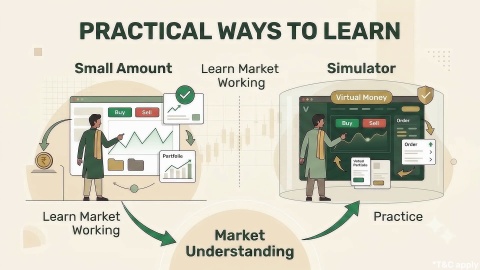
A stock market simulator lets you practise trading in a simulated environment using virtual money instead of your own funds. It can help you understand how trading works before dealing with real money.
- You can practise buying and selling stocks and other supported securities.
- Simulators may use real-time or delayed market data, depending on the platform.
- You can learn how market and limit orders work.
- Beginners can use simulators to understand basic trading concepts.
- Experienced users can test different strategies in a simulated setting.
- Simulated results may differ from actual market execution because no real trade takes place.
Show More
Show Less
What is a stock simulator?
A stock simulator is a digital tool that recreates parts of the stock market environment. Depending on the platform, you may be able to practise trading stocks, bonds, options, or other securities with virtual money.
Stock simulators may use real-time or delayed market data. They generally allow you to place simulated orders, monitor a virtual portfolio, view charts, and study market movements.
For example, suppose you receive ₹1 lakh in virtual money. You could use part of it to buy shares in the simulator and then watch how changes in their market price affect your virtual portfolio.
For beginners, simulators can help explain basic activities such as placing orders and reading stock charts. Experienced users may use them to practise strategies or become familiar with more advanced tools.
Show More
Show Less
What types of stock market simulators are there?
Stock market simulators are available in different formats. Their features depend on the platform and the type of user they are designed for.
1. App-based simulators
App-based simulators are accessed through mobile applications. They usually make it easy to practise trading from a phone and may include simple interfaces or learning activities.
They can be useful for beginners who want to understand basic trading concepts.
2. Web-based simulators
Web-based simulators run through an internet browser. Depending on the platform, they may provide charts, portfolio information, market data, and analytical tools.
They can suit users who want to practise trading on a larger screen or use more detailed features.
3. Beginner-focused simulators
Beginner-focused simulators are designed for people with little or no trading experience. They may provide tutorials, simple trading tools, and guided activities.
For example, a beginner may first practise placing a market order and a limit order before exploring more complex trading tools.
4. Advanced simulators
Advanced simulators may support more complex trading features, depending on the platform. These can include options, margin-related tools, historical data, advanced charts, or strategy testing.
For example, an experienced trader may use a simulator to see how a particular options strategy behaves under different market conditions.
Each type serves a different purpose, so the suitable simulator depends on what you want to learn or practise.
Show More
Show Less
Current IPO
Mainboard
SME

HD FIRE PROTECT LIMITED
Bidding period
15 Oct 2026- 13 Oct 2026
Minimum investment
₹14,190 / 13 Lot

FUSION CX LIMITED
PRE-APPLY
Bidding period
16 Oct 2026- 14 Oct 2026
Minimum investment
₹14,025 / 13 Lot

TONBO IMAGING INDIA LIMITED
PRE-APPLY
Bidding period
19 Oct 2026- 15 Oct 2026
Minimum investment
₹13,965 / 13 Lot
What are the benefits of stock market simulators?
Stock market simulators can help you learn trading through practical experience without putting real money at risk.
1. Risk-free learning environment
- You can practise trades using virtual money.
- Beginners can learn how buying and selling work without risking their own funds.
2. Hands-on experience
- You can practise placing orders, monitoring a portfolio, and studying market movements.
- This makes it easier to understand concepts that may seem complicated when explained only in theory.
3. Strategy testing
- You can test different trading approaches in a simulated environment.
- More advanced users may practise strategies involving options or margin features when these are supported by the simulator.
For example, you could test the same strategy several times using virtual money and compare the simulated results.
4. Understanding market behaviour
- Simulators can help you observe how prices move during different market conditions.
- You can practise studying charts and market trends before making real investment decisions.
5. Building familiarity
- Regular practice can make you more familiar with trading platforms and order types.
- You can make mistakes in the simulator and use them to understand how different decisions affect a virtual portfolio.
6. Customisable features
- Some simulators allow you to adjust features such as starting virtual capital.
- Available customisation depends on the simulator you use.
7. Cost-effective learning
- Many simulators are available free of charge or at a relatively low cost.
- This can provide a practical way to learn basic trading concepts without initially using real investment capital.
Stock market simulators can therefore support learning and practice, although simulated performance does not guarantee similar results in live markets.
Show More
Show Less
How can you use a stock simulator?
Using a stock market simulator generally involves a few simple steps. The exact process depends on the platform you choose.
1. Choose a suitable simulator
Select a simulator based on what you want to practise and your level of experience.
Beginners may prefer basic learning tools, while experienced users may look for detailed charts or more advanced trading features.
2. Set up an account
Register on the platform using the required details. Some simulators then provide a fixed amount of virtual money or allow you to choose a starting amount.
3. Explore the platform
Learn where the charts, order controls, watchlists, and portfolio information are located.
If tutorials or guides are available, use them to understand the simulator before placing virtual trades.
4. Start trading
Use your virtual money to buy and sell the securities supported by the simulator.
You can also practise different order types. For example, a market order generally aims to execute at the available market price, while a limit order sets the maximum buying price or minimum selling price you are willing to accept.
5. Monitor and analyse your performance
Track your virtual portfolio and review the results of your decisions.
Look at which trades worked as expected and which did not. This can help you understand how your decisions affected the simulated portfolio.
6. Refine your strategies
Try different trading approaches and compare their simulated results.
For example, you might practise holding a position for several days and compare it with a shorter-term trading approach. This can help you understand how different strategies behave before you consider live trading.
Show More
Show Less
Start investing today

Open Demat Account
Open Trading Account

Margin Trading Facility
Conclusion
Stock market simulators are useful learning tools for beginners as well as experienced traders. They let you practise trading, understand order types, manage a virtual portfolio, and test strategies without risking real money.
They can help you become more familiar with market movements and trading platforms. However, simulated trades may not behave exactly like real trades, so simulator performance should be treated as practice rather than an indication of future investment results.
Show More
Show Less
Upcoming IPO
Mainboard
SME
Aarvee Engineering Consultants Limited
Bidding
To
be announced
Price
To be announced
Abakkus Asset Manager Limited
Bidding
To
be announced
Price
To be announced
Absolute Project India Limited
Bidding
To
be announced
Price
To be announced
Advanced SysTek Limited
Bidding
To
be announced
Price
To be announced
Advanta Enterprises Limited
Bidding
To
be announced
Price
To be announced
Features and Benefits of LAS

Tenure 36 months
Flexible repayment from 7 days to 36 months

1000+ shares
Get 50% value on 1000+ shares

All DP shares available
All companies’ and DPs’ Demat accounts accepted for loans

Customer portal
Handle loans, shares, and statements — all in one place
Pro Tip
Top Investment Options for You





Related Articles

Frequently Asked Questions
Stock Market Simulator
What are the benefits of using a stock simulator?
A stock simulator lets you practise trading with virtual money instead of risking real funds. You can learn how orders work, track a virtual portfolio, understand market movements, and test different trading strategies. It can also help beginners become more familiar with trading platforms before they consider entering the real market.
Can I use a stock market simulator to make real money?
No. A stock market simulator uses virtual money, so any profit or loss shown on the platform is simulated and cannot be withdrawn as real money. Its main purpose is learning and practice. Results in a simulator may also differ from actual trading because real markets involve factors such as liquidity, execution prices, costs, and market conditions.
Where can I find a stock market simulator?
You can find stock market simulators on websites and digital platforms that offer virtual trading or paper-trading features. Some are designed for beginners, while others provide advanced charts, historical data, and strategy-testing tools. Before choosing one, check which securities it supports, whether its market data is real-time or delayed, and which practice features are available.
How does a share market simulator work?
A share market simulator creates a virtual trading environment and gives you simulated money to place trades. Depending on the platform, it may use real-time or delayed market data. You can buy or sell supported securities, use different order types, track your virtual portfolio, and review how your trading decisions would have performed in the simulated market.
Disclaimer
Investments in the securities market are subject to market risk, read all related documents carefully before investing.
Broking services offered by Bajaj Financial Securities Limited (Bajaj Broking). Reg Office: Bajaj Auto Limited Complex, Mumbai –Pune Road Akurdi Pune 411035. Corporate Office: Bajaj Financial Securities Limited, 1st Floor, Mantri IT Park, Tower B, Unit No 9 & 10, Viman Nagar, Pune, Maharashtra 411014. SEBI Registration No.: INZ000218931 | BSE Cash/F&O/CDS (Member ID:6706) | NSE Cash/F&O/CDS (Member ID: 90177) | MCX (Member ID: 57680) | DP registration No: IN-DP-418-2019 | CDSL DP No.: 12088600 | NSDL DP No. IN304300 | AMFI Registration No.: ARN –163403.
Details of Compliance Officer: Mr. Harinatha Reddy Muthumula (For Broking/DP/Research) | Email: compliance_sec@bajajbroking.in | Contact No.: 020-4857 4486. For any investor grievances write to compliance_sec@bajajbroking.in/ compliance_dp@bajajbroking.in (DP related)
This content is for educational purpose only. Securities quoted are exemplary and not recommendatory.
Research Services are offered by Bajaj Broking as Research Analyst under SEBI Regn: INH000010043.
For more disclaimer, check here: https://www.bajajbroking.in/disclaimer