Snapdragon 4 Gen 2 vs Snapdragon 625

Snapdragon 4 Gen 2 vs Snapdragon 625

Compare Snapdragon 4 Gen 2 vs Snapdragon 625 across specifications, performance, efficiency, connectivity, and benchmarks to understand which chipset offers better overall value.

Get pre-approved loan offer

Quick approval | Flexible Tenure Options | Zero Approval Fees

In summary

  • Snapdragon 4 Gen 2 uses a 4nm manufacturing process with 2x Cortex-A78@2.2GHz performance cores and 6x Cortex-A55@2.0GHz efficiency cores, while Snapdragon 625 uses 14nm technology with 8x Cortex-A53@2.0GHz cores.
  • Snapdragon 4 Gen 2 integrates the Adreno 613 GPU with Vulkan 1.1 and OpenGL ES 3.2 support, while Snapdragon 625 uses Adreno 506 for HD gaming and video playback scenarios.
  • Snapdragon 4 Gen 2 supports 5G through the Snapdragon X61 modem with up to 2.5Gbps download speed, while Snapdragon 625 supports 4G LTE connectivity through the Snapdragon X9 LTE modem.
  • Snapdragon 4 Gen 2 supports a 108MP single camera sensor and FHD+ display up to 120Hz, while Snapdragon 625 supports up to 24MP camera sensors and Full HD displays.

With Bajaj Finance, you can convert the cost of your preferred smartphone into Easy EMIs at more than 1.5 lakh partner stores, including Reliance Digital, Croma, and Vijay Sales, making your purchase easier to manage.


Snapdragon 4 Gen 2 vs Snapdragon 625 – Overview

Choosing a smartphone processor affects everyday activities such as app switching, photography, gaming, and connectivity. The Qualcomm Snapdragon 625 uses 8x Cortex-A53@2.0GHz cores built on a 14nm process for 4G smartphones handling calls, social media, and video playback. The Qualcomm Snapdragon 4 Gen 2 uses a 4nm process with 2x Cortex-A78@2.2GHz and 6x Cortex-A55@2.0GHz cores, supporting budget 5G smartphones with features such as a Snapdragon X61 5G modem, 108MP camera support, and FHD+ displays up to 120Hz. Both processors support daily smartphone tasks, while their architecture, connectivity, and multimedia capabilities reflect different generations of mobile chip design.


Explore latest Snapdragon processor phones on Easy EMIs from Bajaj Finance and enjoy exclusive discounts. Check your loan eligibility online now and make your next purchase more affordable than ever.

Snapdragon 4 Gen 2 vs Snapdragon 625 - Technical specifications

A processor's real-world performance depends on CPU architecture, GPU capability, memory handling, multimedia support, and connectivity features. Snapdragon 4 Gen 2 and Snapdragon 625 differ across core design, manufacturing process, camera support, and network technology, affecting tasks such as app switching, video streaming, photography, and mobile gaming.


General

The Snapdragon 625 launched in February 2016 for mid-range 4G smartphones, while the Snapdragon 4 Gen 2 launched in June 2023 for budget 5G smartphones. The two processors use different manufacturing approaches, with Snapdragon 625 built on 14nm technology and Snapdragon 4 Gen 2 using a 4nm Samsung process.

SpecificationSnapdragon 4 Gen 2Snapdragon 625
BrandQualcommQualcomm
ModelSnapdragon 4 Gen 2Snapdragon 625
AnnouncedJune 2023February 2016
Target segmentBudget 5G smartphonesMid-range 4G smartphones
Network support5G, 4G LTE4G LTE
Manufacturing process4nm14nm

CPU

The Snapdragon 4 Gen 2 uses a hybrid Cortex-A78 and Cortex-A55 architecture with 2 performance cores at 2.2GHz and 6 efficiency cores at 2.0GHz. The Snapdragon 625 uses 8x Cortex-A53 cores at 2.0GHz, designed for everyday tasks such as messaging, browsing, and video playback on 4G smartphones.

SpecificationSnapdragon 4 Gen 2Snapdragon 625
CPU architectureCortex-A78 + Cortex-A55Cortex-A53
CPU cores8-core8-core
Performance cores2x Cortex-A78@2.2GHz8x Cortex-A53@2.0GHz
Efficiency cores6x Cortex-A55@2.0GHzNot separate
Maximum clock speed2.2GHz2.0GHz
Instruction setARMv8.2-AARMv8-A
64-bit supportYesYes
Process node4nm14nm

Graphics

The Snapdragon 4 Gen 2 uses the Adreno 613 GPU with Vulkan 1.1 and OpenGL ES 3.2 support for casual gaming, HD/FHD content, and displays supporting up to 120Hz. The Snapdragon 625 uses the Adreno 506 GPU, supporting HD gaming, video playback, and everyday graphical tasks on older 4G devices.

SpecificationSnapdragon 4 Gen 2Snapdragon 625
GPU modelAdreno 613Adreno 506
GPU generationAdreno 6 SeriesAdreno 5 Series
Gaming capabilityCasual gaming, HD and FHD titles, up to 120fps supported displaysCasual gaming and HD titles
Vulkan supportVulkan 1.1Vulkan 1.0
OpenGL ES3.23.1
Video playbackHD and FHD streamingHD and Full HD streaming
AI graphics supportSupported through Qualcomm AI optimisationsSupported through Qualcomm technologies

Memory

The Snapdragon 4 Gen 2 supports LPDDR5 and LPDDR4X memory with up to 6,400Mbps memory frequency and 25.6GB/s bandwidth. The Snapdragon 625 supports LPDDR3 memory, designed for smartphones running basic apps such as WhatsApp, web browsers, and video streaming services.

SpecificationSnapdragon 4 Gen 2Snapdragon 625
Memory typeLPDDR5, LPDDR4XLPDDR3
Maximum memory frequency6,400Mbps (LPDDR5), 4,266Mbps (LPDDR4X)933MHz
Memory bus width2 × 16-bit32-bit
Maximum memory bandwidth25.6GB/s~7.5GB/s
Maximum RAM support16GB4GB
ECC memory supportNoNo

Multimedia (ISP)

The Snapdragon 4 Gen 2 includes the Qualcomm Spectra ISP with support for up to a 108MP single camera, FHD+ displays at up to 120Hz, and 1080p60 video recording. The Snapdragon 625 uses an older dual ISP design supporting up to 24MP cameras, Full HD displays, and everyday photography for social media sharing.

SpecificationSnapdragon 4 Gen 2Snapdragon 625
ISPQualcomm Spectra ISPQualcomm Spectra ISP
Storage supportUFS 3.1, UFS 2.2eMMC 5.1
Maximum display resolutionFHD+Full HD
Maximum refresh rateUp to 120HzUp to 60Hz
Maximum camera resolution108MP (single camera)24MP
Multi-camera supportYesYes
Video recording1080p at 60fps4K at 30fps
Video playbackH.264, H.265, VP9H.264, H.265
Audio codecsQualcomm Aqstic audio supportQualcomm Aqstic audio support

Connectivity and network

The Snapdragon 4 Gen 2 integrates the Snapdragon X61 5G modem with 5G SA/NSA support, 2.5Gbps download speed, and 900Mbps upload speed. The Snapdragon 625 uses the Snapdragon X9 LTE modem for 4G connectivity with Wi-Fi 5 and Bluetooth 4.1 support for daily wireless usage.

SpecificationSnapdragon 4 Gen 2Snapdragon 625
Cellular modemSnapdragon X61 5GSnapdragon X9 LTE
Network support5G SA/NSA, 4G LTE4G LTE
Maximum download speed2.5Gbps300Mbps
Maximum upload speed900Mbps150Mbps
Wi-FiWi-Fi 5 (802.11ac)Wi-Fi 5 (802.11ac)
Bluetooth5.14.1
GNSSGPS, GLONASS, Galileo, BeiDou, NavIC, QZSSGPS, GLONASS, BeiDou, Galileo

Snapdragon 4 Gen 2 vs Snapdragon 625 - Benchmarking

Benchmark scores provide a standard way to compare CPU processing, graphics performance, memory handling, and overall system responsiveness. Snapdragon 4 Gen 2 uses a newer Cortex-A78 architecture on a 4nm process, while Snapdragon 625 uses Cortex-A53 cores on a 14nm process. These architectural differences are reflected in application launch speeds, multitasking capability, and graphics workloads.

Benchmark ParameterSnapdragon 4 Gen 2Snapdragon 625
AnTuTu v10417,800167,228
Geekbench 6 – Single-Core928189
Geekbench 6 – Multi-Core2,229862
3DMark Wild Life1,233159

AnTuTu

AnTuTu evaluates CPU, GPU, memory, and UX performance to represent overall smartphone responsiveness. Snapdragon 4 Gen 2 records higher CPU, graphics, and memory scores through its Cortex-A78 cores, Adreno 613 GPU, LPDDR5 memory support, and 4nm process. Snapdragon 625 remains suitable for basic everyday workloads but delivers lower benchmark results because of its older Cortex-A53 architecture and Adreno 506 GPU.

ComponentSnapdragon 4 Gen 2Snapdragon 625
CPU142,00061,394
GPU73,40016,162
Memory98,60045,586
UX103,80044,086
Total Score417,800167,228

Geekbench 6

Geekbench 6 measures processor performance in workloads such as web browsing, image processing, document editing, and application execution. Snapdragon 4 Gen 2 achieves substantially higher single-core and multi-core scores with its Cortex-A78 performance cores, while Snapdragon 625 relies on eight Cortex-A53 cores that prioritise efficiency for everyday smartphone tasks.

BenchmarkSnapdragon 4 Gen 2Snapdragon 625
Single-Core928189
Multi-Core2,229862

3DMark Wild Life

3DMark Wild Life measures graphics capability under sustained GPU workloads. Snapdragon 4 Gen 2 achieves a considerably higher graphics score through its Adreno 613 GPU, making it more capable for modern casual games and GPU-intensive applications. Snapdragon 625, equipped with the Adreno 506 GPU, is primarily designed for older games and standard multimedia workloads.

ComponentSnapdragon 4 Gen 2Snapdragon 625
Graphics Score1,233159
Overall Score1,233159

Save more with Smart Savings Calculator

Combine the best offers, EMI plans, and exclusive vouchers with Smart Savings Calculator to save big.

20k+ people used their offers at the store

Shop smart with Easy EMIs

Bajaj Finance puts you in control of your shopping. See if you are eligible for a loan and get instant approval in just a few steps. Once approved, go to any of 1.5 lakh+ partner stores across India. Pick from over 1 million products from 550+ leading brands. Pay in Easy EMIs with 50+ flexible options that fit your budget. Enjoy a fast, seamless, and stress-free shopping experience—with more freedom and more savings.

Why use the Smart Savings Calculator

Bajaj Finance’s Smart Savings Calculator helps you unlock maximum savings every time you shop at partner stores. It brings together all available brand, dealer, and scheme offers—so you can see your total savings instantly and shop smarter with Easy EMIs.


1. Dealer offers - Grab exclusive in-store deals at over 1.5 lakh partner stores across India. Enjoy local discounts and special prices you will not find online.

2. Brand offers - Access limited-time discounts from top brands across electronics, appliances, and more. Discover brand-specific savings selected just for you.

3. Bajaj offers - Unlock exclusive Bajaj Finance deals on popular products—available only to our customers. More rewards, more value.

4. Scheme offers - Take advantage of time-sensitive offers on select EMI schemes. Get extra benefits after paying just 3 EMIs—visible during EMI selection at checkout.


Calculate your extra savings today!

vivo Y19

vivo Y19

4.5

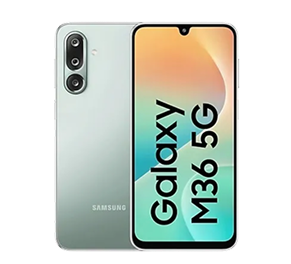
Samsung Galaxy M36 5G

Samsung Galaxy M36 5G

4.5

POCO M7 5G

POCO M7 5G

4.4

EMIs starting from

Rs. 1,083/month

Rs. 1,502/month

Rs. 831/month

Front camera

8MP, f/2.0, (wide)

13MP (wide)

Motorised pop-up 32 MP, f/2.0, 26mm (wide), 1/2.8", 0.8µm Motorised pop-up 8 MP, 17mm (ultrawide)

Screen size

6.88-inch

6.7-inch

6.85-inch

RAM

6GB/8GB

6GB

8GB

Internal storage

256GB

128GB

128GB

Processor

Qualcomm SM4450 Snapdragon 4 Gen 2 (4 nm)

Exynos 1380 S5E8835

Qualcomm SDM675 Snapdragon 675 (11 nm)

Explore other Samsung smartphones

FAQs

General

What are the architecture differences between Snapdragon 4 Gen 2 and Snapdragon 625?

Snapdragon 4 Gen 2 uses a newer CPU architecture with 2x Cortex-A78 performance cores at 2.2GHz and 6x Cortex-A55 efficiency cores at 2.0GHz, built on a 4nm process. Snapdragon 625 uses 8x Cortex-A53 cores at up to 2.0GHz on a 14nm process. Both support 64-bit computing, but their different core designs target different generations of smartphone performance and efficiency.

Snapdragon 4 Gen 2 features the Adreno 613 GPU with Vulkan 1.1 and OpenGL ES 3.2 support, making it suitable for casual gaming, HD and FHD titles, and displays supporting up to 120fps. Snapdragon 625 uses the Adreno 506 GPU with Vulkan 1.0 support for older and lighter games, HD video playback, and everyday graphical workloads on 4G smartphones.

Snapdragon 4 Gen 2 is manufactured on Samsung's 4nm process, while Snapdragon 625 uses Samsung's 14nm FinFET process. The smaller manufacturing process of Snapdragon 4 Gen 2 allows higher transistor density and supports newer CPU architecture, whereas Snapdragon 625 was designed using an earlier fabrication technology suited to smartphones released during its launch period.

Snapdragon 4 Gen 2 combines a 4nm manufacturing process with Cortex-A78 and Cortex-A55 cores to handle messaging, web browsing, video streaming, and app switching efficiently. Snapdragon 625 also focuses on efficiency through its 14nm FinFET process and eight Cortex-A53 cores, which were designed for balanced battery life and everyday smartphone usage during its generation.

Yes, you can easily upgrade to a new smartphone with Bajaj Finance's Easy EMI options. Whether you already have the Insta EMI Card or are new to it, here is how you can get started:

If you have the Bajaj Finance Insta EMI Card:

  • Explore smartphones on Bajaj Mall: Choose from top brands offering models with powerful processors, high-resolution cameras, and long-lasting batteries.
  • Visit a partner store: Check out the latest phones in person at any of 1.5 lakh partner stores across 4,000 cities.
  • Use your Insta EMI Card at checkout: Convert the total cost into Easy EMIs that fit your monthly budget.
  • Zero down payment on select models: Bring home your smartphone without paying anything upfront.


If you do not have an Insta EMI Card:

Check your Insta EMI Card eligibility online using your mobile number and OTP. If eligible, you can apply instantly and start shopping for your favourite smartphone easily and affordably.

Show More Show Less

Disclaimer

1. Bajaj Finance Limited (“BFL”) is a Non-Banking Finance Company (NBFC) and Prepaid Payment Instrument Issuer offering financial services viz., loans, deposits, Bajaj Pay Wallet, Bajaj Pay UPI, bill payments and third-party wealth management products. The details mentioned in the respective product/ service document shall prevail in case of any inconsistency with respect to the information referring to BFL products and services on this page. 

2. All other information, such as, the images, facts, statistics etc. (“information”) that are in addition to the details mentioned in the BFL’s product/ service document and which are being displayed on this page only depicts the summary of the information sourced from the public domain. The said information is neither owned by BFL nor it is to the exclusive knowledge of BFL. There may be inadvertent inaccuracies or typographical errors or delays in updating the said information. Hence, users are advised to independently exercise diligence by verifying complete information, including by consulting experts, if any. Users shall be the sole owner of the decision taken, if any, about suitability of the same.