








Rs. 1 lakh - Rs. 2.50 crore
Check your pre-approved offer and other benefits
Enter mobile and OTP | Check offer | Know your exact loan terms
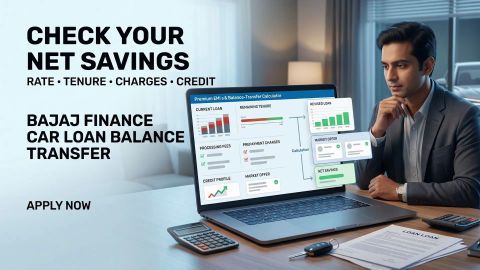
Is Car Loan Balance Transfer the Right Choice for You
In summary
A car loan balance transfer can be useful when the new loan terms improve the overall cost or repayment structure of your existing car loan.
- Bajaj Finance Car Loan Balance Transfer and Top-up offers interest rates from 10% to 18.25% p.a.
- Repayment tenure ranges from 12 months to 84
- Eligible customers can also access a top-up from Rs. 1 lakh and Rs. 2.50 crore, subject to valuation and eligibility
- Funding can reach up to %$$CBTTP-Max- Car-Valuation$$% of the car’s value, including the transferred balance and eligible top-up
Last updated: 28 September 2026
Do not compare interest rates alone. Check the remaining interest on your existing loan, processing and transfer costs, new tenure, EMI, and total repayment before deciding. Check your eligibility for the Bajaj Finance Car Loan Balance Transfer and Top-up now and find out your applicable savings.
What is a car loan balance transfer?
A car loan balance transfer allows you to move the outstanding amount of an existing car loan from your current lender to a new lender.
The new lender repays the eligible outstanding balance to the existing lender, and you then repay the transferred loan according to the new terms.
With the Bajaj Finance Car Loan Balance Transfer and Top-up, you can also apply for additional funds over and above the transferred balance, subject to your eligibility and the car’s valuation.
The main reason to consider a transfer is not simply to change lenders. The switch should improve your repayment position, reduce your overall cost, provide access to an appropriate top-up, or give you terms that better match your current finances.
When can a car loan balance transfer make sense?
A balance transfer can make sense when the new loan provides a meaningful financial benefit after all applicable costs are considered.
You may consider transferring your car loan when:
- the new interest rate is lower than your current rate
- a lower EMI would help your monthly cash flow
- you want a different repayment tenure
- your existing loan has repayment conditions that no longer suit you
- you need additional funds through a top-up
- the total savings from switching exceed the transfer-related costs
The remaining tenure matters. If your current loan is close to completion, much of the interest may already have been paid. A small rate reduction late in the loan may therefore produce limited savings.
Pro tip: A lower advertised rate does not automatically make a transfer worthwhile. Compare the total amount payable from today under both loans, including applicable fees.
What should you compare before transferring?
Start with your existing loan statement.
Note:
- Outstanding principal
- Current interest rate
- Remaining tenure
- Current EMI
- Foreclosure or closure charges, if applicable
- Any pending dues
Then compare these with the proposed balance-transfer terms:
- New interest rate
- New tenure
- Revised EMI
- Processing fee
- Documentation charges
- Other applicable charges
- Total repayment under the new loan
This comparison tells you whether the transfer creates an actual saving or merely changes the monthly EMI.
For example, a lower EMI can come from either a lower rate or a longer tenure. Extending the tenure can make the monthly payment easier but may increase total interest.
How do you calculate whether a transfer saves money?
Compare the remaining repayment under the existing loan with the total cost of the proposed balance transfer.
A simple approach is:
Estimated transfer benefit = Remaining cost of existing loan − Total cost of new loan − Transfer-related costs
The new loan EMI can be estimated using:
EMI = [P × R × (1 + R)ᴺ] ÷ [(1 + R)ᴺ − 1]
Where:
- P = outstanding principal transferred
- R = monthly interest rate, calculated as annual rate ÷ 12 ÷ 100
- N = remaining or selected repayment months
Consider Rohan, a 35-year-old salaried applicant in Pune earning Rs. 95,000 per month with a CIBIL Score of 780.
He has:
- Outstanding car loan: Rs. 8 lakh
- Remaining tenure: 48 months
- Current interest rate: 14% p.a.
His approximate existing EMI is Rs. 21,861.
If he continues with the existing loan for 48 months:
- Estimated remaining repayment: Rs. 10,49,337
- Estimated remaining interest: Rs. 2,49,337
Now assume he receives a balance-transfer offer at 11% p.a. for the same Rs. 8 lakh and the same 48-month tenure.
His approximate new EMI becomes Rs. 20,676.
Under the new loan:
- Estimated repayment: Rs. 9,92,468
- Estimated interest: Rs. 1,92,468
- Estimated interest difference: about Rs. 56,869
These are illustrative figures and do not include processing fees, documentation charges, foreclosure costs on the existing loan, stamp duty, or other applicable expenses.
If the combined switching costs are lower than the potential saving, the transfer may reduce the overall borrowing cost. If the charges absorb most of the saving, switching may offer little financial benefit.
Pro tip: Compare savings after fees, not before fees. A rate reduction looks attractive only when the net benefit remains meaningful.
Can a lower EMI increase the total cost?
Yes. A balance transfer may reduce your EMI because of a lower interest rate, a longer tenure, or both.
A lower rate can reduce interest cost when the principal and tenure remain similar. However, extending the tenure can offset part of that saving.
For example, moving the same outstanding principal to a substantially longer repayment period may make the monthly EMI easier, but you continue paying interest for more months.
Use the balance transfer to improve the overall repayment structure rather than focusing only on the smallest monthly EMI.
Pro tip: If you can comfortably manage the existing EMI, retaining a similar tenure after transferring can help you capture more of the interest-rate benefit.
What costs apply to a balance transfer?
Bajaj Finance Car Loan Balance Transfer and Top-up currently carries interest rates from 10% to 18.25% p.a.
Applicable charges can include:
- Processing fee
- Documentation charges
- Stamp duty
- Foreclosure or part-prepayment charges
- Other charges stated in the loan agreement
Your existing lender may also levy foreclosure or closure charges when you transfer the outstanding loan. This is why a proper balance-transfer comparison should include costs at both ends: closing the old loan and starting the new one.
Review the latest car loan balance transfer and top-up fees and charges before deciding.
When does a top-up help?
A top-up provides additional funds along with the transferred car loan.
With Bajaj Finance Car Loan Balance Transfer and Top-up, eligible customers can receive a top-up ranging from Rs. 1 lakh and Rs. 2.50 crore, subject to eligibility and vehicle valuation.
The additional funds can be useful when you have another financing requirement and do not want to take a separate loan. However, a top-up also increases the principal you repay.
Pro tip: Do not take a top-up simply because it is available. Compare the additional EMI and total interest with the actual amount you need.
Who is eligible for a car loan balance transfer?
Here are applicant-level eligibility criteria for a car loan balance transfer and top-up facility.
| Criteria | Requirement |
| Nationality | Indian |
| Age | 21 to 80 years* |
| CIBIL Score | 650 or higher |
| Salaried applicants | Minimum monthly salary of Rs. 20,000 and at least 1 year of work experience |
| Self-employed applicants | Income Tax Return proof for the previous 2 years |
*The higher age limit applies at loan maturity.
Last updated: September 2026
Quick definition: A Credit Information Bureau (India) Limited (CIBIL) Score is a three-digit score that reflects your credit history and repayment behaviour.
Meeting the listed criteria allows you to apply but does not guarantee approval. Bajaj Finance can also assess repayment capacity, existing obligations, supporting documents, and vehicle details.
What documents do you need?
Once you meet the applicant and vehicle criteria, keep the required documents ready.
Bajaj Finance currently lists:
- Know Your Customer (KYC) documents
- Permanent Account Number (PAN) card
- Employee ID card, where applicable
- Salary slips for the last 3 months
- Bank account statements for the last 3 months
- Vehicle Registration Certificate
- Vehicle insurance copy
- Income Tax Return proof for self-employed applicants, where applicable
The exact requirement might change depending on your profile and verification process.
When should you avoid transferring your car loan?
A transfer may not be worthwhile simply because another lender quotes a lower rate.
Reconsider the switch when:
- Only a short tenure remains on the current loan
- The rate difference is small
- Foreclosure and transfer charges absorb most of the saving
- The new tenure substantially increases total repayment
- You are adding an unnecessary top-up
- The revised EMI still does not fit your monthly finances
Also compare the effort and cost of transferring with the amount you realistically stand to save.
Pro tip: The relevant question is not “Is the new rate lower?” It is “Will I pay meaningfully less overall, or get repayment terms that genuinely improve my financial position?”
How do you apply for a car loan balance transfer?
You can apply for Bajaj Finance Car Loan Balance Transfer and Top-up online.
- Click the ‘CHECK LOAN OFFER’ button on the product page.
- Enter your 10-digit mobile number and verify it using the one-time password (OTP).
- Fill in the requested personal and employment information.
- Enter your car details, including make, model, current loan, and year of purchase.
- Verify or update your KYC details.
- Schedule the applicable verification appointment.
- Submit the completed application.
A Bajaj Finance representative can assist with the remaining verification and documentation steps.
Approval, sanctioned amount, top-up availability, and disbursal remain subject to eligibility, vehicle valuation, document verification, and applicable checks.
You can check your car loan balance transfer and top-up offer after comparing the potential savings with your existing loan.
What do our customers say about us
Amit Chauhan
Reviewed on 04 Mar 2025
Smooth and transparent used car loan process. The interest rates were competitive, and the documentation was minimal. The team guided me clearly at every step, making my used car purchase simple and stress-free. Highly recommended for quick approvals.
Ashwin Kamble
Reviewed on 24 Feb 2025
Clear guidance, quick approval, and flexible repayment options made buying my used car easier than expected. The team handled everything professionally. Very satisfied and would definitely recommend their used car loan.
Rohit Sharma
Reviewed on 12 Apr 2025
I had a great experience while applying for my used car loan. The process was quick, and the interest rate helped me manage the purchase better. Customer service was helpful throughout. Highly recommended for a smooth used car financing experience.
Ajay Kulkarni
Reviewed on 08 Dec 2024
My used car loan experience was simple and hassle-free. The approval was quick, the repayment options were flexible, and the team explained every step clearly. It helped me buy my preferred used car without financial stress. I would surely recommend it.
Related articles

Used Car Loan: Everything You Need To Know
Read More
Should You Opt for a Used Car Loan to Purchase Your Dream Car
Read More
How to choose the right tenure for your used car loan
Read More
Should You Opt for a Used Car Loan to Purchase Your Dream Car
Read More
Frequently asked questions
Overview
Repayment
Should I transfer my car loan as soon as I find a lower interest rate?
A lower rate can reduce interest, but you should compare the outstanding principal, remaining tenure, new repayment period, processing fees, foreclosure costs, and other charges first. A small interest-rate reduction may produce little net saving when only a short tenure remains or when switching costs are high.
Is a car loan balance transfer useful near the end of the loan?
It may offer limited benefit if only a few instalments remain. During the later part of a reducing-balance loan, much of the interest may already have been paid. The potential saving from a lower rate can therefore be smaller. Compare the remaining repayment under the current loan with the complete transfer cost before switching.
Does a car loan balance transfer affect my CIBIL Score?
A balance transfer does not automatically improve or reduce your CIBIL Score. When you apply, the new lender may check your credit profile, and the transferred loan will form part of your credit history. Continue paying all EMIs on time and ensure that the previous loan is correctly shown as closed after the transfer.
Do I need to take a top-up when transferring my car loan?
No. A top-up is an additional borrowing facility linked to the balance transfer and vehicle valuation. Take it only when you genuinely need extra funds and can manage the resulting repayment. Adding a top-up increases your outstanding principal and can increase both your EMI and total interest.
Does a balance transfer always reduce the EMI?
Not really, the revised EMI depends on the outstanding principal, new interest rate, and selected tenure. A lower interest rate can reduce the EMI if the tenure remains similar, but the lender may offer different repayment terms. A longer tenure can also lower the EMI while increasing the total interest paid.
Disclaimer
1. Bajaj Finance Limited (“BFL”) is a Non-Banking Finance Company (NBFC) and Prepaid Payment Instrument Issuer offering financial services viz., loans, deposits, Bajaj Pay Wallet, Bajaj Pay UPI, bill payments and third-party wealth management products. The details mentioned in the respective product/ service document shall prevail in case of any inconsistency with respect to the information referring to BFL products and services on this page.
2. All other information, such as, the images, facts, statistics etc. (“information”) that are in addition to the details mentioned in the BFL’s product/ service document and which are being displayed on this page only depicts the summary of the information sourced from the public domain. The said information is neither owned by BFL nor it is to the exclusive knowledge of BFL. There may be inadvertent inaccuracies or typographical errors or delays in updating the said information. Hence, users are advised to independently exercise diligence by verifying complete information, including by consulting experts, if any. Users shall be the sole owner of the decision taken, if any, about suitability of the same.