








Rs. 2 lakh – Rs. 30 crore
Check your pre-approved medical equipment loan
Enter mobile and OTP | Check offer | Know your exact loan terms
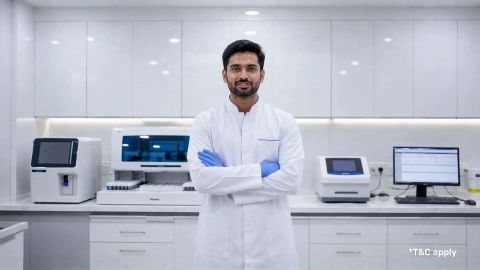
Pathology Lab Equipment Guide
In summary
A pathology lab equipment list covers instruments for blood testing, biochemistry, tissue examination, molecular diagnostics and laboratory safety. The equipment required depends on the tests offered and the expected sample volume.
- Essential pathology lab instruments: Microscopes, centrifuges, haematology analysers, biochemistry analysers and PCR machines support common laboratory tests.
- Equipment categories: Basic testing tools, histopathology instruments, molecular diagnostic systems and safety equipment serve different laboratory needs.
- Setup cost: A basic pathology lab setup may cost around Rs. 7.5 lakh, while a larger setup may cost Rs. 70 lakh or more. These are indicative estimates.
- Quality standards: Laboratories should follow suitable quality control procedures and applicable regulatory requirements. NABL accreditation is based on ISO 15189.
- Finance: Bajaj Finance offers medical equipment finance from Rs. 2 lakh to Rs. 30 crore, with repayment tenures from 3 to 120 months and no collateral required, subject to terms.
Healthcare providers can review Bajaj Finance medical equipment finance to plan eligible equipment purchases. Check your eligibility for medical equipment finance to explore financing options for your pathology lab equipment, subject to applicable terms and conditions.
What equipment is needed in a pathology lab?
A pathology lab equipment list usually includes basic laboratory tools, haematology and biochemistry analysers, histopathology instruments, molecular diagnostic systems and safety equipment. These pathology lab instruments help process samples and perform different tests.
| Equipment category | Key equipment | Primary function | Indicative price range |
|---|---|---|---|
| Basic laboratory tools | Microscopes, centrifuges, incubators | Sample preparation and examination | Rs. 50,000–Rs. 5 lakh |
| Haematology | Automated haematology analyser, coagulation analyser | Blood cell counts and clotting tests | Rs. 1.5 lakh–Rs. 15 lakh |
| Biochemistry | Biochemistry analyser, urine analyser | Measures substances in blood and urine | Rs. 2 lakh–Rs. 20 lakh |
| Molecular diagnostics | PCR machines, ELISA readers | Detects genetic material and specific biological markers | Rs. 3 lakh–Rs. 30 lakh |
| Histopathology | Tissue processor, microtome, embedding station | Prepares tissue samples for examination | Rs. 1 lakh–Rs. 10 lakh |
| Safety and support | Biosafety cabinet, autoclave, LIMS | Supports safe work and sample management | Rs. 50,000–Rs. 5 lakh |
Prices are broad planning estimates, not verified supplier quotations. Actual costs depend on the brand, model, capacity, accessories and installation requirements.
Haematology equipment
Haematology equipment is used to examine blood cells and assess conditions such as anaemia and infections. Common instruments include:
- Automated haematology analyser for complete blood counts (CBC).
- Semi-automated haematology analyser.
- Coagulation analyser.
- Blood gas analyser.
- Erythrocyte sedimentation rate (ESR) analyser.
Fully automated models can process more samples with less manual input. The actual throughput depends on the analyser model and test type. These instruments are also used in hospital and nursing laboratory settings.
Biochemistry and clinical chemistry equipment
A biochemistry analyser measures substances such as glucose, enzymes, proteins and electrolytes in blood and urine samples. Common equipment includes:
- Semi-automated or fully automated biochemistry analyser.
- Urine analyser.
- Electrolyte analyser.
- Spectrophotometer.
- ELISA reader.
The choice depends on the test menu and daily sample volume. A pathology lab should compare throughput, reagent costs and maintenance needs before selecting an analyser.
Histopathology equipment
Histopathology equipment is used to prepare and examine tissue samples. The workflow generally moves from grossing and processing to embedding, sectioning, staining and microscopy.
- Grossing station: Provides a work area for examining and preparing tissue samples.
- Tissue processor: Prepares tissue for embedding.
- Embedding station: Places processed tissue into a suitable medium.
- Microtome: Cuts thin tissue sections for slide preparation.
- Slide stainer and coverslipper: Stains and covers prepared slides.
- Microscope: Helps examine tissue sections.
Molecular diagnostics equipment
A PCR machine amplifies genetic material and supports molecular testing. Other pathology lab instruments used in this area include:
- Real-time PCR or quantitative PCR (qPCR) machine.
- ELISA reader.
- Flow cytometer.
- Nucleic acid extraction system.
- High-performance liquid chromatography (HPLC) system.
The equipment required depends on the tests offered. Laboratories should plan suitable work areas, infection control and biosafety measures. Applicable NABL requirements should also be reviewed when seeking accreditation.
Get professional loan for your needs

Personal loan for doctors for wedding
Get doctor loan for for wedding

Chartered accountant loan
Get CA loan with minimal documents

CA loan for setting practice
Get CA loan for setting up your practice
CA loan for office renovation
Get CA loan for renovating office

Business loan for lawyer
Get business loan for lawyer today

Business loan for CA
Get business loan for CA today
Medical equipment finance for diagnostic centre
Setup diagnostic centre with medical equipment finance

Personal loan for lawyer
Get a personal loan for lawyer

Personal loan for doctors for wedding
Get a personal loan for wedding

Personal loan for doctors
Get a personal loan for doctor

Personal loan for CA
Get a personal loan for CA
Medical equipment finance
Get a medical equipment finance

Lawyer loan to start firm
Get a lawyer loan to start firm

Lawyer loan for Chamber
Get a lawyer loan for Chamber

Lawyer loan
Get a lawyer loan

Hospital loan
Get a hospital loan

Doctor loan for setting up practice
Get a doctor loan for setting up practice
Doctor loan for clinic renovation
Get a doctor loan for clinic renovation

Doctor loan
Get a doctor loan
Our loan variants
Use our popular calculators






Types of medical equipment loan

Business loan for doctors

Business loan for chartered accountants

Set up a diagnostic centre with medical equipment finance

How to start a law firm in India

Doctor loan for clinic renovation
Frequently asked questions
Overview
What is the use of an ACT machine?
An ACT machine is used to measure the time it takes for blood to clot, aiding in monitoring anticoagulation therapy during surgeries and other medical procedures.
What is the purpose of an ACT machine?
The primary purpose of an ACT machine is to provide real-time data on blood coagulation, ensuring safe and effective anticoagulation management in patients.
What is the average lifespan of an ACT machine?
The average lifespan of an ACT machine ranges from 5 to 10 years, depending on the brand, usage frequency, and maintenance. Regular servicing and using certified consumables can help extend its life span.
Which ACT machine is best for cardiac surgeries?
For cardiac surgeries, a fully automated ACT machine is considered the best option. These machines provide fast, accurate, and consistent results, which are crucial during procedures requiring precise anticoagulation monitoring, such as bypass surgeries. Fully automated models reduce the risk of human error and can deliver results within seconds, allowing for real-time clinical decisions. They often include features like touchscreen displays, data storage, and integration with hospital systems. Their reliability and advanced capabilities make them ideal for high-stakes environments like cardiac operating theatres.
When should a hospital upgrade or replace its ACT machine?
A hospital should consider upgrading or replacing its ACT machine when the device shows frequent errors, inconsistent results, outdated features, rising maintenance costs, or limited service support. Newer equipment may offer improved testing efficiency, connectivity, automation and operational reliability.
How much does it cost to set up a pathology lab in India?
The pathology lab setup cost in India may start at around Rs. 7.5 lakh for a basic setup and reach Rs. 70 lakh or more for a larger setup with advanced equipment. The pathology lab equipment list, test menu, automation level and premises affect the total cost.
| Equipment or expense | Basic setup | Mid-range setup | High-end setup |
|---|---|---|---|
| Basic haematology analyser | Rs. 1.5 lakh | Rs. 5 lakh | Rs. 15 lakh+ |
| Biochemistry analyser | Rs. 2 lakh | Rs. 8 lakh | Rs. 20 lakh+ |
| Microscopes (set of 2) | Rs. 30,000 | Rs. 80,000 | Rs. 2 lakh+ |
| Centrifuge | Rs. 20,000 | Rs. 60,000 | Rs. 1.5 lakh+ |
| PCR machine | Rs. 3 lakh | Rs. 8 lakh | Rs. 25 lakh+ |
| LIMS software | Rs. 50,000 | Rs. 1.5 lakh | Rs. 5 lakh+ |
| Indicative total | Rs. 7.5 lakh | Rs. 25 lakh | Rs. 70 lakh+ |
These are model-derived planning estimates from the supplied brief. They are not confirmed market prices. The total excludes or may not fully cover premises, interiors, staff, licences, reagents, utilities, installation and working capital. Obtain current quotations before preparing a budget.
How much space is needed to set up a pathology lab?
There is no single minimum floor area that applies to every pathology lab. Space depends on the test menu, sample volume, equipment layout, staff numbers and local requirements.
| Lab type | Indicative planning area | Possible work areas |
|---|---|---|
| Small or basic lab | 300–500 sq. ft. | Reception, sample collection, testing and storage |
| Mid-size lab | 600–1,000 sq. ft. | Basic areas plus separate specialised testing space |
| Larger laboratory | 1,000 sq. ft. or more | Dedicated testing, storage, processing and waste areas |
These figures are preliminary space-planning estimates, not statutory minimums. A qualified laboratory planner should check the layout against applicable building, fire, biosafety and local regulatory requirements.
Bajaj Finance medical equipment finance may help eligible healthcare providers fund qualifying equipment purchases, subject to the product terms.
Semi-automated vs fully automated analyser: which should you choose?
The choice between a semi-automated analyser and a fully automated analyser depends on daily test volume, budget and staff availability. A semi-automated haematology analyser may suit a small pathology lab, while a fully automated model may suit a laboratory with higher sample volumes.
| Parameter | Semi-automated analyser | Fully automated analyser | Best suited for |
|---|---|---|---|
| Sample processing | More manual steps | More automated steps | Depends on workflow |
| Operator involvement | Higher | Lower for routine processing | Labs with limited staff may prefer automation |
| Throughput | Varies by model | Varies by model; often higher | Higher-volume laboratories |
| Initial cost | Generally lower | Generally higher | Budget-conscious labs may consider semi-automated models |
| Maintenance | May have simpler service needs | May need specialised servicing | Depends on service access |
| Test consistency | Depends on procedure and operator | Supports standardised processing | Both require quality control |
The throughput figures and prices should be checked against the selected manufacturer's specifications. A laboratory should compare reagent costs, service support and total ownership costs before choosing pathology lab equipment.
How do you maintain quality control in a pathology lab?
A pathology lab maintains quality control through instrument checks, internal quality control and external quality assessment. These practices help identify testing errors and support reliable results.
Key practices include:
- Instrument calibration: Follow the manufacturer's calibration and verification schedule for each analyser.
- Internal quality control (IQC): Run suitable control materials at the frequency required by the test and laboratory procedure.
- External quality assessment (EQA): Participate in an appropriate external quality assessment programme for the tests offered.
- Standard operating procedures: Maintain written procedures for sample collection, processing, testing and reporting.
- Staff competency: Train staff and assess their ability to perform assigned tasks.
- Sample checks: Identify and manage unsuitable, haemolysed, lipaemic or clotted samples according to test requirements.
- Record-keeping: Maintain equipment, reagent, calibration, control and maintenance records.
Calibration frequency should follow the manufacturer instructions and the laboratory's quality system. NABL accreditation assesses laboratory quality and competence against ISO 15189.
What are the NABL accreditation requirements for a pathology lab?
NABL accreditation for medical laboratories is based on ISO 15189:2022, which sets requirements for laboratory quality and competence. The National Accreditation Board for Testing and Calibration Laboratories assesses laboratories within their stated testing scope.
A laboratory preparing for accreditation should review the following areas:
- Personnel: Suitable qualifications, training and defined responsibilities.
- Facilities: Appropriate work areas and environmental conditions.
- Equipment: Suitable equipment, maintenance and calibration records.
- Testing procedures: Validated or verified methods and documented procedures.
- Quality control: Internal quality control and external quality assessment.
- Sample management: Procedures for collection, identification, transport and storage.
- Records and reporting: Controlled records and accurate test reports.
- Safety: Risk management, biosafety and waste handling procedures.
The accreditation process, assessment scope, fees and timeline depend on the laboratory and its application. NABL accreditation is not the same as a business licence to operate. Laboratories should consult the current NABL documents and applicable local regulations before applying.
What licences are required to open a pathology lab in India?
The licences and registrations required to open a pathology lab in India depend on the state, services offered, premises and business structure. Requirements may include clinical establishment registration, biomedical waste authorisation, local business permissions and fire safety clearance.
| Registration or permission | Relevant authority | When it may apply |
|---|---|---|
| Clinical establishment registration | State or Union Territory health authority | Where the Clinical Establishments Act or relevant state law applies |
| Biomedical waste authorisation | State Pollution Control Board or Pollution Control Committee | As applicable to facilities generating biomedical waste |
| Local trade or business permission | Municipal or local authority | As required for the premises and business |
| Fire safety approval | Local fire authority | Where required for the building or facility |
| GST registration | GST authorities | When the business meets applicable registration conditions |
| Drug licence | State Drugs Control Department | Where the laboratory's activities require one |
The Clinical Establishments Act, 2010 applies in the states and Union Territories that have adopted it. It includes laboratories and diagnostic centres within its definition of clinical establishments. The exact permissions must be checked with the relevant state and local authorities.
A PCPNDT registration is relevant where a facility carries out activities covered by the Pre-Conception and Pre-Natal Diagnostic Techniques Act. It is not a general licence for every pathology laboratory.
What are the biomedical waste management rules for a pathology lab?
Pathology labs must handle biomedical waste under the Biomedical Waste Management Rules, 2016, as amended. Waste should be segregated at the point of generation and sent for treatment through an authorised system.
Key requirements include:
- Separate waste into the applicable yellow, red, white and blue categories.
- Use the correct bags or containers for each type of waste.
- Keep sharps in suitable puncture-proof containers.
- Label and handle waste as required by the rules.
- Maintain the required waste records and reports.
- Use an authorised Common Biomedical Waste Treatment Facility where applicable.
The colour category depends on the waste type. Not all laboratory waste belongs in the same bag. Laboratories should follow the current rules, state pollution control requirements and approved waste-management procedures.
Which sample collection tubes are used in a pathology lab?
Pathology labs use sample collection tubes with different additives to prepare blood samples for specific tests. The cap colour often indicates the additive, but colours and tube specifications can vary by manufacturer.
| Tube colour | Common additive | Sample or function | Common tests |
|---|---|---|---|
| Red | No additive or clot activator, depending on tube | Serum | Biochemistry, serology and immunology |
| Purple or lavender | EDTA | Anticoagulated whole blood | Complete blood count and haematology |
| Light blue | Sodium citrate | Coagulation sample | PT and APTT |
| Green | Heparin | Plasma | Selected chemistry and electrolyte tests |
| Grey | Sodium fluoride with potassium oxalate or another specified additive | Helps preserve glucose | Blood glucose testing |
| Yellow | Additive depends on tube type; may include SPS or ACD | Blood culture or specialised testing | Microbiology or selected genetic tests |
| Black | Sodium citrate in a specified concentration | Anticoagulated blood | ESR |
Always check the tube label, additive and manufacturer's instructions. The correct tube and collection order depend on the test.
How can healthcare providers finance pathology lab equipment?
Medical equipment finance can help eligible healthcare providers manage the cost of setting up or upgrading a pathology lab. Bajaj Finance offers medical equipment finance for doctors and healthcare facility promoters, subject to eligibility and product terms.
Key product details include:
- Loan amount: Rs. 2 lakh to Rs. 30 crore.
- Repayment tenure: 3 to 120 months.
- Equipment funding: Up to 100% of equipment value, subject to terms.
- Collateral: No collateral is required.
- Processing: The stated approval or disbursal estimate is 48 hours, subject to verification and additional documents.
The loan amount and approval depend on the application and lender assessment. A borrower should review the applicable interest rate, fees, repayment terms and eligibility before applying.
Healthcare providers can explore medical equipment finance from Bajaj Finance. Check your eligibility for medical equipment finance to explore financing options for your purchase, subject to applicable terms and conditions.
What do our customers say about us
Dr. Rohan Mehta
Reviewed on
I applied for a doctor loan to upgrade my clinic infrastructure, and the experience was excellent. The application process was simple, the documentation was minimal, and the approval came through quickly. The team guided me throughout the process and ensured a seamless experience. I would highly recommend this financing option to medical professionals looking for reliable funding support.
Dr. Priya Sharma
Reviewed on
The doctor loan helped me manage my professional expenses without any financial stress. The loan disbursal was fast, and the customer support team was always available to answer my questions. The repayment options were flexible and suited my financial requirements perfectly. Overall, I am very satisfied with the service and support provided.
Dr. Arvind Nair
Reviewed on
I availed a doctor loan to purchase advanced medical equipment for my practice. The entire process was smooth, transparent, and completed within a short time. The competitive interest rates and hassle-free documentation made the experience even better. The support team remained helpful at every stage, making the loan journey convenient and stress-free.
Dr. Neha Kapoor
Reviewed on
I needed financial assistance to expand my healthcare practice, and this doctor loan proved to be the right solution. The approval process was quick, and the team provided clear guidance from application to disbursal. The flexible repayment tenure helped me plan my finances effectively. I am pleased with the overall experience and would recommend it to fellow doctors.
More articles
6 benefits of medical equipment loans
Read More
Set up a diagnostic centre with Medical Equipment Finance
Read More

Things to keep in mind when applying for Medical Equipment Loan
Read More

Role of credit score in securing medical equipment financing
Read More
Frequently asked questions
Overview
What are the essential instruments used in a pathology lab?
Pathology lab instruments include microscopes, centrifuges, haematology analysers, biochemistry analysers and PCR machines. The pathology lab equipment list may also include incubators, tissue processors, autoclaves and sample storage systems. The exact requirements depend on the tests offered, daily sample volume and whether the laboratory provides basic or specialised diagnostic services.
Can I get a customised pathology lab equipment list for my specific needs?
Yes. A pathology lab equipment list can be customised according to the test menu and expected sample volume. A haematology-only lab needs different instruments from a full-service laboratory that offers biochemistry, histopathology and molecular testing. Healthcare providers can also review medical equipment finance from Bajaj Finance for eligible equipment purchases.
What is the difference between a semi-automated and a fully automated pathology analyser?
A semi-automated analyser requires more manual steps, while a fully automated analyser performs more of the testing process automatically. Throughput varies by model, test type and laboratory workflow. A semi-automated analyser may suit a small pathology lab, while a fully automated model may suit a facility processing higher sample volumes.
What is included in pathology lab instruments used for molecular diagnostics?
Molecular diagnostic instruments include PCR machines, real-time PCR systems, ELISA readers, flow cytometers and nucleic acid extraction systems. These instruments support tests that detect genetic material or specific biological markers. The equipment required depends on the laboratory's testing scope, sample volume and biosafety requirements.
How often should pathology lab equipment be calibrated and serviced?
Pathology lab equipment should be calibrated, checked and serviced according to the manufacturer's instructions and the laboratory's quality system. Haematology and biochemistry analysers may need routine calibration, control testing and preventive maintenance. The laboratory should maintain records of calibration, repairs, service visits and performance checks.
Which haematology analyser suits a small pathology lab?
A semi-automated haematology analyser may suit a small pathology lab with a lower daily sample volume and a limited equipment budget. The laboratory should compare the analyser's test menu, throughput, reagent costs and service support. The final choice should reflect the expected workload and quality requirements.
Where can I buy refurbished pathology lab analysers in India?
Refurbished pathology lab analysers may be available through authorised manufacturer channels, established medical equipment dealers and verified hospital equipment sellers. Buyers should check the equipment's service history, calibration status, parts availability and warranty. They should also confirm applicable regulatory documents before purchasing or installing a refurbished analyser.
What are the basic requirements for NABL accreditation of a pathology lab?
NABL accreditation for medical laboratories is based on ISO 15189:2022. A laboratory needs suitable staff, facilities, equipment, documented procedures, quality control systems and reliable records. It must also demonstrate competence for the tests included in its accreditation scope. Requirements and assessment timelines depend on the application and laboratory.
How can I finance pathology lab equipment in India?
Medical equipment finance can help eligible healthcare providers fund pathology lab equipment purchases. Bajaj Finance offers loans from Rs. 2 lakh to Rs. 30 crore, with repayment tenures from 3 to 120 months and no collateral required, subject to terms. Applicants can check their offer using an OTP on the Bajaj Finance website or app. Approval is subject to verification and lender assessment.
What is the loan amount available for medical equipment finance from Bajaj Finance?
Bajaj Finance medical equipment finance is available for loan amounts from Rs. 2 lakh to Rs. 30 crore, with tenures from 3 to 120 months. No collateral is required, subject to product terms. Eligible healthcare providers can review the product details and check their offer through the application process. Check your eligibility for medical equipment finance to explore financing options for your purchase, subject to applicable terms and conditions.
Disclaimer
Bajaj Finance Limited has the sole and absolute discretion, without assigning any reason to accept or reject any application. Terms and conditions apply*.