







Support available Online, on call, or at branches
Get answers instantly without waiting on call:
Enter mobile and OTP · No password needed · No branch visit needed
In Summary
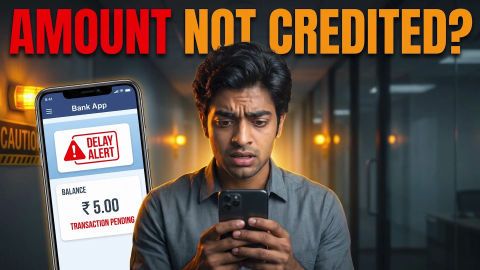
Track Disbursed Loan Amount Not Credited
A loan against securities not credited after a “disbursed” status means the lender has sent the money, but your bank has not added it to your balance. Check for a delayed transfer, wrong account details, a closed account, a returned amount or an undrawn credit limit. Ask your lender for the Unique Transaction Reference (UTR) number and give it to your bank. You can check your loan details and statement in Bajaj Finance My Account.
- 5 causes of a loan against securities not credited each have a different fix.
- The Reserve Bank of India (RBI) circular of 29 April 2024 calls interest from the sanction date, instead of the actual disbursement date, unfair.
- Your securities stay pledged while the loan account is open.
- With no lender reply in 30 days, you can complain to the RBI Ombudsman.
For a loan against securities not credited, the UTR shows whether the money is with your bank, back with the lender, or still in transit.
Also check your outstanding payment and track your my EMI status to stay on top of your loan.
Why is a loan against securities not credited after disbursal?
A loan against securities not credited after disbursal has 5 causes to check, and each needs a different fix. A loan against securities is a loan backed by shares, mutual fund units or other securities that you pledge. Disbursal is the lender sending the money. Credit is your bank adding it to your balance.
The table matches each cause of a loan against securities not credited to a first check.
| Cause | What it means | First check |
|---|---|---|
| Transfer in progress | Not yet finished | The UTR number and date |
| Details do not match | The account number, Indian Financial System Code (IFSC) or name differs | The account in your loan agreement |
| Account cannot accept credit | Your account is closed, frozen or inactive | Your account status |
| Amount returned | Your bank returned it | A reversal in the loan statement |
| Limit not drawn | A credit limit pays out only when you withdraw | Your sanction letter |
A mismatch returns the money to the lender. So check account details first for a loan against securities not credited.
How do you trace a loan against securities not credited?
You trace a loan against securities not credited by matching the lender’s UTR number with your bank’s records. A UTR number is the reference the banking system gives each bank transfer. Your bank locates the money with this number.
Follow these five steps for a loan against securities not credited.
- Check your bank statement for the loan amount, or a smaller credit after charges as applicable.
- Ask your lender, through an official channel, for the UTR number, the transfer date and the bank account used.
- Compare that account number and IFSC with your own. Read the digits aloud to catch a swapped number.
- Give the UTR number to your bank. Ask whether the amount was credited, held or returned.
- Tell the lender what your bank said, and ask for the next action in writing.
If the bank confirms a return, the next step on a loan against securities not credited sits with the lender. Keep every reply from both in writing.
Do you pay interest on a loan against securities not credited?
Interest on a loan against securities not credited must start from the actual disbursement of funds to you, not from the sanction date. The RBI set this out in a circular of 29 April 2024. The circular applies to non-banking financial companies (NBFCs). RBI supervisory teams have advised lenders to refund such excess interest. Check the first statement of a loan against securities not credited for the date interest starts.
Example (illustrative, not Bajaj Finance rates): Arjun, 42, an engineer in Pune, earns Rs. 1,20,000 a month and has a Credit Information Bureau (India) Limited (CIBIL) score of 760. He borrows Rs. 5,00,000 against shares at 12% per annum.
Formula: interest for a day = loan amount × annual rate ÷ 365. It splits a year’s interest into a daily cost.
- Interest for 1 day: Rs. 5,00,000 × 12% ÷ 365 = Rs. 164.38.
- Interest for 5 days: Rs. 5,00,000 × 12% × 5 ÷ 365 = Rs. 821.92.
For a loan against securities not credited until 5 days after interest starts, Arjun asks the lender to reverse Rs. 821.92. His bank statement is the proof of the credit date.
What happens to pledged securities while the credit is pending?
Your pledged securities stay pledged while a loan against securities not credited is traced, because the pledge is linked to the loan account. A pledge is a mark on your demat account (the electronic account for shares) or mutual fund folio that gives the lender a right over those securities.
While the pledge is active, three things apply:
- You cannot sell or transfer the pledged securities until the lender releases the pledge.
- You keep ownership, and benefits such as dividends stay yours, subject to your loan agreement.
- The pledge value moves with the market, and your loan agreement states what happens if it falls below the required level.
A loan against securities not credited still carries a live pledge. The pledge works as security from the day it is created, even before you receive any money. If you want the securities back before the issue is settled, ask the lender in writing how the pledge is released and which charges as applicable apply. Check your demat or folio statement to confirm which securities are marked.
Can you cancel a loan against securities not credited?
You can ask to cancel a loan against securities not credited, subject to the lender’s terms and your loan agreement. Compare the three realistic choices for a loan against securities not credited before you decide.
| Choice | When it suits you | What to keep in mind |
|---|---|---|
| Wait for the trace | The money is in transit or held by your bank | Ask your bank for a written credit date |
| Ask for a fresh transfer | The money came back to the lender | Submit new account details as the lender asks |
| Cancel and release the pledge | You no longer need the money | Charges as applicable and interest follow your loan agreement |
Waiting keeps the loan and the pledge in place. Cancelling frees your securities, but it ends the loan and the rate you were offered.
A loan against securities not credited does not cancel itself. The loan account stays open until the lender closes it in writing. If you cancel, ask for a closure letter that confirms the pledge release.
Raise a complaint in 2 steps: Lender first, then RBI Ombudsman
A complaint about a loan against securities not credited goes to the lender first, and to the RBI Ombudsman only after that. The Reserve Bank - Integrated Ombudsman Scheme, 2026 has applied since 1 July 2026. It covers NBFCs registered with the RBI, with exclusions listed in the Scheme.
The table sets out when each step for a loan against securities not credited applies.
| Step | When to take it | How to file |
|---|---|---|
| 1. Complain to the lender | Your bank confirms it does not hold the money | Official grievance channel, with the UTR |
| 2. Complain to the RBI Ombudsman | No reply in 30 days, or an unsatisfactory reply | cms.rbi.org.in, crpc@rbi.org.in, or post to the RBI’s Centralised Receipt and Processing Centre, Chandigarh |
File with the RBI Ombudsman within 90 days of the 30-day wait ending, or of the lender’s last reply, whichever is later. The RBI contact centre on 14448 gives information but does not take complaints. Attach both replies to show the loan against securities not credited was raised with the bank and the lender.
Next steps
- Check your loan details and statement in Bajaj Finance My Account.
- Review the charges that apply to your loan on the Bajaj Finance fees and charges page.
- Ask your bank to trace the UTR number and confirm in writing whether the amount was credited, held or returned.
Read more
Frequently Asked Questions
Disbursement Status & Delays
Missing Funds & Resolution
Where do I find the UTR number for my loan disbursal?
You get the UTR number from the lender that sent the money. Ask through an official channel and quote your loan account number. For a loan against securities not credited, your bank statement shows no entry yet. Your bank then traces the transfer from the UTR, the date and the amount.
Can I change the bank account after my loan is disbursed?
You can ask your lender to change the bank account, and the change follows the lender’s verification process. A new account matters only when the first transfer came back. Ask in writing and attach proof of the new account. The lender then sends the money again, with a new UTR.
My bank says the money came in, but my balance has not changed. Why?
A loan against securities not credited to your usable balance points to a hold by your bank, for example a freeze or a lien on your account. Ask your bank for a written note of any hold against that UTR. In this case, the issue sits with your bank, not the lender.
Will a loan against securities not credited show on my CIBIL report?
Yes, a loan account appears on your CIBIL report once the lender opens and reports it, even before the money reaches you. If you cancel, keep the closure letter. Check your report after closure. Raise a dispute on cibil.com if a loan against securities not credited and then cancelled still shows as open.
Can I sell my pledged shares while the credit is being traced?
No, you cannot sell pledged shares or units until the lender releases the pledge. The pledge stays live while the loan account is open, even before the money arrives. To sell, you first repay or cancel the loan as your agreement allows. Then ask the lender to release the pledge.
Someone called offering to release my loan amount for a fee. What should I do?
Do not pay the caller, and do not share any OTP, personal identification number (PIN) or password. Your lender traces a disbursal only through official channels. Call your lender on the number printed on your loan documents to check the call. Report fraud calls to the Government of India’s Cyber Crime Helpline on 1930.
More Articles

Disclaimer
While care is taken to update the information, products, and services included in or available on our website and related platforms/websites, there may be inadvertent inaccuracies or typographical errors or delays in updating the information. The material contained in this site, and on associated web pages, is for reference and general information purpose and the details mentioned in the respective product/service document shall prevail in case of any inconsistency. Subscribers and users should seek professional advice before acting on the basis of the information contained herein. Please take an informed decision with respect to any product or service after going through the relevant product/service document and applicable terms and conditions. In case any inconsistencies observed, please click on reach us.
*Terms and conditions apply.