








Rs. 1 lakh – Rs. 2.50 crore
Check your pre-approved offer and other benefits
Enter mobile and OTP | Check offer | Know your exact loan terms
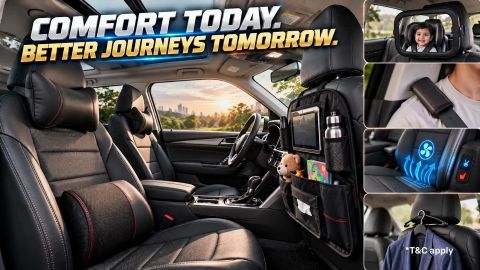
Must Have Car Seat Accessories for Comfort & Style
In summary
The right car seat accessory should solve a specific need without affecting the seat or its safety systems.
- Seat protection: Covers and protectors can reduce stains, wear, and everyday damage
- Comfort: Cushions, lumbar supports, cooling pads, and bead mats can change seat support or ventilation
- Organisation: Backseat organisers and coat hangers can help manage smaller items during travel
- Safety first: Check compatibility with side airbags, seat belts, child-restraint anchorages, and seat adjustment
Choose function and fitment before colour, material, or styling. An accessory that interferes with a restraint or airbag is not a suitable upgrade.
Last updated: September 2026
Which car seat accessories are useful?
Car seat accessories broadly serve four purposes: protection, comfort, cabin organisation, and passenger support.
You do not need every available accessory. Start with the problem you want to solve, then check whether the product suits your exact seat design.
Here are some commonly used options.
| Accessory | Main purpose | What to check |
| Seat cover | Protects original upholstery | Vehicle fit and airbag compatibility |
| Seat protector | Reduces marks, spills, and local wear | Secure positioning and restraint access |
| Seat cushion | Adds padding or support | Driving position and stability |
| Lumbar support | Supports the lower back | Seat-belt position and driving posture |
| Backseat organiser | Stores small travel items | Secure mounting and passenger space |
| Coat hanger | Holds jackets or clothing | Safe mounting position |
| Bead seat mat | Changes airflow and seat feel | Stable fit and unrestricted belt use |
| Heated cushion | Adds warmth | Electrical compatibility and wiring |
| Cooling cushion | Improves airflow | Fitment, power requirement, and seat compatibility |
The useful accessory is not necessarily the one with the most features. It is the one that works with your car without compromising the way the original seat functions.
Which accessories protect your car seats?
Seat covers and seat protectors are the most direct options for protecting upholstery.
A full seat cover shields a larger surface from dust, stains, friction, and everyday use. A seat protector targets a smaller area, such as beneath a child restraint or on a rear seat frequently used by children or pets.
Material alone should not drive the decision. A poorly fitted cover can bunch around the seat base, obstruct a buckle, or interfere with adjustment controls.
If your car has airbags built into the seats, check the owner's manual before adding a cover. Some vehicle manuals explicitly caution against accessory covers because they can affect side-airbag operation.
Which accessories improve seat comfort?
Seat cushions, lumbar supports, bead mats, heating pads, and cooling cushions can change how the seat feels during everyday driving.
A lumbar support can help when the standard seat does not give you enough lower-back support. A cooling cushion or bead mat focuses more on ventilation during longer journeys.
Start by adjusting the factory seat properly before adding anything. Set the backrest, seat height, steering position, and head restraint first.
Avoid cushions that raise you excessively or push your torso too far forward. Your seat belt should continue to sit correctly, and you should remain comfortable reaching the steering wheel and pedals.
Are cooling cushions and bead mats worth using?
Cooling cushions and bead mats can be useful when heat and perspiration make the seat uncomfortable, particularly during longer drives.
A bead mat creates small spaces between your body and the seat surface. Powered cooling cushions can use fans or airflow channels to reduce heat around the contact area.
Their benefit depends on your actual driving conditions. If the factory seat already provides adequate comfort or ventilation, an additional layer may add little value.
Whichever option you choose, make sure it stays in position while braking and cornering. A cushion that moves underneath you can interfere with a stable driving posture.
How should you choose a backseat organiser?
Choose a backseat organiser according to what you regularly carry rather than the number of pockets it offers.
An organiser can hold items such as tissues, charging cables, small travel accessories, documents, or children's essentials. Keeping these items secured can also reduce loose objects inside the cabin.
Check how the organiser attaches to the front seat. It should not restrict seat adjustment or cover any safety-system area.
Avoid storing heavy or hard objects loosely. During sudden braking, anything that is not properly secured can move through the cabin.
Should you use a seat-belt adjuster?
Treat aftermarket seat-belt adjusters more cautiously than ordinary comfort accessories.
A vehicle seat belt is designed to route the lap and shoulder sections across specific areas of the occupant's body. An accessory that changes this routing can affect how the restraint sits.
For an adult, first use the car's built-in seat-position and belt-height adjustments where available.
For a child, use the appropriate child restraint or booster according to its instructions and the vehicle's approved anchorage system. Do not treat a generic belt adjuster as a substitute for a suitable child-restraint system.
What should you check before buying seat covers?
Compatibility should come before appearance when you choose a car seat cover.
Check the seat and restraint system as a complete unit before buying.
- Exact fit: Confirm compatibility with your car model, variant, and seat layout.
- Airbag provision: Check whether side airbags are integrated into the seat.
- Seat-belt access: Keep buckles and belt paths completely accessible.
- Head-restraint movement: The cover should not restrict adjustment.
- Seat controls: Manual and powered controls should remain accessible.
- Child-restraint access: Keep ISOFIX or other approved anchorage points clear.
- Material suitability: Consider heat, ventilation, cleaning, grip, and durability.
- Fitment: Avoid loose straps or attachments around moving or safety-related components.
A custom-looking fit does not automatically make a cover suitable. The seat's original restraint and airbag functions take priority.
Which seat-cover material should you choose?
Choose material according to your climate, usage, cleaning needs, and comfort preference.
Fabric is often more breathable and can suit daily use in warmer conditions. Leatherette or similar synthetic surfaces are easier to wipe but can retain more heat after the car sits in the sun.
Water-resistant materials can be useful if children, pets, outdoor activities, or frequent spills are part of your routine.
There is no single material that suits every car. Consider how the seat will feel after an hour of driving, how often it will need cleaning, and whether the cover remains compatible with the seat's safety equipment.
What should you avoid when fitting seat accessories?
Avoid accessories that compromise the factory seat, restraint system, or your driving position.
Pay particular attention to the following situations:
- Seat covers fitted over seats with side airbags without confirmed compatibility
- Thick cushions that significantly alter your driving position
- Products that cover or obstruct seat-belt buckles
- Accessories that block child-restraint anchorages
- Loose organisers carrying heavy or hard objects
- Electrical cables running through seat-adjustment mechanisms
- Rigid accessories positioned near airbag deployment areas
- Cushions or mats that move when you brake or turn
If the accessory manufacturer and your vehicle manual give conflicting instructions, follow the vehicle manufacturer's safety guidance.
What should you inspect in a used car's seats?
Seat condition can reveal how heavily a pre-owned car has been used and whether refurbishment costs are likely after purchase.
Where practical, look beneath fitted covers rather than judging the cabin only by what is visible. Check the original upholstery for tears, sagging foam, damaged bolsters, staining, broken controls, or poor repairs.
Test the seat adjustment mechanisms and make sure the seat belts retract and latch properly. Check that child-restraint anchorages remain accessible where fitted.
A fresh set of covers can improve presentation while hiding worn original upholstery. Include the condition underneath in your assessment of the car.
When does replacing the car make more sense?
Worn seats or old seat covers alone are rarely a reason to replace a car. The decision becomes more relevant when interior deterioration comes with repeated mechanical expenses.
For example, an ageing car may need upholstery repairs while also requiring tyres, suspension work, clutch repairs, air-conditioning repairs, or other significant maintenance.
Instead of treating every workshop expense separately, consider what the car is likely to cost over the next 6 to 12 months. Compare that figure with its present value and the cost of moving to a better-maintained pre-owned vehicle.
Keeping the current car can still make sense when the work is mainly cosmetic and the mechanical condition remains sound. Considering a replacement becomes more reasonable when multiple costly repairs are accumulating and the vehicle no longer suits your needs.
How can a used car loan support the change?
If your assessment points towards replacing the car, the next step is to find a suitable pre-owned vehicle before deciding how to finance it.
Inspect the replacement car just as carefully. Check its seats, tyres, service history, mechanical condition, ownership records, insurance, and immediate repair requirements. Moving to another used car only makes sense when the replacement represents a meaningful improvement.
Once you have shortlisted an eligible vehicle, a used car loan can help you finance the purchase without paying the entire eligible amount from your available savings.
With the Bajaj Finance Used Car Loan, the amount and repayment structure depend on your borrowing requirement, repayment capacity, credit profile, and vehicle assessment.
Here are the current loan details to consider when planning the purchase.
| Loan detail | Bajaj Finance Used Car Loan |
| Loan amount | Rs. 1 lakh to Rs. 2.50 crore |
| Maximum financing | Up to 100% of the assessed car value |
| Repayment tenure | 12 months to 84 months |
| Interest rate | 10% to 18.25% p.a. |
| Credit score | CIBIL Score of 650 or higher |
| Vehicle requirement | Eligible private car, subject to vehicle age and ownership conditions |
Last updated: September 2026
Financing should support a replacement decision you have already made. The loan amount available should not determine which car you choose.
Once you know the amount you need to finance, use the used car loan EMI calculator to compare monthly repayment and total interest across different loan amounts and tenures.
If you have already identified the replacement car, you can also check your pre-approved used car loan offer before deciding whether to proceed.
What do our customers say about us
Amit Chauhan
Reviewed on 04 Mar 2025
Smooth and transparent used car loan process. The interest rates were competitive, and the documentation was minimal. The team guided me clearly at every step, making my used car purchase simple and stress-free. Highly recommended for quick approvals.
Ashwin Kamble
Reviewed on 24 Feb 2025
Clear guidance, quick approval, and flexible repayment options made buying my used car easier than expected. The team handled everything professionally. Very satisfied and would definitely recommend their used car loan.
Rohit Sharma
Reviewed on 12 Apr 2025
I had a great experience while applying for my used car loan. The process was quick, and the interest rate helped me manage the purchase better. Customer service was helpful throughout. Highly recommended for a smooth used car financing experience.
Ajay Kulkarni
Reviewed on 08 Dec 2024
My used car loan experience was simple and hassle-free. The approval was quick, the repayment options were flexible, and the team explained every step clearly. It helped me buy my preferred used car without financial stress. I would surely recommend it.
Related articles
Used Car Loan: Everything You Need To Know
Read More
Should You Opt for a Used Car Loan to Purchase Your Dream Car
Read More
How to choose the right tenure for your used car loan
Read More
Should You Opt for a Used Car Loan to Purchase Your Dream Car
Read More
Bajaj Finance app for all your financial needs and goals
Trusted by 50 million+ customers in India, Bajaj Finance App is a one-stop solution for all your financial needs and goals.
You can use the Bajaj Finance App to:
- Apply for loans online, such as Instant Personal Loan, Home Loan, Business Loan, Gold Loan, and more.
- Invest in fixed deposits and mutual funds on the app.
- Choose from multiple insurance for your health, motor and even pocket insurance, from various insurance providers.
- Pay and manage your bills and recharges using the BBPS platform. Use Bajaj Pay and Bajaj Wallet for quick and simple money transfers and transactions.
- Apply for Insta EMI Card and get a pre-qualified limit on the app. Explore over 1 million products on the app that can be purchased from a partner store on Easy EMIs.
- Shop from over 100+ brand partners that offer a diverse range of products and services.
- Use specialised tools like EMI calculators, SIP Calculators
- Check your credit score, download loan statements and even get quick customer support—all on the app.
Download the Bajaj Finance App today and experience the convenience of managing your finances on one app.
Frequently asked questions
Overview
Fitment and safety
Which car seat accessories are most useful?
The most useful car seat accessories depend on the problem you want to solve. Seat covers and protectors help preserve upholstery, while cushions and lumbar supports can change comfort. Backseat organisers help manage smaller travel items. Before adding any accessory, check whether it affects airbags, seat belts, child-restraint anchorages, seat adjustment, or your normal driving position.
Are aftermarket seat covers safe to use?
Aftermarket seat covers should only be used when they suit your vehicle's seat and safety-system design. This is particularly important where side airbags are integrated into the seats. Some vehicle manuals warn that unsuitable accessory covers can reduce or prevent the intended operation of side airbags. Check the owner's manual and product compatibility before fitment.
Can a seat cushion improve driving comfort?
A suitable cushion can improve comfort when the factory seat does not provide the support you need. It should not raise you excessively, move you too far from the seatback, or alter correct seat-belt positioning. Adjust the original seat and steering position first. Add a cushion only when it improves comfort while allowing stable access to the pedals, steering wheel, and controls.
Can car seat accessories interfere with airbags?
Yes. Seat covers and other accessories positioned around a seat-mounted side airbag can interfere with the area through which the airbag is designed to deploy. Avoid accessories near identified airbag locations unless their compatibility is specifically established for your vehicle. Check your owner's manual because airbag position and seat construction differ between models.
Should you use a seat-belt adjuster for a child?
A generic seat-belt adjuster should not replace an appropriate child-restraint system. Child restraints are designed to secure children through defined seat-belt routing or approved vehicle anchorages. Select the restraint appropriate for the child and install it according to the restraint and vehicle instructions. India's AIS-072 standard covers the attachment of child restraints through approved belt and anchorage arrangements.
Disclaimer
1. Bajaj Finance Limited (“BFL”) is a Non-Banking Finance Company (NBFC) and Prepaid Payment Instrument Issuer offering financial services viz., loans, deposits, Bajaj Pay Wallet, Bajaj Pay UPI, bill payments and third-party wealth management products. The details mentioned in the respective product/ service document shall prevail in case of any inconsistency with respect to the information referring to BFL products and services on this page.
2. All other information, such as, the images, facts, statistics etc. (“information”) that are in addition to the details mentioned in the BFL’s product/ service document and which are being displayed on this page only depicts the summary of the information sourced from the public domain. The said information is neither owned by BFL nor it is to the exclusive knowledge of BFL. There may be inadvertent inaccuracies or typographical errors or delays in updating the said information. Hence, users are advised to independently exercise diligence by verifying complete information, including by consulting experts, if any. Users shall be the sole owner of the decision taken, if any, about suitability of the same.