










Invest in equities, F&O and upcoming IPOs effortlessly by opening a demat account online. Enjoy a free subscription for the first year with Bajaj Broking

Know the benefits of demat account
Check now
Free Demat account in minutes | Low brokerage | Online account opening
In summary
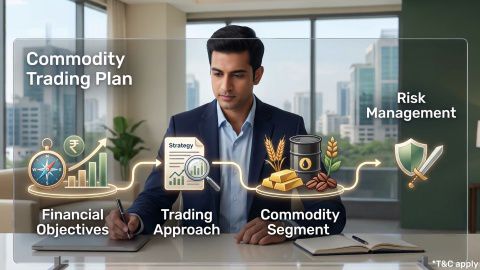
How to Create a Commodity Trading Business Plan
Want to trade gold, silver, or crude oil without putting all your savings at risk? A commodity trading business plan helps you decide how much money to use and when to exit a trade. It also helps you prepare for sudden price changes.
- Set your trading budget before risking money
- Choose commodities whose prices you can understand
- Check contract sizes before placing any trades
- Know your margin requirements and trading costs
- Fix your entry and exit prices beforehand
- Keep extra funds for sudden margin calls
Show More
Show Less
What is commodity trading and how does it work?
Commodity trading means buying and selling raw materials or contracts linked to their prices. These include gold, silver, crude oil, natural gas, and agricultural products.
In India, commodity derivatives trading is regulated by the Securities and Exchange Board of India (SEBI).
Two common types of contracts are:
- Futures: You agree to buy or sell a commodity at a fixed price on a future date, subject to the contract terms. Both parties have obligations.
- Options: You pay a premium for the right, but not the obligation, to exercise a contract. Option sellers have different obligations and can face large losses.
Some contracts are settled in cash. Others may require physical delivery.
Trading hours also depend on the commodity. Non-agricultural contracts generally trade from 9:00 AM to 11:30 PM during the applicable period, while some agricultural contracts close earlier.
Also read: Stock market vs commodity market
Show More
Show Less
How can a commodity trading business plan protect your money?
A commodity trading business plan helps you control how much money you risk on each trade. It also helps you avoid making decisions based on fear or excitement.
Suppose you have ₹50,000 in savings. You need some money for rent, food and family expenses.
If you use all ₹50,000 for trading, a sudden market fall could affect your household budget.
A trading plan helps you decide:
- How much money you can afford to lose
- Which commodities you want to trade
- When you should enter or exit
- How much money to keep for emergencies
The main purpose is to manage risk, not promise profits.
Show More
Show Less
How do you create a commodity trading business plan?
You can create a commodity trading business plan by following 7 steps. These steps cover your money, trading choices, risks, and costs.
1. Decide how much money you can risk
First, calculate your monthly income and expenses.
Keep money for rent, food, school fees, loan payments, and emergencies separate.
Only consider money you can afford to lose without affecting your daily needs.
2. Choose which commodities to trade
Different commodities react to different market conditions.
| Commodity | What affects its price? |
| Gold | Global interest rates and demand |
| Silver | Industrial demand and global prices |
| Crude oil | Global supply and demand |
| Natural gas | Weather, production and storage |
| Agricultural commodities | Weather, harvests and government policies |
For example, crude oil prices may rise when global supply falls. Gold prices may change when interest rates or currency values move.
No commodity is always stable.
3. Choose your trading style
Your trading style decides how long you hold a position.
Common trading styles include:
- Intraday trading: Buying and selling within the same trading day
- Swing trading: Holding positions for several days
- Hedging: Using contracts to reduce price risks linked to an existing business exposure
Each style carries risks. Holding a position overnight can expose you to sudden price changes.
4. Decide when to enter and exit
Before taking a trade, decide:
- At what price will you enter?
- How much loss can you accept?
- When will you exit?
- When will you avoid trading?
A stop-loss order can help manage losses. However, it may not execute at your chosen price during sudden market movements.
5. Understand margin requirements
In commodity futures, you usually deposit margin instead of paying the full contract value.
For example, you may need ₹15,000 as initial margin for a contract worth ₹1 lakh, depending on the contract and current requirements.
However, your profit or loss depends on the full contract exposure.
This means you could lose more than your initial margin.
6. Calculate your trading costs
Trading involves charges that can reduce your profits or increase your losses.
These may include:
- Brokerage charges
- Exchange transaction charges
- Applicable taxes
- Other contract-related charges
Check the applicable charges before calculating your expected trading result.
7. Review your trading decisions
Maintain a record of your trades.
Write down why you entered, when you exited, and how much money you gained or lost after charges.
This can help you identify repeated mistakes and check whether you followed your trading plan.
Show More
Show Less
What risks should you include in your trading plan?
Commodity prices can change suddenly. Your plan should explain how you will deal with losses and unexpected costs.
| Risk | How it affects your money |
| Market risk | Prices may move against your trade |
| Margin risk | You may need to deposit extra funds |
| Liquidity risk | You may struggle to exit at your expected price |
| Settlement risk | Some contracts may require physical delivery |
| Cost risk | Charges reduce your final trading result |
| Operational risk | Technical problems or order errors may affect trades |
For example, if crude oil prices move sharply against your position, you may face a margin call.
If you cannot maintain the required margin, your position may be closed under the applicable rules.
Also read: Commodity channel index
Show More
Show Less
Start investing today

Open Demat Account
Open Trading Account

Margin Trading Facility
What should you check before choosing a commodity broker?
A commodity broker provides access to commodity trading contracts. However, brokers may differ in their charges, services, and available contracts.
Before selecting one, check:
- Whether the broker has the required regulatory registration
- Which commodity contracts are available
- How much brokerage and other charges apply
- What margin requirements you must meet
- How settlements and withdrawals work
- How customer complaints are handled
A broker cannot remove the risk of market losses.
What do you need for a commodity trading account?
To trade exchange-listed commodity derivatives in India, you generally need a trading account with a registered broker that offers the relevant segment.
The usual requirements include:
- Completing Know Your Customer (KYC) verification
- Providing Permanent Account Number (PAN) details
- Linking an eligible bank account
- Submitting income proof where required
- Completing the relevant trading segment activation
- Understanding margin and settlement rules
Document requirements and account activation timelines may vary.
Show More
Show Less
Upcoming IPO
Mainboard
SME
Aarvee Engineering Consultants Limited
Bidding
To
be announced
Price
To be announced
Abakkus Asset Manager Limited
Bidding
To
be announced
Price
To be announced
Absolute Project India Limited
Bidding
To
be announced
Price
To be announced
Advanced SysTek Limited
Bidding
To
be announced
Price
To be announced
Advanta Enterprises Limited
Bidding
To
be announced
Price
To be announced
Conclusion
A commodity trading business plan helps you decide how much money to risk, which commodities to trade, and when to exit. It also helps you prepare for trading costs and sudden price changes.
Before taking any position, understand the contract size, margin requirements, and possible losses. Keep your household savings separate from trading funds. Review your decisions regularly and follow your risk limits. A written plan cannot ensure profits, but it can help you make more disciplined trading decisions.
Show More
Show Less
Features and Benefits of LAS

Tenure 36 months
Flexible repayment from 7 days to 36 months

1000+ shares
Get 50% value on 1000+ shares

All DP shares available
All companies’ and DPs’ Demat accounts accepted for loans

Customer portal
Handle loans, shares, and statements — all in one place
Pro Tip
Top Investment Options for You




Related Articles
Frequently Asked Questions
How to Create a Commodity Trading Business Plan
What is the best strategy for commodity trading?
Is commodity trading still profitable?
Commodity trading can generate profits, but losses are also possible. Your result depends on price movements, contract exposure, trading costs, and your decisions. Futures and options can involve substantial financial risk.
Disclaimer
Investments in the securities market are subject to market risk, read all related documents carefully before investing.
Broking services offered by Bajaj Financial Securities Limited (Bajaj Broking). Reg Office: Bajaj Auto Limited Complex, Mumbai –Pune Road Akurdi Pune 411035. Corporate Office: Bajaj Financial Securities Limited, 1st Floor, Mantri IT Park, Tower B, Unit No 9 & 10, Viman Nagar, Pune, Maharashtra 411014. SEBI Registration No.: INZ000218931 | BSE Cash/F&O/CDS (Member ID:6706) | NSE Cash/F&O/CDS (Member ID: 90177) | MCX (Member ID: 57680) | DP registration No: IN-DP-418-2019 | CDSL DP No.: 12088600 | NSDL DP No. IN304300 | AMFI Registration No.: ARN –163403.
Details of Compliance Officer: Mr. Harinatha Reddy Muthumula (For Broking/DP/Research) | Email: compliance_sec@bajajbroking.in | Contact No.: 020-4857 4486. For any investor grievances write to compliance_sec@bajajbroking.in/ compliance_dp@bajajbroking.in (DP related)
This content is for educational purpose only. Securities quoted are exemplary and not recommendatory.
Research Services are offered by Bajaj Broking as Research Analyst under SEBI Regn: INH000010043.
For more disclaimer, check here: https://www.bajajbroking.in/disclaimer