








Rs. 2 lakh – Rs. 30 crore
Check your pre-approved medical equipment loan
Enter mobile and OTP | Check offer | Know your exact loan terms

Auto CPAP Machine — Sleep Apnoea Ka Smart Ilaaj
In summary
Operation theatre equipment helps healthcare professionals prepare patients for surgery, monitor vital parameters and support surgical procedures. Different equipment serves specific functions, from maintaining sterile conditions to supporting anaesthesia and patient monitoring.
- Common equipment includes operating tables, surgical lights, anaesthesia machines and patient monitors.
- Other equipment may include electrosurgical units, suction machines, surgical microscopes and sterilisation equipment.
- Equipment selection depends on the type of procedures, required specifications, space and facility requirements.
- Medical Equipment Finance can help eligible healthcare professionals and facilities finance the purchase of equipment, subject to applicable terms and conditions.
Bajaj Finance offers Medical Equipment Finance to eligible applicants for purchasing medical equipment. The available loan amount, repayment tenure and other terms depend on applicable eligibility criteria and loan conditions.
Last updated: September 2026
What is operation theatre?
-
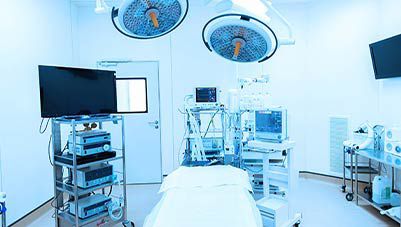
An operation theatre (OT), also known as an operating room, is a specialised and sterile environment within a hospital or surgical facility where surgical procedures are performed. It is designed to maintain strict aseptic conditions, minimise the risk of infection, and ensure patient safety throughout the surgical process. Operation theatres must comply with established healthcare infrastructure standards and regulatory requirements, including guidelines issued by the National Accreditation Board for Hospitals & Healthcare Providers (NABH) and relevant medical equipment regulations overseen by the Central Drugs Standard Control Organisation (CDSCO).
What equipment is used in an operation theatre?
An operation theatre may contain several types of equipment, depending on the procedures performed and the facility's requirements.
| Equipment | Primary use |
|---|---|
| Operating table | Positions and supports the patient during surgery |
| Surgical light | Provides focused illumination of the surgical area |
| Anaesthesia machine | Supports the administration of anaesthesia and ventilation |
| Patient monitor | Displays parameters such as heart rate, blood pressure and oxygen saturation |
| Electrosurgical unit | Supports cutting or coagulation during selected procedures |
| Suction machine | Removes fluids and secretions during procedures |
| Defibrillator | Provides emergency cardiac intervention when clinically required |
| Infusion pump | Delivers fluids or medicines at controlled rates |
| Surgical microscope | Provides magnification for procedures requiring detailed visualisation |
| Sterilisation equipment | Supports sterilisation of reusable medical instruments |
What should you consider when buying operation theatre equipment?
Before purchasing equipment, healthcare facilities can assess the following factors:
- Type of procedures: Identify the surgical procedures performed at the facility and the equipment required for them.
- Technical specifications: Compare specifications with the clinical and operational requirements of the facility.
- Space requirements: Check whether the equipment can be installed and operated within the available space.
- Compatibility: Ensure that the equipment can work with existing systems and accessories where required.
- Maintenance requirements: Review servicing requirements, warranty coverage and availability of technical support.
- Training requirements: Consider whether healthcare professionals and technicians require training to operate the equipment.
- Safety requirements: Check applicable safety standards, certifications and manufacturer instructions before purchase.
How much does operation theatre equipment cost?
The cost of operation theatre equipment varies depending on the type of equipment, specifications, brand, technology and other factors. A complete operation theatre setup may include multiple devices, making the overall investment different from the cost of purchasing individual equipment. Healthcare facilities should compare equipment specifications, warranty terms, after-sales support and maintenance requirements rather than considering the purchase price alone.
| Equipment Type | Price Range (INR) | Key Features |
| Surgical tables | Rs. 1,50,000 - Rs. 7,00,000 | Adjustability, load capacity, attachments |
| Anaesthesia machines | Rs. 2,00,000 - Rs. 15,00,000 | Gas control, ventilators, and monitoring systems |
| Surgical lights | Rs. 50,000 - Rs. 3,50,000 | LED output, intensity control, colour accuracy |
| Patient monitors | Rs. 40,000 - Rs. 5,00,000 | Multi-parameter tracking, connectivity |
| Electrosurgical units | Rs. 70,000 - Rs. 4,50,000 | Mono and bipolar modes, safety controls |
| Autoclaves and sterilisers | Rs. 40,000 - Rs. 3,00,000 | Chamber size, cycle efficiency |
| Defibrillators | Rs. 50,000 - Rs. 4,00,000 | Energy control, AED functionality |
| Suction machines | Rs. 15,000 - Rs. 1,20,000 | Vacuum strength, portability |
Can you finance operation theatre equipment?
Yes. Eligible doctors and healthcare facility promoters can use Bajaj Finance Medical Equipment Finance to finance the purchase of eligible medical equipment, subject to applicable eligibility criteria and loan terms. Bajaj Finance offers loan amounts from Rs. 2 lakh to Rs. 30 crore, with repayment tenures ranging from 3 months to 120 months. Financing of up to 100% of equipment value may be available, subject to applicable terms and conditions.
Features of Bajaj Finance Medical Equipment Finance
Loan amount up to Rs. 30 crore
Access financing from Rs. 2 lakh to Rs. 30 crore to manage the cost of purchasing eligible medical equipment.Repayment tenures of 3 months to 120 months
Choose a repayment tenure ranging from 3 months to 120 months, subject to applicable loan terms.Approval in 48 hours*
Eligible applications may receive approval within 48 hours*. The actual timeframe may vary depending on verification, application timing and additional documentation.Transparent fees and charges
Applicable fees and charges are disclosed in the loan documents and on the relevant product page. Review the applicable charges before proceeding.End-to-end online application
Start the application process online by providing the required details and documents.Pre-approved offers for select customers
Select customers may receive pre-approved offers. You can check your available offer by entering your registered mobile number and completing the required OTP verification.Financing of up to 100% of equipment value
Bajaj Finance may finance up to 100% of the equipment value, subject to applicable terms and conditions.
*Terms and conditions apply.
Get professional loan for your needs

Personal loan for doctors for wedding
Get doctor loan for for wedding

Chartered accountant loan
Get CA loan with minimal documents

CA loan for setting practice
Get CA loan for setting up your practice
CA loan for office renovation
Get CA loan for renovating office

Business loan for lawyer
Get business loan for lawyer today

Business loan for CA
Get business loan for CA today
Medical equipment finance for diagnostic centre
Setup diagnostic centre with medical equipment finance

Personal loan for lawyer
Get a personal loan for lawyer

Personal loan for doctors for wedding
Get a personal loan for wedding

Personal loan for doctors
Get a personal loan for doctor

Personal loan for CA
Get a personal loan for CA
Medical equipment finance
Get a medical equipment finance

Lawyer loan to start firm
Get a lawyer loan to start firm

Lawyer loan for Chamber
Get a lawyer loan for Chamber

Lawyer loan
Get a lawyer loan

Hospital loan
Get a hospital loan

Doctor loan for setting up practice
Get a doctor loan for setting up practice
Doctor loan for clinic renovation
Get a doctor loan for clinic renovation

Doctor loan
Get a doctor loan
How can you apply for Medical Equipment Finance?
You can start the Bajaj Finance Medical Equipment Finance application online.
The application journey involves:
- Visit the Bajaj Finance Medical Equipment Finance page
- Click on the 'APPLY' button on the page
- Enter your 10-digit mobile number and OTP
- Fill in the application form with your basic details, such as your full name, PAN, date of birth, and PIN code
- Once you enter all your details, please click on 'PROCEED' to visit the loan selection page
- Enter the loan amount that you need
- Choose the repayment tenure – you can select tenure options of 3 months to 120 months and click on ‘PROCEED’
- Complete your KYC and submit your medical equipment finance application
Bajaj Finance Medical Equipment Finance can help you purchase operation theatre equipment without paying the entire cost upfront. Choose a repayment tenure that suits your financial requirements and plan your equipment investment.
Ready to upgrade your healthcare facility? Check your Medical Equipment Finance eligibility now and plan your purchase.
Our loan variants
Use our popular calculators






Types of medical equipment loan

Business loan for doctors

Business loan for chartered accountants

Set up a diagnostic centre with medical equipment finance

How to start a law firm in India

Doctor loan for clinic renovation
Frequently asked questions
Overview
What is the meaning of operation theatre?
An operation theatre, commonly referred to as an operating theatre (OT) or surgery suite, is a specialised facility within a hospital or healthcare facility where surgical procedures are performed on patients. It is equipped with surgical instruments, anaesthesia machines, and other medical equipment necessary for surgical interventions.
What are the 3 types of operating rooms?
The three types of operating rooms are main, minor, and specialised theatres. Main theatres accommodate major surgical procedures, while minor theatres handle minor surgeries and procedures. Specialised theatres are equipped for specific surgical specialties, such as orthopaedics or neurosurgery, requiring specialised equipment and expertise.
What equipment is used in the operation theatre?
In the operating theatre, various equipment is employed, including surgical tables, lighting systems, anaesthesia machines, monitoring devices, endoscopic instruments, microscopes, and electrosurgical units. These tools play pivotal roles in facilitating surgical procedures and ensuring patient safety and optimal outcomes.
What are examples of operating equipment?
Examples of operating equipment include surgical lights, anesthesia machines, defibrillators, surgical tables, ECG machines, electrocautery units, infusion pumps, patient monitors, and various surgical instruments. These tools are essential for performing surgeries, ensuring patient safety, and maintaining a sterile and efficient operating environment.
What equipment is mandatory in an operation theatre?
Essential OT equipment includes surgical tables, anaesthesia machines, OT lights, patient monitors, sterilisation units, and basic surgical instruments. These ensure safe anaesthesia delivery, proper visibility, infection control, and continuous patient monitoring during procedures.
How often should operation theatre equipment be serviced?
Routine checks should be done daily and weekly, while preventive maintenance is typically scheduled quarterly. A comprehensive servicing by authorised technicians is recommended annually to ensure accuracy, safety, and compliance.
Who needs to understand operation theatre equipment?
Healthcare professionals, hospital administrators, surgeons, operation theatre technicians and facility managers should understand operation theatre equipment. This knowledge helps them assess equipment requirements, understand basic functions, plan purchases, coordinate maintenance and ensure that equipment is suitable for the facility’s surgical needs.
Why should professionals pay attention to operation theatre equipment?
Operation theatre equipment directly supports surgical procedures, patient monitoring, anaesthesia delivery and other clinical requirements. Professionals should carefully assess equipment quality, specifications, safety features, compatibility, maintenance needs and manufacturer support to ensure it meets the operational and clinical requirements of their healthcare facility.
What do our customers say about us
Dr. Rohan Mehta
Reviewed on
I applied for a doctor loan to upgrade my clinic infrastructure, and the experience was excellent. The application process was simple, the documentation was minimal, and the approval came through quickly. The team guided me throughout the process and ensured a seamless experience. I would highly recommend this financing option to medical professionals looking for reliable funding support.
Dr. Priya Sharma
Reviewed on
The doctor loan helped me manage my professional expenses without any financial stress. The loan disbursal was fast, and the customer support team was always available to answer my questions. The repayment options were flexible and suited my financial requirements perfectly. Overall, I am very satisfied with the service and support provided.
Dr. Arvind Nair
Reviewed on
I availed a doctor loan to purchase advanced medical equipment for my practice. The entire process was smooth, transparent, and completed within a short time. The competitive interest rates and hassle-free documentation made the experience even better. The support team remained helpful at every stage, making the loan journey convenient and stress-free.
Dr. Neha Kapoor
Reviewed on
I needed financial assistance to expand my healthcare practice, and this doctor loan proved to be the right solution. The approval process was quick, and the team provided clear guidance from application to disbursal. The flexible repayment tenure helped me plan my finances effectively. I am pleased with the overall experience and would recommend it to fellow doctors.
More articles

Disclaimer
Bajaj Finance Limited has the sole and absolute discretion, without assigning any reason to accept or reject any application. Terms and conditions apply*.