





Tips to Maximise Honda Dio Mileage
Improve your Honda Dio mileage through smoother riding, correct tyre pressure, timely servicing, and practical fuel-saving habits for city travel.


Key Specifications
-
Analogue, Digital Instrument Console
-
LED Headlight
-
Tubeless Tyre Type
-
LED Tail Light
-
Vibrant Orange, Matte Dark Blue Color

You may be eligible for a pre-approved offer
Quick approval | Flexible tenure options | Minimal paperwork
In summary
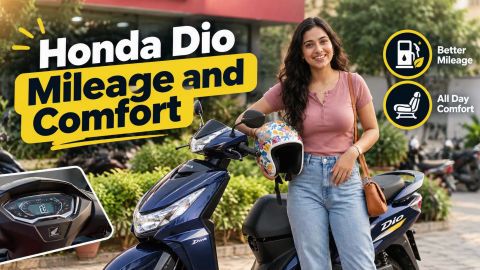
Honda Dio Mileage and Comfort
Honda Dio mileage depends on traffic, acceleration, road conditions, and regular maintenance. The 109.51 cc petrol scooter uses an automatic transmission that makes daily commuting convenient, particularly on busy city roads.
- Engine: The Honda Dio has a 109.51 cc, single-cylinder, fuel-injected petrol engine with an automatic transmission.
- Mileage benchmark: Approximately 50 kmpl is a commonly published reference figure, but Honda has not disclosed an official ARAI figure for the updated 2025 model.
- Fuel tank: Its 5.3-litre tank provides an illustrative theoretical range of 265 km at 50 kmpl.
- Mileage improvement: Smooth throttle use, correct tyre pressure, and avoiding unnecessary engine idling can help limit petrol consumption.
- Maintenance: Regular inspection of the air filter, spark plug, brakes, and transmission helps maintain consistent performance.
- Bajaj Finance Two-wheeler Loan amount: Rs. 35,000 to Rs. 21 lakh
If you eventually decide to replace your scooter, explore the Bajaj Finance Two-wheeler Loan to understand your financing options.
Last updated: 26th October, 2026
What is the Honda Dio mileage?
The Honda Dio has a commonly published mileage benchmark of approximately 50 kmpl. However, this should not be presented as an officially confirmed Automotive Research Association of India (ARAI) mileage figure for the updated model.
The 2025 Dio received an emissions-compliant 109.51 cc engine, and Honda did not publish an ARAI-certified mileage number with that update. Everyday petrol consumption will also depend on traffic, throttle use, and maintenance.
| Mileage type | Honda Dio mileage |
|---|---|
| Published mileage reference | Approximately 50 kmpl |
| Independently verified city mileage | Not available |
| Independently verified highway mileage | Not available |
At the reference figure of 50 kmpl, the 5.3-litre fuel tank gives a theoretical range of approximately 265 km. Actual distance between refills will be lower or higher depending on consumption and the fuel reserve you maintain.
Pro tip: Keep a record of your scooter's fuel consumption over three or four complete refills. Compare the results from similar routes rather than judging mileage from one short journey.
Source: Autocar India (October 2026 listing); BikeWale (January 2025 model update)
How can you maximise Honda Dio mileage?
-
1. Accelerate smoothly - Apply the throttle gradually when moving away from traffic signals. Quick acceleration followed by immediate braking uses more petrol than maintaining steady progress. The Dio's automatic transmission adjusts the drive ratio without manual gear changes. Avoid repeatedly opening and closing the throttle when travelling through slow traffic.
2. Maintain a steady riding speed - Try to maintain a consistent speed whenever traffic and road conditions allow. Unnecessary changes in speed make the engine work harder. On clear roads, use gentle throttle inputs rather than repeatedly accelerating towards slower vehicles. Always follow speed limits and adjust your speed to the road conditions. Do not chase a particular speed simply because someone suggests it gives better mileage.
3. Maintain correct tyre pressure - Underinflated tyres increase rolling resistance and may cause the engine to consume more petrol. Check the tyres when they are cold and inflate them according to Honda's recommendations for your model year. If you frequently carry a pillion, follow the appropriate pressure recommendation for additional load. Do not exceed the specified tyre pressure to improve mileage, as this can affect handling and grip.
4. Follow the recommended service schedule - Regular servicing helps keep the Dio's engine and automatic transmission working correctly. During maintenance, ask the technician to inspect the spark plug, brakes, air filter, drive belt, and CVT components. A worn transmission component or dragging brake can affect how efficiently the scooter moves. Follow Honda's service schedule for your particular model rather than relying on generic servicing intervals.
5. Use the recommended engine oil - Correct engine oil supports lubrication and smooth operation. Check the oil level using Honda's recommended procedure and use the oil grade specified in the owner's manual for your Dio's model year. Avoid choosing a different grade simply because it is advertised as improving fuel efficiency. An unsuitable oil can affect engine protection and performance.
6. Maintain the air filter - The air filter prevents dust and dirt from entering the engine. When the filter becomes clogged, airflow can be restricted, affecting combustion and engine response. If your daily commute includes dusty roads or construction areas, arrange air-filter inspection as recommended by Honda. Replace the filter when its condition or the maintenance schedule requires it. Do not operate the scooter without an air filter.
7. Avoid unnecessary engine idling - Idling uses petrol even when your scooter is stationary. Switch off the engine during longer, safe stops where doing so will not interfere with traffic movement. Do not assume every Honda Dio variant has an automatic idle-stop system. Check your particular version's equipment and follow its owner's manual. Avoid switching off the engine during brief stops when you need to move immediately.
8. Avoid carrying unnecessary weight - Additional luggage increases the load on the scooter, especially while accelerating. Remove unnecessary belongings from the storage compartment and keep luggage secure. If you regularly carry another person, follow Honda's recommended load and tyre-pressure limits. Never compromise stability or exceed the permitted weight to complete a journey.
9. Anticipate traffic and braking - Watch the traffic ahead and keep adequate space between your scooter and other vehicles. This helps you slow down progressively rather than accelerating towards a traffic signal and
then braking suddenly. Plan your movements carefully around junctions, speed breakers, and congested sections. Never compromise braking or traffic safety to reduce fuel consumption.
10. Monitor your mileage regularly - Record the petrol purchased and kilometres travelled between refills. If your Dio normally returns similar mileage on a familiar route, a continuing decline may indicate changing traffic conditions or a maintenance issue. Compare several readings before concluding that something is wrong. A simple notebook or phone record can help you identify when fuel consumption began increasing.
How can you calculate Honda Dio mileage accurately?
Mileage = Distance travelled ÷ Petrol consumed
The full-tank method helps you calculate Honda Dio mileage using actual distance travelled and the petrol required to refill the tank.
Follow these steps:
- Fill the petrol tank to a consistent level without overfilling.
- Reset the trip meter or record the odometer reading.
- Ride normally during your daily journeys.
- Return to a petrol station when you need to refuel.
- Refill to approximately the same level.
- Record the amount of petrol added.
- Divide the distance travelled by the litres consumed.
- Repeat the calculation across several refills.
Example: Suppose your Honda Dio covers 225 km and needs 4.5 litres of petrol at the next refill.
Mileage = 225 km ÷ 4.5 litres = 50 kmpl
This is an illustrative calculation, not an independently measured result for the current Honda Dio. Refuelling levels, route changes, and traffic can affect individual readings. An average across several refills is more useful for estimating monthly petrol expenses.
How much can better Honda Dio mileage save?
If you travel 1,000 km monthly, improving your mileage from an illustrative 40 kmpl to 50 kmpl would save Rs. 550 per month, assuming petrol costs Rs. 110 per litre.
The table below shows how different mileage assumptions change monthly fuel expenses.
| Mileage assumption | Petrol needed for 1,000 km | Monthly fuel cost |
|---|---|---|
| 40 kmpl | 25.00 litres | Rs. 2,750 |
| 45 kmpl | 22.22 litres | Rs. 2,444 |
| 50 kmpl | 20.00 litres | Rs. 2,200 |
| 55 kmpl | 18.18 litres | Rs. 2,000 |
Monthly fuel cost = Monthly distance ÷ Mileage × Petrol price
These mileage figures are illustrative scenarios, not verified road-test results. No riding or maintenance practice guarantees a particular improvement. At the assumed petrol price, increasing mileage from 45 kmpl to 50 kmpl would save approximately Rs. 244 monthly, or Rs. 2,933 annually.
Use your own measured mileage and local petrol price to estimate realistic expenses.
What are Honda Dio specifications?
When should you get your Honda Dio checked?
Have your Honda Dio checked when petrol consumption rises consistently on familiar routes, particularly if you also notice unusual vibrations, weak acceleration, difficult starting, or irregular engine operation. A low reading during exceptionally heavy traffic may not indicate a mechanical problem. Repeated poor mileage under comparable conditions deserves attention.
| Warning sign | What to check |
|---|---|
| Mileage falls unexpectedly | Tyre pressure, air filter, spark plug, and fuel system |
| Engine struggles to start | Spark plug, battery, and starting system |
| Acceleration becomes weak | CVT belt, clutch, air filter, and fuel injection |
| Scooter vibrates unusually | CVT components, engine mounts, and wheel condition |
| Scooter feels difficult to move | Dragging brakes and tyre inflation |
| Engine runs unevenly | Fuel delivery, spark plug, and engine sensors |
| Unusual noises during acceleration | CVT belt, rollers, and clutch condition |
Have a trained technician inspect the scooter before replacing components. Some problems can be corrected through cleaning or adjustment, while others may require repairs.
When should you consider replacing your Honda Dio?
Consider replacing your Honda Dio when ongoing repair costs, frequent breakdowns, or changing commuting needs make continued ownership less practical. A small mileage reduction alone rarely justifies purchasing a new scooter.
For example, consider Meera, a 30-year-old teacher in Chennai who rides 24 km daily for 25 working days. Her monthly travel distance is 600 km. Suppose her older Dio returns an illustrative 40 kmpl, while a replacement scooter could return 50 kmpl under comparable conditions. At Rs. 110 per litre, the estimated expenses would be:
| Expense | Existing scooter | Replacement scooter |
|---|---|---|
| Monthly travel | 600 km | 600 km |
| Illustrative mileage | 40 kmpl | 50 kmpl |
| Petrol needed | 15 litres | 12 litres |
| Monthly petrol cost | Rs. 1,650 | Rs. 1,320 |
Meera would save approximately Rs. 330 per month, or Rs. 3,960 annually.
The mileage assumptions are hypothetical and do not represent verified results for either scooter. This petrol saving alone would not usually cover the purchase cost of a replacement within a reasonable period. However, if the existing scooter also needs repeated transmission repairs or frequently breaks down before work, replacement may deserve consideration.
Compare likely repair bills, resale value, insurance, servicing, and purchase expenses before deciding.
How Bajaj Finance Two-wheeler Loan can help
If replacing your Honda Dio becomes necessary, a Bajaj Finance Two-wheeler Loan can help finance an eligible new scooter through monthly instalments. Review the available borrowing limits and repayment terms before selecting a replacement and deciding how much to borrow.
| Loan detail | Bajaj Finance Two-wheeler Loan |
|---|---|
| Loan amount | Rs. 35,000 to Rs. 21 lakh |
| Maximum financing | Up to 100% of the on-road price |
| Repayment tenure | 6 months to 84 months |
| Interest rate | Up to 24.25% p.a. |
Last updated: 26th October, 2026
The approved loan amount, applicable interest rate, and repayment conditions depend on your eligibility and lending assessment.
What could a replacement scooter EMI look like?
Suppose Meera decides to purchase a replacement scooter and borrows Rs. 60,000 for 24 months at an illustrative annual interest rate of 12%.
The equated monthly instalment (EMI) is calculated using the reducing-balance formula:
EMI = [P × R × (1 + R)^N] ÷ [(1 + R)^N − 1]
Where:
- P = Loan amount
- R = Monthly decimal interest rate
- N = Number of monthly instalments
For this example:
- P = Rs. 60,000
- R = 12 ÷ 12 ÷ 100 = 0.01
- N = 24 months
The estimated repayment details are shown below.
| EMI calculation detail | Illustrative amount |
|---|---|
| Loan amount | Rs. 60,000 |
| Annual interest rate | 12% |
| Repayment tenure | 24 months |
| Monthly EMI | Rs. 2,824 |
| Total repayment | Rs. 67,786 |
| Total interest | Rs. 7,786 |
Last updated: 26th October, 2026
The totals use the unrounded EMI. These figures are illustrative, exclude applicable fees and charges, and do not represent a sanctioned offer.
Meera's estimated EMI would be considerably higher than her hypothetical monthly petrol saving of Rs. 330. She should consider reliability and affordability rather than expecting better mileage to pay for the new scooter.
Use the two-wheeler loan EMI calculator to compare repayment options. After choosing an eligible scooter and assessing your budget, check your pre-approved loan offer to explore available financing options.
What is the eligibility for a Bajaj Finance Two-wheeler Loan?
For a Bajaj Finance Two-wheeler Loan, the required CIBIL Score is 600 or above.
Quick definition: Credit Information Bureau (India) Limited Score (CIBIL Score) is a three-digit credit score ranging from 300 to 900. It reflects your credit history and repayment behaviour.
The basic eligibility requirements are:
- Nationality: Indian
- Age: 18 years to 70 years
- CIBIL Score: 600 or above
The maximum age applies at loan maturity.
Meeting these conditions does not guarantee loan approval. Your income, existing repayments, and applicable verification checks can also influence the outcome. You may need identification, address, and income-related
documents. These can include Aadhaar details and Permanent Account Number (PAN) information, depending on the applicable process.
Review the two-wheeler loan eligibility requirements before applying.
Compare with similar products

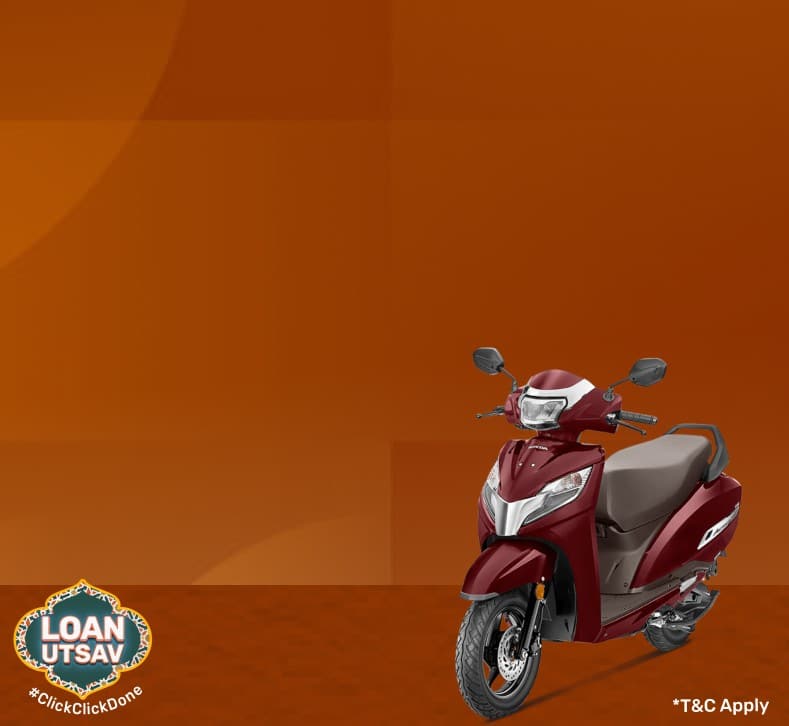
Honda Dio BS6 Standard (Sports Red)

Honda Activa 6G Standard (Black)

Suzuki Access 125 Disc Alloy Bluetooth (Glossy Grey)
EMI
₹1,315/ mo
₹1,469/ mo
₹1,715/ mo
Brand Name
Honda
Honda
Suzuki
Color
Sports Red
Black
Glossy Grey
Rear Wheel Brake
Drum
Drum
Drum
Front Wheel Brake
Drum
Drum
Disc
Speedometer
Analogue
Analogue
Digital
Wheel Type
Tubeless
Tubeless
Tubeless
Compare other products with Honda Dio
Not your nearest branch?

What are you looking for
Bike
Scooters
Electric Scooters
Popular two-wheelers
What our customers say about us
Kushal K
Reviewed on 04 Mar 2026
I applied for a Bajaj Finance two-wheeler loan last month and was surprised at how fast the approval came through. The process was simple, and I was riding my new bike within a week. Very happy with the service.
Vikram
Reviewed on 10 Jan 2026
This was my first loan, so I was nervous, but Bajaj Finance made it easy. The staff guided me step by step, and now I own my bike without any hassle. Highly recommend them.
Mamtha
Reviewed on 25 Dec 2025
The EMI options were flexible enough to fit my monthly budget. I didn’t feel pressured, and the repayment plan was explained clearly. It made buying my scooter stress-free.
Vishal
Reviewed on 05 Jan 2026
I liked that there were no hidden charges. Everything was transparent from the start, and the loan disbursal was quick. Bajaj Finance made the whole experience smooth.
Explore other brands











Related articles
Bajaj Finance app for all your financial needs and goals
Trusted by 50 million+ customers in India, Bajaj Finance App is a one-stop solution for all your financial needs and goals.
You can use the Bajaj Finance App to:
- Apply for loans online, such as Instant Personal Loan, Home Loan, Business Loan, Gold Loan, and more.
- Invest in fixed deposits and mutual funds on the app.
- Choose from multiple insurance for your health, motor and even pocket insurance, from various insurance providers.
- Pay and manage your bills and recharges using the BBPS platform. Use Bajaj Pay and Bajaj Wallet for quick and simple money transfers and transactions.
- Apply for Insta EMI Card and get a pre-qualified limit on the app. Explore over 1 million products on the app that can be purchased from a partner store on Easy EMIs.
- Shop from over 100+ brand partners that offer a diverse range of products and services.
- Use specialised tools like EMI calculators, SIP Calculators
- Check your credit score, download loan statements and even get quick customer support—all on the app.
Download the Bajaj Finance App today and experience the convenience of managing your finances on one app.
Frequently asked questions about Honda Dio mileage
Overview
Repayment
Does frequent braking reduce Honda Dio mileage?
Frequent braking can increase petrol consumption when it follows repeated acceleration, particularly in heavy city traffic. Every time you accelerate again, the engine needs fuel to regain speed. Maintain a safe following distance and watch traffic ahead so you can respond smoothly. Never avoid necessary braking to save petrol, and always prioritise pedestrian safety, road conditions, and traffic signals.
Can a worn CVT belt affect Honda Dio mileage?
A worn or damaged continuously variable transmission belt can affect how smoothly power reaches the rear wheel. You might notice weak acceleration, unusual noise, or vibration. However, reduced mileage does not automatically mean the belt needs replacement. Have the transmission inspected according to Honda's maintenance schedule. The technician can determine whether the belt, rollers, clutch, or another component requires attention.
Should I use premium petrol to improve Honda Dio mileage?
Use petrol that meets Honda's fuel specifications for your particular Dio model. Higher-priced premium petrol does not automatically improve mileage if the engine is designed to operate on regular compliant petrol. Consistent fuel quality, correct maintenance, and sensible throttle use are generally more useful than paying extra without a clear requirement. Consult the owner's manual if you are uncertain about the recommended fuel grade.
When does financing a replacement Honda Dio make financial sense?
Financing a replacement may make sense when your existing scooter has repeated mechanical problems and a new purchase fits your monthly budget. Compare expected repairs with the total borrowing cost, including interest and applicable charges. A loan spreads the purchase expense over time, but it also creates a repayment commitment. Avoid replacing a reliable scooter solely because its mileage has fallen slightly.
How much down payment should I pay for a new scooter?
Your down payment depends on the scooter's on-road price, approved financing amount, and savings you can comfortably use. A larger upfront payment generally reduces the amount borrowed, potentially lowering the EMI and total interest. However, keep enough money for emergencies, servicing, and regular household costs. Compare different down payment and tenure combinations before choosing an affordable repayment plan.
Disclaimer
1. Bajaj Finance Limited (“BFL”) is a Non-Banking Finance Company (NBFC) and Prepaid Payment Instrument Issuer offering financial services viz., loans, deposits, Bajaj Pay Wallet, Bajaj Pay UPI, bill payments and third-party wealth management products. The details mentioned in the respective product/ service document shall prevail in case of any inconsistency with respect to the information referring to BFL products and services on this page.
2. All other information, such as, the images, facts, statistics etc. (“information”) that are in addition to the details mentioned in the BFL’s product/ service document and which are being displayed on this page only depicts the summary of the information sourced from the public domain. The said information is neither owned by BFL nor it is to the exclusive knowledge of BFL. There may be inadvertent inaccuracies or typographical errors or delays in updating the said information. Hence, users are advised to independently exercise diligence by verifying complete information, including by consulting experts, if any. Users shall be the sole owner of the decision taken, if any, about suitability of the same.