








Rs. 1 lakh – Rs. 2.50 crore
Check your pre-approved offer and other benefits
Enter mobile and OTP | Check offer | Know your exact loan terms
In summary
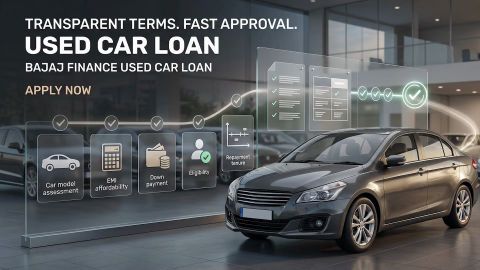
Five Questions Before Getting Used Car Loan
Evaluate a used car loan as part of the complete vehicle purchase, not as a separate decision. The Bajaj Finance Used Car Loan offers amounts from Rs. 1 lakh to Rs. 2.50 crore and repayment tenure from 12 months to 84 months.
- Purchase budget: Account for the car price as well as insurance, maintenance, repairs, and other ownership costs
- Repayment cost: Compare the equated monthly instalment (EMI), interest rate, tenure, and total repayment
- Vehicle suitability: Check the car's condition, age, ownership history, documents, and assessed value before financing it
If you are considering a used car loan, answering the following five questions can help you decide how the car and the financing fit your wider financial plans.
Last updated: September 2026
What to know before taking a used car loan
The loan decision starts with two assessments: whether you can support the repayment and whether the selected car meets the financing conditions.
The Bajaj Finance Used Car Loan offers interest rates ranging from 10% to 18.25% p.a. Your applicable terms depend on the assessment of your profile and selected vehicle.
Your CIBIL Score is one of the factors considered while assessing your credit profile.
→ Quick definition: A Credit Information Bureau (India) Limited Score (CIBIL Score) is a three-digit number, ranging from 300 to 900, that reflects your credit repayment history. Lenders use it to assess how reliably you have repaid past loans and cards.
For Bajaj Finance Used Car Loan, the required CIBIL Score is 650 or higher. The financing is available for eligible private cars, subject to vehicle conditions.
With that starting point clear, the following five questions can help you assess the purchase more systematically.
1. Can you afford the complete cost of the car?
Start with the amount the car will cost you to own, not just the seller's asking price.
A pre-owned car can create expenses immediately after purchase. These can include insurance, servicing, tyres, brakes, battery replacement, repairs, parking, and fuel.
Before deciding the purchase budget, account for:
- Car price: The amount agreed with the seller
- Down payment: The portion you plan to pay yourself
- Insurance: Existing cover and any renewal requirement
- Initial maintenance: Servicing or repairs needed soon after purchase
- Running costs: Fuel, parking, routine servicing, and consumables
- Emergency reserve: Savings that remain available after the purchase
Do not use all available savings simply to reduce the amount financed.
A larger down payment lowers the principal, but retaining some cash can help you manage unexpected ownership expenses without creating another borrowing requirement.
2. How much do you actually need to borrow?
The amount you qualify for and the amount you should borrow are not necessarily the same.
Start with the agreed purchase price. Subtract the contribution you can make without weakening your emergency savings. The remaining amount gives you a more realistic financing requirement.
For example, if the car costs Rs. 9 lakh and you can safely contribute Rs. 2 lakh, your initial financing requirement is Rs. 7 lakh.
Before fixing that amount, also consider whether:
- the seller's price is reasonable for the vehicle
- the car needs immediate repairs
- your down payment leaves sufficient savings
- the vehicle's assessed value supports the financing requested
Bajaj Finance offers financing of up to 100% of the assessed car value, subject to the applicable assessment.
This means the financing decision should be based on the value assessed for the vehicle, not only on the price quoted by the seller.
3. What will the EMI and total repayment cost?
Calculate the monthly repayment before committing to the financing structure.
Your EMI is determined by the principal, monthly interest rate, and repayment tenure.
The monthly instalment is calculated using the reducing-balance formula:
EMI = [P × R × (1+R)^N] / [(1+R)^N - 1]
Where:
- P = Principal loan amount
- R = Monthly interest rate
- N = Tenure in months
The annual interest rate must be converted into a monthly rate before using the formula.
Consider Sonia, aged 35, living in Mumbai, earning Rs. 95,000 per month with a CIBIL Score of 770. She has shortlisted a used sedan and plans to finance Rs. 7 lakh.
Assume an illustrative interest rate of 14% p.a. and a tenure of 60 months.
Her repayment would be approximately:
| Loan detail | Illustrative value |
| Principal | Rs. 7 lakh |
| Interest rate | 14% p.a. |
| Tenure | 60 months |
| Approximate EMI | Rs. 16,288 |
| Approximate total interest | Rs. 2.77 lakh |
| Approximate total repayment | Rs. 9.77 lakh |
The Rs. 16,288 EMI shows what Sonia's monthly cash flow must support. The Rs. 2.77 lakh interest figure shows why the monthly instalment should never be assessed in isolation.
If Sonia extends the repayment period, the EMI will fall but total interest will rise when the principal and rate remain unchanged.
You can use the used car loan EMI calculator to compare different amounts, rates, and repayment periods before applying. The calculator also shows indicative total interest and total repayment.
4. Do you and the car meet the eligibility requirements?
Used-car financing depends on both the applicant and the vehicle.
A strong financial profile does not automatically make every car suitable for financing, and an eligible vehicle does not compensate for an applicant who does not meet the lender's requirements.
Your age, income, employment profile and credit history are among the factors considered during assessment.
| Criteria | Salaried applicants | Self-employed applicants |
| Nationality | Indian | Indian |
| Age | 21 years to 80 years* | 21 years to 80 years* |
| Credit score | 650 or higher | 650 or higher |
| Income | Minimum Rs. 20,000 per month | ITR for the previous 2 years |
| Experience | At least 1 year of work experience | Income assessed through ITR |
*You should be 80 years old or younger at the end of the loan tenure.
Vehicle conditions also matter.
The current Bajaj Finance requirements state that:
- financing is available for private cars
- the car should not be more than 12 years at the end of the loan tenure the vehicle should not have more than 2 previous owners
You can review the complete used car loan eligibility criteria before building the purchase around a particular vehicle.
This check should happen before you make a non-refundable commitment to the seller.
5. Is the car itself worth financing?
A loan can make an eligible car easier to purchase, but it cannot make a poor vehicle a good purchase.
The condition of the car matters because you will be repaying the financing while also paying for maintenance and repairs.
Before moving ahead, assess:
- service history
- accident and repair history
- engine and transmission condition
- tyres and brakes
- suspension and steering
- electrical systems
- odometer reading
- insurance history
- Registration Certificate details
- chassis and engine numbers
- previous ownership
- outstanding finance, if any
A professional inspection can be useful if you cannot confidently evaluate the mechanical condition yourself.
Also compare the asking price with the condition of the specific car. A lower purchase price can lose its advantage quickly if major repairs are due soon after delivery.
Financing should follow the decision that the vehicle itself is worth owning.
What should you compare before accepting the loan?
After you answer the five questions, review the final financing offer against the plan you created.
Do not assume the final rate, tenure, or sanctioned amount will exactly match the first scenario you calculated.
Before accepting, compare:
| Check | What to review |
| Sanctioned amount | Whether you are borrowing only what you need |
| Interest rate | The rate applicable to your final offer |
| Tenure | Number of months you will remain in repayment |
| EMI | Whether it fits your regular monthly cash flow |
| Total interest | Financing cost across the term |
| Total repayment | Principal plus interest |
| Applicable charges | Relevant fees and other loan costs |
| Vehicle details | Whether the correct car is linked to the financing |
If one of these changes materially, recalculate the repayment before moving ahead.
The goal is not simply to obtain approval. It is to make sure the final financing still fits the purchase you originally planned.
Choose Bajaj Finance Used Car Loan for your purchase decision
With the Bajaj Finance Used Car Loan, you can finance an eligible pre-owned car based on your borrowing requirement, repayment capacity, and the vehicle assessment.
Here are the key loan details to review before you apply.
| Loan detail | Bajaj Finance Used Car Loan |
| Loan amount | Rs. 1 lakh to Rs. 2.50 crore |
| Maximum financing | Up to 100% of the assessed car value |
| Repayment tenure | 12 months to 84 months |
| Interest rate | 10% to 18.25% p.a. |
| Credit score | CIBIL Score of 650 or higher |
| Vehicle requirement | Eligible private car, subject to vehicle age and ownership conditions |
Last updated: September 2026
Once you have answered the five questions and shortlisted a car that fits both your purchase and repayment budget, check your pre-approved used car loan offer to see the financing option available to you before moving ahead.
What do our customers say about us
Amit Chauhan
Reviewed on 04 Mar 2025
Smooth and transparent used car loan process. The interest rates were competitive, and the documentation was minimal. The team guided me clearly at every step, making my used car purchase simple and stress-free. Highly recommended for quick approvals.
Ashwin Kamble
Reviewed on 24 Feb 2025
Clear guidance, quick approval, and flexible repayment options made buying my used car easier than expected. The team handled everything professionally. Very satisfied and would definitely recommend their used car loan.
Rohit Sharma
Reviewed on 12 Apr 2025
I had a great experience while applying for my used car loan. The process was quick, and the interest rate helped me manage the purchase better. Customer service was helpful throughout. Highly recommended for a smooth used car financing experience.
Ajay Kulkarni
Reviewed on 08 Dec 2024
My used car loan experience was simple and hassle-free. The approval was quick, the repayment options were flexible, and the team explained every step clearly. It helped me buy my preferred used car without financial stress. I would surely recommend it.
Related articles

Used Car Loan: Everything You Need To Know
Read More
Should You Opt for a Used Car Loan to Purchase Your Dream Car
Read More
How to choose the right tenure for your used car loan
Read More
Should You Opt for a Used Car Loan to Purchase Your Dream Car
Read More
Bajaj Finance app for all your financial needs and goals
Trusted by 50 million+ customers in India, Bajaj Finance App is a one-stop solution for all your financial needs and goals.
You can use the Bajaj Finance App to:
- Apply for loans online, such as Instant Personal Loan, Home Loan, Business Loan, Gold Loan, and more.
- Invest in fixed deposits and mutual funds on the app.
- Choose from multiple insurance for your health, motor and even pocket insurance, from various insurance providers.
- Pay and manage your bills and recharges using the BBPS platform. Use Bajaj Pay and Bajaj Wallet for quick and simple money transfers and transactions.
- Apply for Insta EMI Card and get a pre-qualified limit on the app. Explore over 1 million products on the app that can be purchased from a partner store on Easy EMIs.
- Shop from over 100+ brand partners that offer a diverse range of products and services.
- Use specialised tools like EMI calculators, SIP Calculators
- Check your credit score, download loan statements and even get quick customer support—all on the app.
Download the Bajaj Finance App today and experience the convenience of managing your finances on one app.
Frequently asked questions
Overview
EMI and repayment
How much should you borrow for a used car?
Borrow the amount required after making a down payment that does not exhaust your savings. Start with the car price, account for insurance and immediate ownership expenses, and then decide what you can safely contribute upfront. The remaining amount should also produce an EMI that fits alongside your existing debt, household spending, regular savings, and car-running costs.
Should you use all your savings as the down payment?
Using more savings upfront reduces the principal and therefore lowers EMI and total interest under identical loan terms. However, using all available cash can leave you without a reserve for emergencies, insurance, servicing, or repairs. Decide the down payment only after separating the funds needed for the purchase from the savings you should retain after taking ownership.
Should you check eligibility before paying the seller?
Yes. Applicant eligibility and vehicle eligibility both affect used-car financing. Before making a non-refundable payment, check whether your profile meets the lender's requirements and whether the selected car satisfies applicable vehicle conditions. This reduces the risk of committing to a vehicle and later discovering that the planned financing structure is unavailable for that particular purchase.
Should I compare interest rates before taking a pre-owned car loan?
The EMI shows the amount you pay every month, while total interest shows the cost of financing over the complete repayment period. A longer tenure can reduce the monthly instalment but increase total interest. Looking at both values prevents you from choosing an apparently smaller monthly payment without understanding what it adds to the overall amount repaid.
What happens if you choose a longer repayment tenure?
A longer tenure spreads the same principal over more monthly instalments, reducing the EMI. When the interest rate and principal stay unchanged, the longer repayment period increases total interest because the balance remains outstanding for more months. Choose a longer term when the lower EMI is needed for cash flow rather than simply to obtain the smallest instalment.
Disclaimer
1. Bajaj Finance Limited (“BFL”) is a Non-Banking Finance Company (NBFC) and Prepaid Payment Instrument Issuer offering financial services viz., loans, deposits, Bajaj Pay Wallet, Bajaj Pay UPI, bill payments and third-party wealth management products. The details mentioned in the respective product/ service document shall prevail in case of any inconsistency with respect to the information referring to BFL products and services on this page.
2. All other information, such as, the images, facts, statistics etc. (“information”) that are in addition to the details mentioned in the BFL’s product/ service document and which are being displayed on this page only depicts the summary of the information sourced from the public domain. The said information is neither owned by BFL nor it is to the exclusive knowledge of BFL. There may be inadvertent inaccuracies or typographical errors or delays in updating the said information. Hence, users are advised to independently exercise diligence by verifying complete information, including by consulting experts, if any. Users shall be the sole owner of the decision taken, if any, about suitability of the same.