







Support available Online, on call, or at branches
Get answers instantly without waiting on call:
Enter mobile and OTP · No password needed · No branch visit needed
In summary
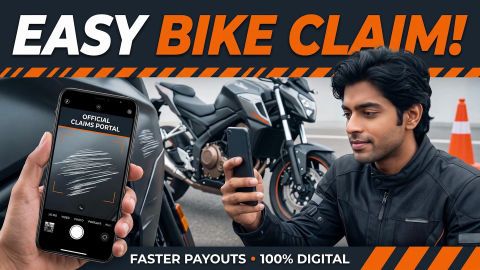
Track and settle two-wheeler insurance claims online
NCB is a discount on the own-damage premium of your two-wheeler insurance policy for each claim-free policy year. You can retain this benefit when you renew your policy, subject to applicable terms.
- NCB rewards you for completing a policy year without an eligible claim.
- The discount generally applies to the own-damage portion of your premium.
- NCB can increase with consecutive claim-free years, subject to the applicable limit.
- A claim can affect the NCB you have accumulated.
- You may be able to retain your NCB when you change your insurer, subject to applicable rules.
- NCB is linked to you as the policyholder and not simply to the vehicle.
You should check your policy terms before renewal or switching insurers. This helps you understand how your accumulated NCB applies and what could affect it. You can check the Bajaj Finance App or in My Account, after OTP verification.
What is NCB in two-wheeler insurance?
NCB, or No Claim Bonus, is a renewal discount you can earn when you do not make an eligible claim during a policy period. It can reduce the own-damage premium payable when you renew your two-wheeler insurance.
For example, if you complete a policy period without making an eligible claim, you may receive an NCB at renewal. The discount can increase after consecutive claim-free years, subject to the applicable maximum.
NCB can help you in two ways:
- You can reduce your renewal premium.
- You can build a higher discount by maintaining a claim-free record.
NCB generally does not apply to the third-party liability component of your two-wheeler insurance premium. Its application depends on the policy terms.
How does NCB work on your two-wheeler policy?
Your NCB can increase when you complete successive policy periods without making eligible claims. The discount is applied when you renew your policy, subject to the applicable terms.
| Claim-free record | NCB treatment |
|---|---|
| First eligible claim-free year | You can become eligible for an NCB discount |
| Consecutive claim-free years | Your NCB can increase at renewal |
| Claim during the policy period | Your accumulated NCB can be affected |
| Policy renewal | Your eligible NCB is applied to the relevant own-damage premium |
The exact discount depends on the applicable NCB structure and your claim history. You should check your renewal details before paying the premium.
What happens to your NCB when you make a claim?
Making an eligible claim can affect the NCB you have accumulated. The impact depends on the type of claim and the terms of your policy.
You should understand the potential effect before making a claim, especially for a minor repair where you can comfortably pay the cost yourself.
Consider these factors:
- Estimate the repair cost.
- Check your current NCB benefit.
- Compare the repair cost with the potential loss of your NCB.
- Check whether your policy has any applicable claim-related conditions.
- Decide whether making a claim is financially suitable.
This does not mean you should avoid making a genuine claim. Your decision should depend on the repair cost, policy coverage and financial impact.
Can you transfer your NCB when you change insurers?
You may be able to retain your accumulated NCB when you switch your two-wheeler insurance policy to another insurer, subject to applicable rules and documentation.
The NCB is generally associated with your claim history as the policyholder rather than being permanently attached to one two-wheeler. You should provide the required proof of your NCB when you buy or renew your policy.
| Situation | What you should check |
|---|---|
| Changing insurer | Confirm whether your accumulated NCB can be retained |
| Changing your two-wheeler | Check how your existing NCB can be carried forward |
| Renewing after a claim-free year | Check the NCB applied to your renewal |
| NCB proof required | Keep relevant policy or renewal documents available |
You should disclose your correct NCB status when purchasing a policy. Incorrect information can affect your premium or policy benefits.
How can you protect your NCB?
You can protect your NCB by avoiding unnecessary eligible claims and checking whether your policy offers an NCB protection feature. The availability and conditions of such protection depend on your policy.
Before renewal, review:
- Your current NCB percentage.
- Your claim history.
- The own-damage premium before the NCB discount.
- The final premium after the discount.
- Any conditions attached to NCB protection.
- The documents required to carry forward your NCB.
NCB protection does not necessarily mean every claim will leave your NCB unchanged. You should check the specific conditions that apply to your policy before relying on the benefit.
How can you check and use your NCB at renewal?
You can check your NCB when you renew your two-wheeler insurance policy. Your renewal details should show the applicable discount and the premium after the NCB adjustment.
You can follow this simple process:
- Check your previous policy and claim history.
- Confirm whether you completed the policy period without an eligible claim.
- Check the NCB applicable at renewal.
- Review the own-damage premium and NCB adjustment.
- Provide the required NCB details when renewing or switching your policy.
- Verify the final premium before completing the renewal.
Keeping your previous policy documents can make it easier to establish your NCB status when you renew or switch your insurance policy.
For more information on obtaining a No Objection Certificate for your bike loan, explore NOC for bike loan. If you need a detailed loan statement, you can access it through Bajaj two wheeler loan statement.
Explore more
Frequently Asked Questions
Understanding NCB
NCB and claims
What does NCB mean in two-wheeler insurance?
NCB stands for No Claim Bonus. It is a discount you can earn on the own-damage premium of your two-wheeler insurance policy when you complete an eligible policy period without making a claim.
Why is NCB important for your two-wheeler insurance?
NCB can reduce the own-damage premium you pay at renewal after a claim-free policy period. Your discount can increase with consecutive claim-free years, subject to the applicable maximum and policy terms.
Does NCB apply to third-party insurance?
NCB generally applies to the own-damage portion of your two-wheeler insurance premium. It does not generally reduce the third-party liability premium. You should check your policy documents for the exact premium components.
Will you lose your NCB after making a claim?
An eligible claim can affect your accumulated NCB. The exact impact depends on the claim and the terms of your policy. You should check the applicable conditions before deciding whether to make a claim.
Can you avoid making a claim to protect your NCB?
You can choose to pay for a minor repair yourself if it is financially practical, but you should not avoid a necessary claim solely to protect your NCB. Consider the repair cost, coverage and potential NCB impact together.
What is NCB protection in two-wheeler insurance?
NCB protection is an optional feature that can help you retain your eligible NCB after certain claims, subject to the policy conditions. It does not necessarily cover every claim or guarantee that your NCB will remain unchanged.
More Articles

Disclaimer
While care is taken to update the information, products, and services included in or available on our website and related platforms/websites, there may be inadvertent inaccuracies or typographical errors or delays in updating the information. The material contained in this site, and on associated web pages, is for reference and general information purpose and the details mentioned in the respective product/service document shall prevail in case of any inconsistency. Subscribers and users should seek professional advice before acting on the basis of the information contained herein. Please take an informed decision with respect to any product or service after going through the relevant product/service document and applicable terms and conditions. In case any inconsistencies observed, please click on reach us.
*Terms and conditions apply.